



A GST fusion protein pull-down assay uses glutathione S-transferase (GST) as the handle, not as proof that the cargo is specific. GST binds reduced glutathione (GSH) on agarose or Sepharose. The bait is expressed as a GST fusion, immobilized through that handle, washed, and offered a purified prey or a lysate. Proteins that remain are read by stain, Western blot, or mass spectrometry (MS). The GSH–GST pair is a purification chemistry. It does not make the fused cargo a high-purity interactor, a drug target, or a screened network. A GST-only fusion, matched for host and occupancy, is part of the assay. Without it, GST dimers and GST-binding lysate proteins are scored as partners of the cargo.
pGEX-class vectors typically place Schistosoma japonicum GST at the N terminus. A C-terminal GST is a different fusion and can change solubility and the exposed face. Choosing the terminus is a design step, not a cloning convenience. For the four-step bench order after the fusion is chosen, What Is the General Procedure for GST Pull-Down Analysis of Protein–Protein Interactions? provides a complementary procedure. For the tube-versus-cell constraint, In Vitro Pull-Down Assay provides a complementary in-vitro discussion.
Researchers who already have a GST-bait construct or a GSH-resin plan can also review the MtoZ Biolabs GST Pull Down Assay Service for project-specific feasibility and analysis planning.
What the Fusion Adds
GST is about 26 kDa and occupies GSH with micromolar-class affinity that is sufficient for bead capture. That occupancy lets a laboratory recover the fusion without an antibody. It also recovers anything that binds GST, the linker, or the resin. High efficiency and high specificity are not properties of the fusion. They are outcomes of a soluble full-length product and a GST-only arm.
Unknown-partner “screening” from a lysate is an open list on that fusion. Bioinformatics predictions can be tested as nominated preys. A database hit that appears in the GST-only lane is still background. Drug-target language is outside this assay.
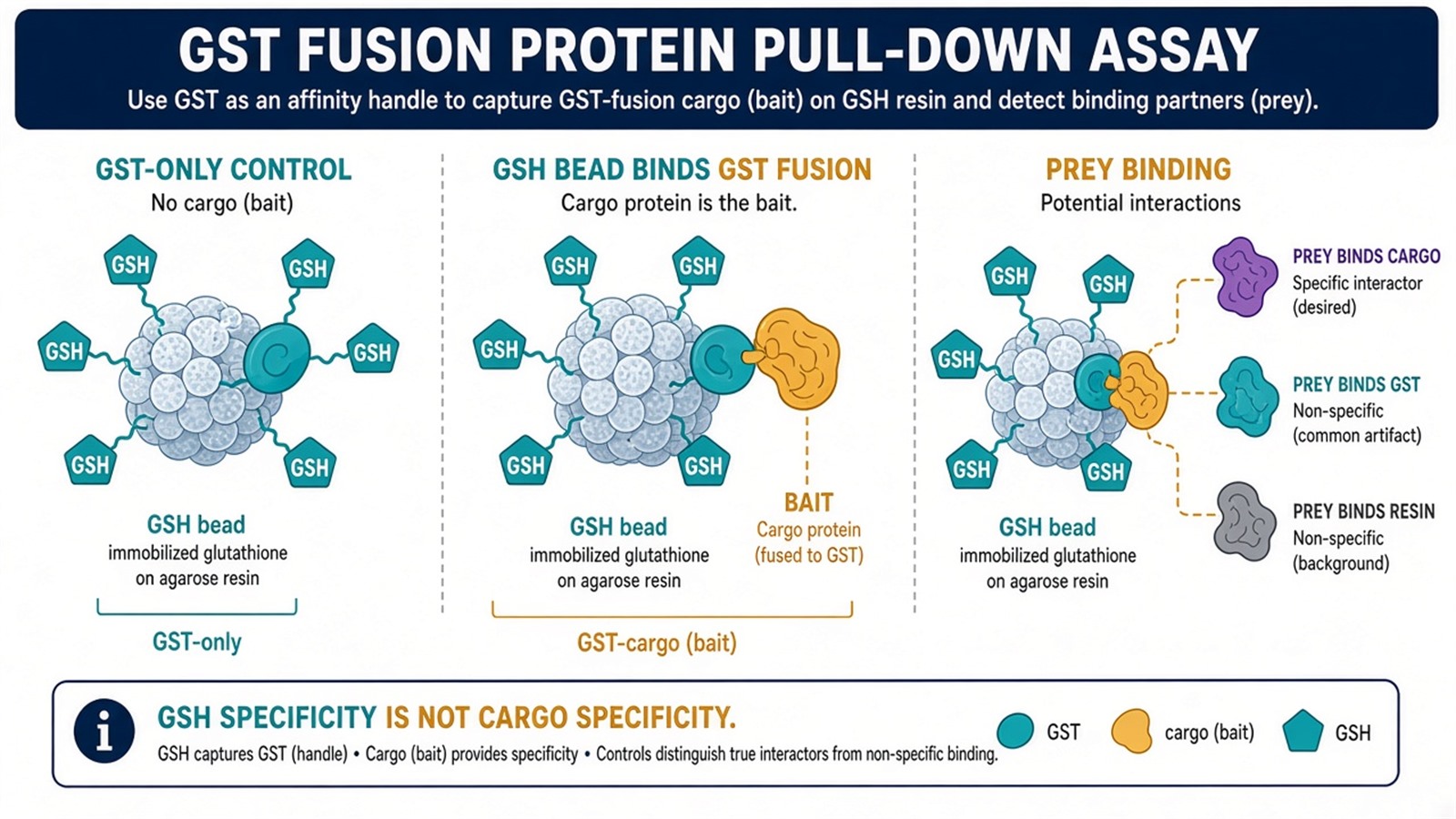
Figure 1. GSH captures GST. The fused protein is the intended bait. GST-only, not a missing-bait lysate, is the handle control.
Name the terminus and the GST-only construct before the first induction. GSH specificity is not cargo specificity.
Analysis Workflow of the GST Fusion Protein Pull-Down Assay
The original three blocks are kept as fusion decisions, not as a second protocol.
1. Sample preparation
Clone the bait into a GST vector and choose a host that can fold that cargo. Escherichia coli is the common starting host and the common source of inclusion bodies and missing eukaryotic modifications. Yeast or insect cells are alternatives when bacterial solubility or a required modification fails. Mammalian GST vectors exist when the fusion must be made in 293T; that is a different expression class. For how 293T transfection feeds a GST blot, Can GST Pull-Down and Western Blot Be Effectively Performed Following Transfection in 293T Cells? provides a complementary design note.
N- versus C-terminal GST, and optional protease sites (thrombin or PreScission), belong in this step. Cleaving GST off after purification makes a different bait and needs its own control.
2. Protein purification
GSH-Sepharose captures the fusion. Wash, then either keep the bait on the resin or elute with reduced glutathione and re-bind later. Elution to “high purity” is a protein-prep goal. A degraded GST stub still binds GSH and still collects GST-binding background. Confirm full-length fusion on SDS-PAGE before offering prey. For ligand classes beyond GST, Affinity Pull-Down Assay provides a complementary family map.
3. Pull-down experiment procedure
Immobilized GST-fusion is incubated with purified prey or a clarified sample. Wash both the fusion arm and the GST-only arm the same way. Detect nominated preys by Western blot. An open list needs MS, not only a stained gel. For how to read those lanes, How to Interpret the Results of a Pull-Down Experiment provides a complementary interpretation order.
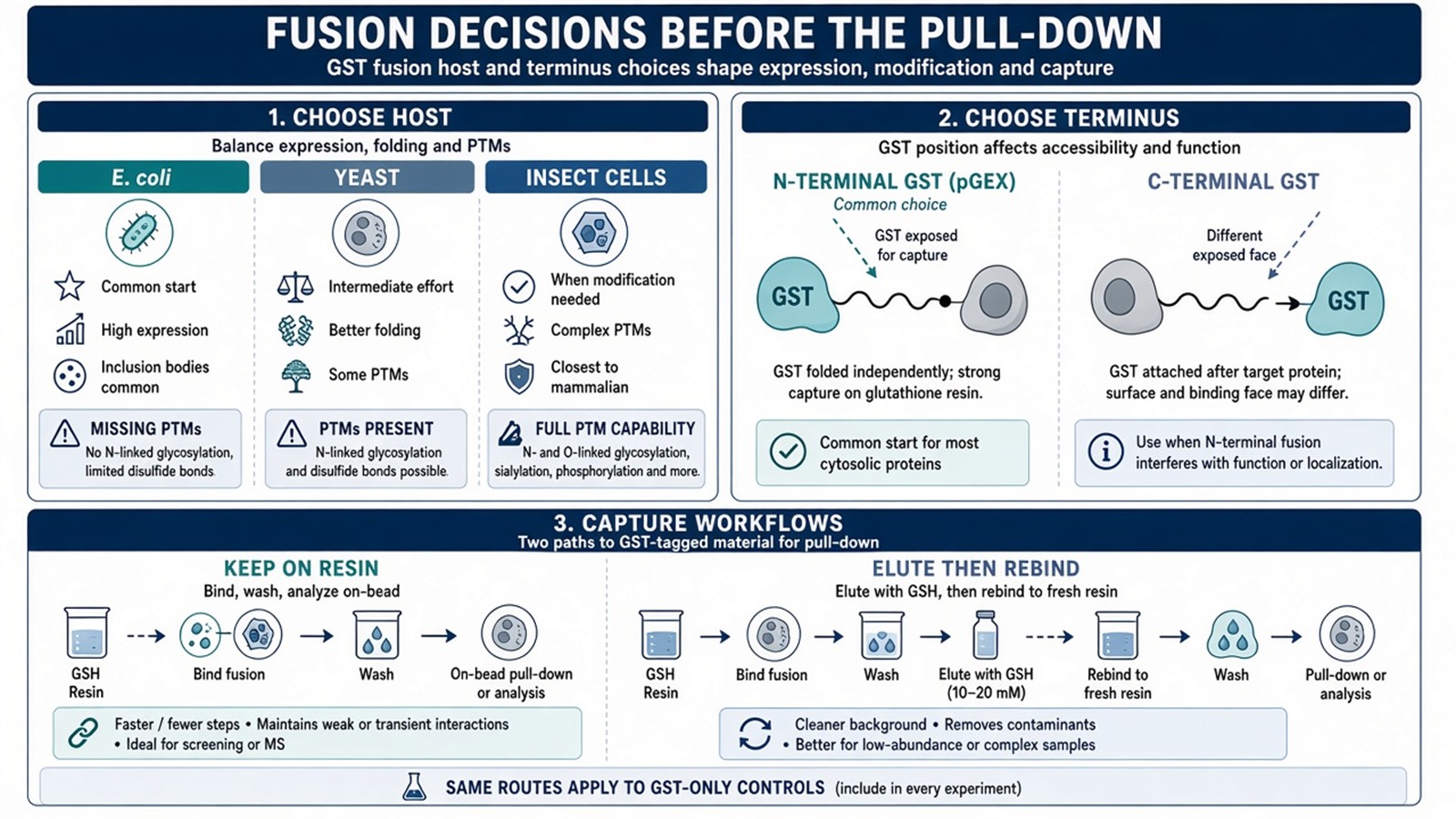
Figure 2. E. coli, yeast, or insect changes folding and modifications. N- or C-terminal GST changes the exposed face. Keep-on-resin and elute-then-rebind are two routes, used on GST-only as well.
Common Issues and Precautions
Non-specific binding
GSH–GST can be specific while the cargo lane is not. Lysates contain proteins that bind GST or GSH resin. More washes, or a harsher buffer, can reduce that class and can strip the intended prey. The comparison that matters is GST-fusion versus GST-only, not the number of washes.
Fusion protein stability
Truncation, proteolysis, and insoluble product are fusion problems. A lower-temperature induction or a different host can raise the full-length fraction. It does not repair a missing GST-only arm.
Elution efficiency
Poor glutathione elution looks like a missing prey. SDS or on-bead digestion recovers more protein and recovers more background. Use the same exit on both arms.
GST dimerization can hold two fusions on one bead and can create artifactual oligomers. Reducing-agent conditions and a GST-only arm are how that class is seen, not eliminated.
Expression-system choice, temperature, and pH are written constraints. They are not a guarantee of “experimental accuracy.” A known partner as a positive control shows that the fusion can recover something. It does not bless every other band.
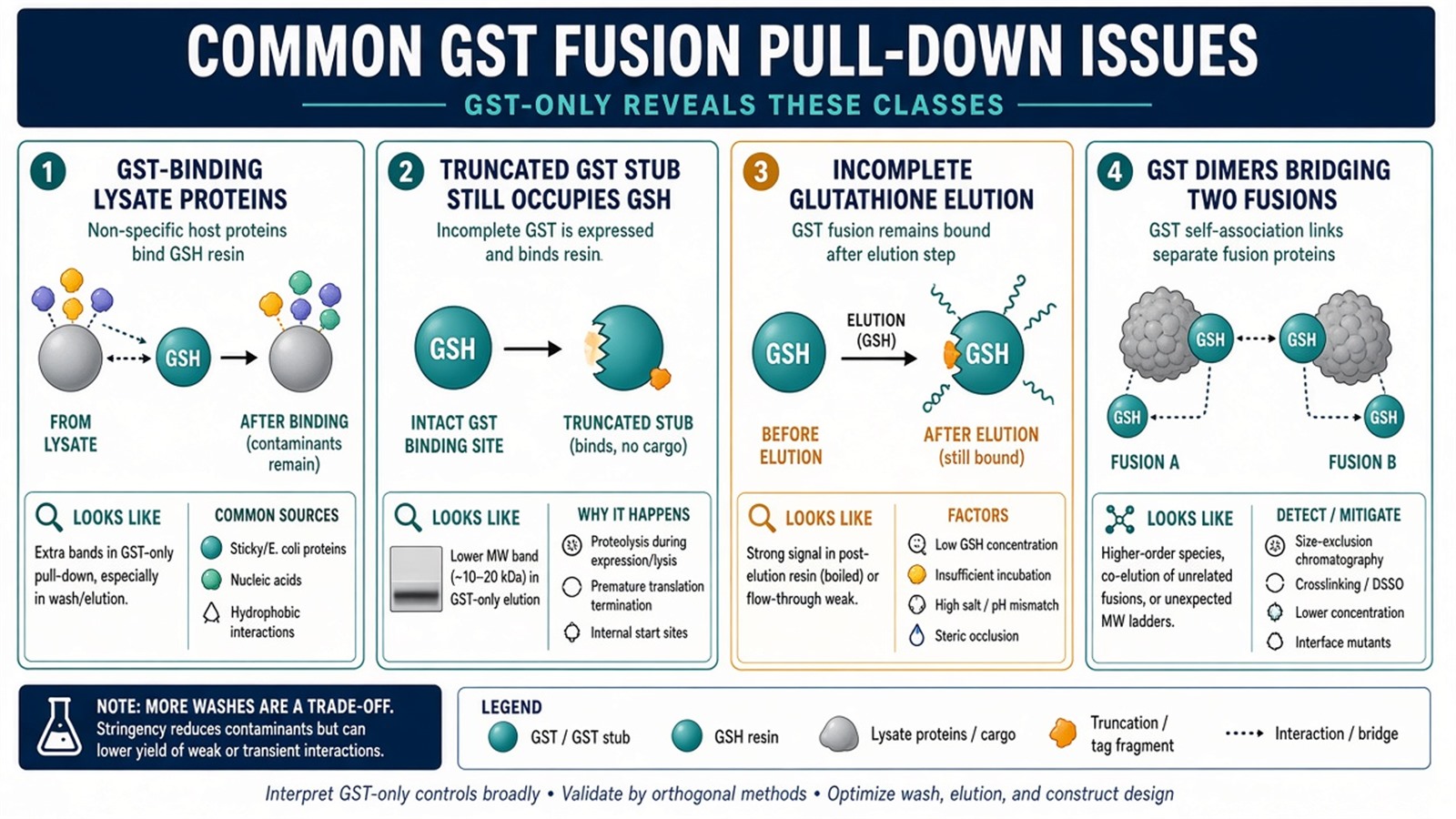
Figure 3. GSH specificity does not remove GST-binding lysate proteins, stubs that still occupy GSH, incomplete elution, or dimer-bridged artifacts.
Experimental Limits
The fusion reduces capture to what GST and GSH can hold. Diagnostic language sits outside ordinary research reporting unless a separately validated assay framework is in place.
Project Planning and Service Scope
A usable GST-fusion plan names the terminus, the host, the GST-only construct, on-resin versus eluted re-bind, the prey class, and the readout, before the first clone is picked. MtoZ Biolabs scopes GST-fusion pull-down with Western or Orbitrap-class LC-MS/MS. Interpretability still follows the fusion and the GST-only arm, not the resin brand.
Once the fusion is specified and the readout is an open list, the project can be scoped as pull-down MS. Researchers who need identification of a GST-fusion eluate can review the MtoZ Biolabs Pull Down based Protein Analysis Service with Mass Spectrometry for project-specific sample evaluation, feasibility assessment, and workflow planning.
Frequently Asked Questions
1. What is a GST fusion protein pull-down assay?
A bait is expressed as a GST fusion, captured on GSH resin, and used to recover proteins that survive the wash. GST-only estimates handle background.
2. Does GST–GSH binding make the assay specific for interactors?
No. It makes the handle capture reliable. Cargo specificity is the GST-only comparison.
3. Should I use E. coli, yeast, or insect cells?
Start with E. coli when the cargo folds there. Change host when solubility or a required modification fails. The pull-down chemistry does not change.
4. Is N-terminal GST required?
No. It is the common pGEX layout. C-terminal GST is a different fusion and should be tested when the N-terminal product is inactive or insoluble.
5. How does this page differ from the general GST procedure?
This page is the fusion handle: terminus, host, dimers, and GST-binding background. The procedure page orders the four bench steps.
Reference
- Smith D.B., Johnson K.S. (1988). Single-step purification of polypeptides expressed in Escherichia coli as fusions with glutathione S-transferase. Gene, 67, 31-40. https://doi.org/10.1016/0378-1119(88)90005-4
- Harper S., Speicher D.W. (2011). Purification of proteins fused to glutathione S-transferase. Methods Mol. Biol., 681, 259-280. https://doi.org/10.1007/978-1-60761-913-0_14
- Vikis H.G., Guan K.L. (2004). Glutathione-S-transferase-fusion based assays for studying protein-protein interactions. Methods Mol. Biol., 261, 175-186. https://doi.org/10.1385/1-59259-762-9:175
- Einarson M.B., Pugacheva E.N., Orlinick J.R. (2007). GST Pull-down. CSH Protoc., 2007, pdb.prot4757. https://doi.org/10.1101/pdb.prot4757
- Frangioni J.V., Neel B.G. (1993). Solubilization and purification of enzymatically active glutathione S-transferase (pGEX) fusion proteins. Anal. Biochem., 210, 179-187. https://doi.org/10.1006/abio.1993.1170
