



Cross-linking mass spectrometry (XL-MS) captures spatial proximities within protein assemblies by creating covalent links between nearby amino acid residues. LC-MS/MS identifies the linked peptides, and mapping the resulting residue pairs onto protein sequences or structural models helps researchers investigate subunit organization, candidate interaction interfaces, and changes in protein assemblies.
Researchers considering this approach can use the MtoZ Biolabs Crosslinking Mass Spectrometry Service to discuss sample context, cross-linking feasibility, and the intended evidence level. A useful project brief identifies the proteins or complex, the biological state to preserve, available sequence information, and whether the main objective is interface localization, architecture testing, or comparison between conditions.
How Does XL-MS Capture Protein Spatial Proximity?
Cross-linking mass spectrometry (XL-MS) uses chemical reagents called cross-linkers to connect amino acid residues that are close enough to react within a protein or protein complex. After cross-linking, the proteins are digested into peptides, and LC-MS/MS is used to identify peptide pairs that remain connected by the cross-linker. Mapping these linked residues onto protein sequences or structural models provides spatial constraints that help researchers investigate how protein domains or subunits are arranged.
The interpretation depends on whether a cross-link connects residues within the same protein molecule or between different protein molecules.
Intramolecular Cross-Links
An intramolecular cross-link connects two residues within the same protein molecule. Because the cross-linker has a defined spacer length, the linked residues must be within a compatible distance when the reaction occurs. However, the spacer length does not represent an exact distance between the residues. Side-chain flexibility, protein movement, and the geometry of the cross-linker also affect the distance that can be accommodated (Leitner et al., 2016).
These links help researchers evaluate how domains are arranged within a protein, compare compact and extended conformations, and assess whether a proposed structural model is consistent with the experimental data.
In a complex containing multiple copies of the same protein, distinguishing links within one protein molecule from links between identical subunits can be difficult because the subunits share the same sequence. The composition and organization of the protein complex should therefore be considered when interpreting the results.
Intermolecular Cross-Links
An intermolecular cross-link connects residues on different protein molecules. These may belong to two different proteins or to separate copies of the same protein within an oligomer. Such links provide spatial constraints that help researchers investigate the relative positions of subunits and identify candidate interaction interfaces.
The cross-linking chemistry determines which residues can be captured. Common amine-reactive cross-linkers target accessible lysine residues and protein N termini. Other chemical approaches, including some photo-cross-linking strategies, can capture different types of reactive sites and may be useful when conventional cross-linking provides limited coverage.
XL-MS does not capture every contact within a protein complex. The observed links depend on residue accessibility, reaction conditions, protein conformational changes, and the detectability of the resulting cross-linked peptides. Consequently, an identified cross-link supports spatial proximity under the experimental conditions, whereas failure to detect a cross-link does not necessarily mean that two regions are distant or do not interact.
The broader role of cross-link restraints among co-enrichment, proximity, and direct-binding evidence is summarized in Protein-Protein Interaction Analysis: From Partner Discovery to Interaction Validation.
Designing an XL-MS Study for Protein Interactions
Protein Complexes
The experimental design should reflect the structural question and the biological state being investigated. A purified complex with a defined composition is often suitable for examining the relative arrangement of known subunits. Cross-linking in cells can preserve interactions in a more native biological environment, but the greater protein background and heterogeneity of cellular assemblies can complicate peptide identification and biological interpretation.
Membrane proteins and transient complexes may also be investigated by XL-MS. Their suitability depends on factors such as solubility, reactive-site accessibility, conformational stability, and the ability to preserve the relevant assembly during sample preparation.
The sample should retain the assembly state required to address the research question. If two purified proteins form a complex with low occupancy under the selected buffer conditions, a sparse intermolecular cross-link map may reflect limited complex formation rather than the absence of binding. Conversely, aggregation can introduce non-native spatial proximities.
Independent evidence of complex formation and appropriately matched controls can help distinguish intended assembly contacts from nonspecific reactions or condition-dependent artifacts.
Cross-Linking Conditions
Cross-linking conditions should balance reaction yield with preservation of the protein assembly. Excessive cross-linking can produce highly cross-linked material, reduce digestibility, or capture contacts associated with aggregation. Insufficient reaction may yield too little cross-linked material for confident identification.
Buffer composition is particularly important for amine-reactive chemistry because primary amines can compete with protein residues for reaction with the cross-linker. HEPES or phosphate-buffered saline (PBS) may be suitable options, depending on the experimental system, whereas buffers containing primary amines, such as Tris or glycine, are generally unsuitable for many amine-reactive cross-linking reactions. Cross-linkers such as DSS, BS3, and DSSO can be considered according to the sample type, chemical requirements, and intended analysis. Their reactive groups, spacer properties, cleavability, and compatibility with downstream mass spectrometry affect the experimental design and data analysis strategy.
As a starting point for project planning, purified-protein XL-MS studies commonly require approximately 100-150 μg of high-purity protein. Smaller amounts may be considered when material is limited. Cell-based experiments are often planned around 1 x 10^7 to 2 x 10^7 cells per condition. Actual input requirements depend on sample quality, complex stability, cross-linking chemistry, and the intended analysis.
Controls should match the claim. Useful designs may include individual proteins processed separately, a nonbinding or interface-disrupting variant, a competition condition, a cross-linker-free control, or matched biological states.
Identifying Cross-Linked Peptides by Mass Spectrometry
Cross-Linked Peptide Identification
After cross-linking, proteins are digested and analyzed by liquid chromatography coupled to tandem mass spectrometry. A cross-linked species contains two peptide chains joined by the reagent, so its precursor mass and fragment pattern are more complex than those of a linear peptide. Cleavable cross-linkers can produce diagnostic fragments that assist assignment, while noncleavable reagents require search strategies that directly evaluate linked peptide combinations. Both routes can be valid when the chemistry, acquisition, and search model are aligned.
Specialized database searching proposes peptide pairs, linkage sites, and supporting spectra. The search space grows rapidly with protein database size because many peptide combinations are theoretically possible. Confidence control is therefore central. A reported residue pair should be supported by an appropriate score, localization evidence, and an error-control strategy suited to cross-linked peptide-spectrum matches. Protein-level plausibility alone cannot rescue an inadequately supported spectrum.
Residue-Pair Assignment
Residue-pair assignment also depends on sequence uniqueness. Shared peptides can prevent confident attribution to one paralog. Repeated sequences or identical subunits can obscure whether a link is intra- or intermolecular. Modification state, missed cleavage, and incomplete fragmentation can create alternative site localizations. Reporting should preserve this uncertainty instead of converting every peptide-pair match into a single exact contact.
The practical output is usually a linked-peptide table and a residue-pair list, accompanied by supporting identification metrics. These results may then be mapped to sequences and available structural models. A cross-link map is strongest when peptide-spectrum evidence, site localization, reproducibility, and biological controls point to the same interpretation. The integrated use of XL-MS for connectivity and structural restraints is described by Liu and Heck (2015), while also emphasizing the need to interpret links within the complexity of the studied assembly.
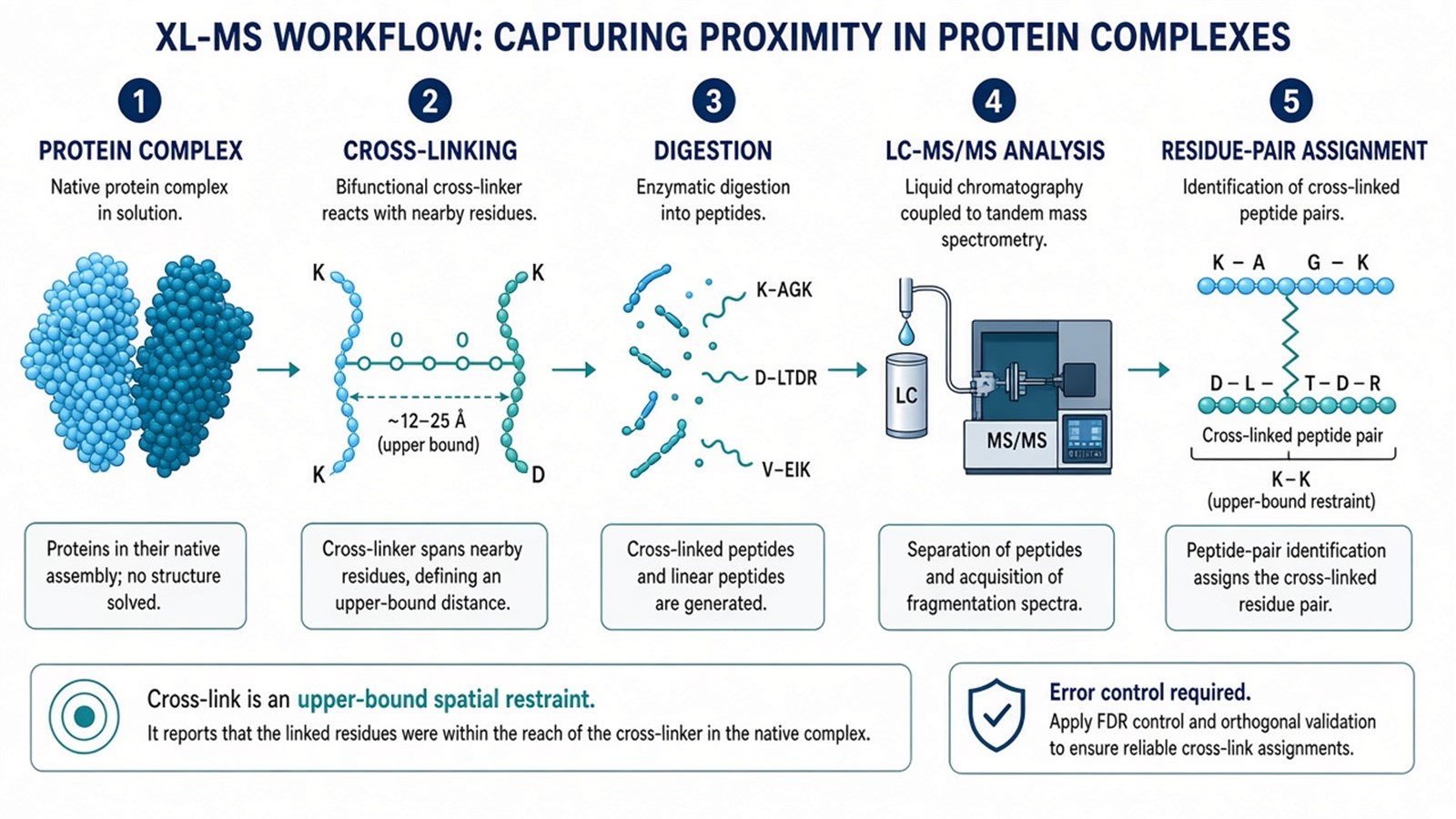
Figure 1. XL-MS converts a captured spatial proximity into a cross-linked peptide identification and then into a residue-pair restraint, provided error control remains appropriate.
Mapping XL-MS Data onto Protein Structures
Evaluating Structural Models with Cross-Link Restraints
After cross-linked peptide pairs have been identified, their residue positions can be mapped onto an experimental structure or a candidate structural model. The resulting restraints help assess whether the proposed arrangement of protein domains or subunits is compatible with the experimental data.
Multiple cross-links that support a consistent arrangement generally provide stronger structural evidence than a single isolated residue pair. Conversely, a model that conflicts with several well-supported restraints may require revision or consideration of alternative conformations.
Distance assessment should account for the cross-linker's spacer properties, the atoms used for measurement, and the flexibility of the linked residues. Straight-line distances between selected atoms are straightforward to calculate, but they do not fully describe the geometry available to a cross-linker. In some analyses, solvent accessibility and alternative conformations also need to be considered.
Identifying Candidate Interaction Interfaces
Clusters of interprotein cross-links near a protein surface can help identify candidate interaction interfaces. When multiple residue pairs connect compatible surface regions, they may support a particular subunit orientation or help distinguish among alternative complex models.
However, cross-linked residues do not necessarily contribute directly to binding energetics. A cross-linker may connect solvent-exposed residues that are spatially close to an interface without those residues being essential for the interaction. Flexible termini and intrinsically disordered regions can also sample a broad range of conformations.
Cross-linking restraints can therefore narrow the range of plausible structural arrangements, while additional structural or biochemical evidence may be needed to evaluate specific interface residues or distinguish among competing models. For complementary information on protein conformational changes and binding interfaces, see HDX-MS for Protein-Protein Binding Interfaces and Conformational Changes.
Interpreting XL-MS Results
The absence of a cross-link is weak negative evidence. A region may lack reactive residues, remain inaccessible to the reagent, generate peptides that are unsuitable for mass spectrometry, or fall below identification sensitivity. Digestion and enrichment can favor some products over others. Consequently, coverage is shaped by chemistry and analytical detectability as well as by structure.
An observed link is positive evidence for a covalently captured spatial proximity under the tested condition, provided identification and error control are sound. Reproducible condition-specific changes can suggest rearrangement, altered occupancy, or accessibility differences, but these alternatives are not automatically distinguishable. Quantitative changes should be interpreted alongside total protein abundance, complex formation, and matched controls.
XL-MS does not independently deliver a complete atomic model. Sparse restraints leave many degrees of freedom, and dense data can still contain ambiguous links, flexible-state links, or assignments from heterogeneous assemblies. Structural models generated with cross-link restraints are hypotheses constrained by the data, not direct images of every atom. Orthogonal evidence from cryogenic electron microscopy, X-ray crystallography, nuclear magnetic resonance, HDX-MS, mutagenesis, or biophysical binding assays may be needed depending on the claim.
A defensible conclusion therefore states exactly what was captured: specific residue pairs were found within cross-linkable proximity in a defined sample and condition. It may add that the pattern supports a candidate interface or is compatible with a proposed architecture.
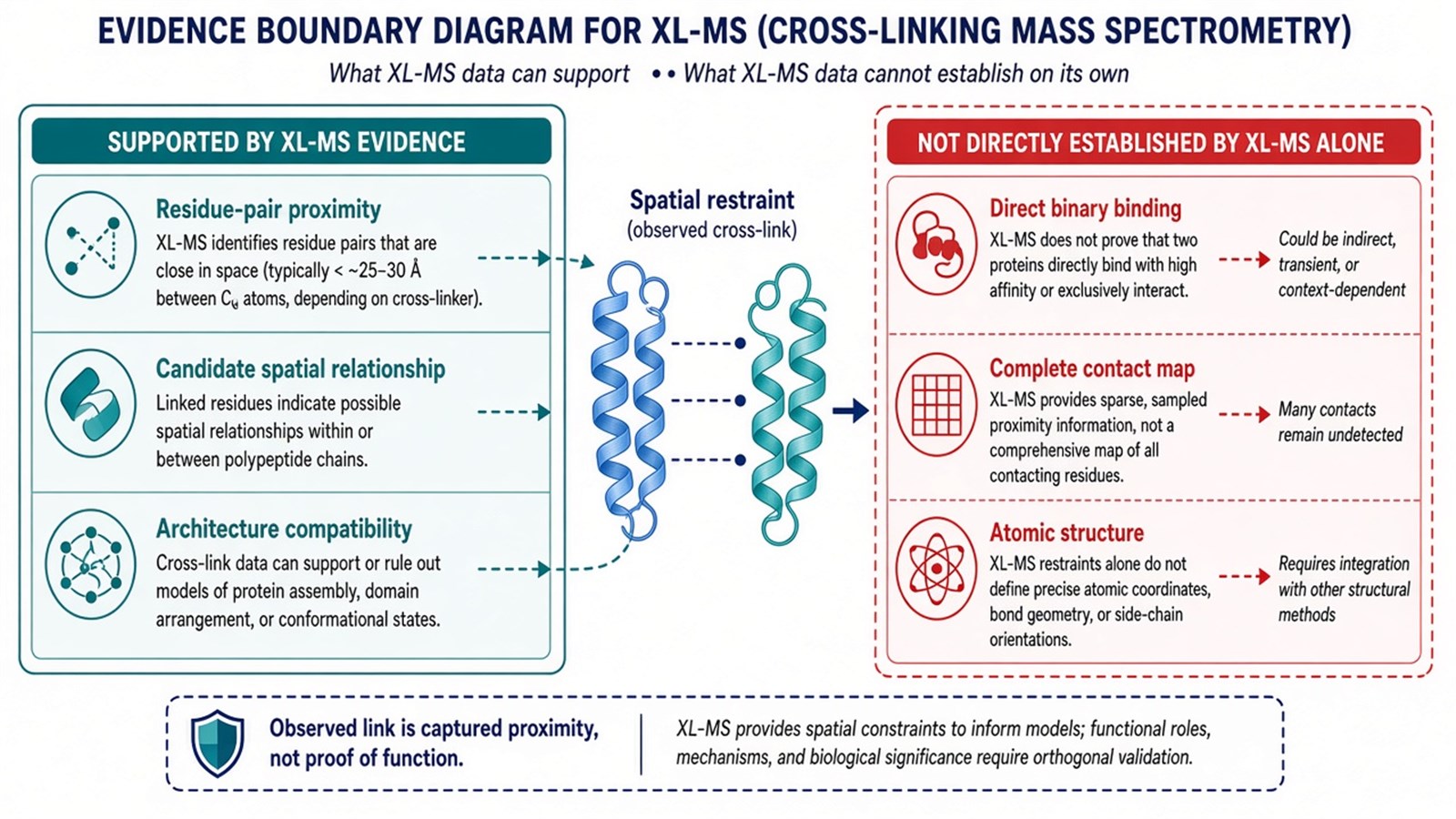
Figure 2. XL-MS can support residue-pair proximity and candidate spatial relationships. It does not by itself prove direct binary binding or provide an atomic structure.
Frequently Asked Questions
1. Can XL-MS compare two conformational or treatment states?
Yes, matched-state comparisons can reveal links that appear, disappear, or change in relative abundance. The design must control protein amount, complex occupancy, reaction handling, and analytical variability. A changed link may reflect geometry, accessibility, occupancy, or detectability, so it should not be assigned to one mechanism without supporting evidence.
2. What information is needed before an XL-MS feasibility assessment?
Provide protein identities and sequences, sample type, expected complex composition, purification state, buffer composition, available evidence of interaction, and the intended conclusion. Also identify whether the material is already cross-linked or whether cross-linking must be designed. These details determine whether the main risk lies in reaction chemistry, complex stability, background complexity, or peptide identification.
3. Should a photo-cross-linking strategy be considered when lysine coverage is poor?
It can be considered when conventional reactive residues are scarce or inaccessible, or when rapid capture is important. Photo-cross-linking brings different selectivity, probe-design, and background challenges. It is an alternative sampling strategy, not a guarantee of complete interface coverage or proof of direct binding.
4. How should a single unexpected long-distance cross-link be handled?
First examine spectrum quality, site-localization ambiguity, sequence uniqueness, oligomeric state, and possible intermolecular assignment. Then consider flexible regions, alternate conformations, or sample heterogeneity. One apparent violation should prompt review rather than immediate rejection of either the data or the model.
Conclusion
XL-MS is most valuable when the question is framed around residue-pair proximity, interface candidates, or compatibility with a complex architecture. Strong studies align the assembly state, cross-linking chemistry, controls, peptide-pair identification, and structural interpretation. The evidence can constrain models and reveal spatial relationships, but it does not automatically prove direct binary binding or provide a complete atomic structure.
For project-specific sample and chemistry assessment, researchers can consult the MtoZ Biolabs Crosslinking Mass Spectrometry Service.
Reference
- A. Leitner, M. Faini, F. Stengel, R. Aebersold (2016). Crosslinking and Mass Spectrometry: An Integrated Technology to Understand the Structure and Function of Molecular Machines. Trends in Biochemical Sciences, 41, 20-32. https://doi.org/10.1016/j.tibs.2015.10.008
- F. Liu, A.J.R. Heck (2015). Interrogating the architecture of protein assemblies and protein interaction networks by cross-linking mass spectrometry. Current Opinion in Structural Biology, 35, 100-108. https://doi.org/10.1016/j.sbi.2015.10.006
