



Co-IP, Pull-Down, and proximity labeling are widely used to investigate protein-protein interactions, but they answer different research questions. Co-IP identifies proteins that co-precipitate with a bait from biological extracts, Pull-Down examines bait-associated proteins in vitro, and proximity labeling identifies proteins near a bait within a cellular environment. The most suitable method depends on the research goal, available starting materials, and whether the study requires evidence of co-complex association, in vitro binding, or cellular proximity.
This article compares the three methods, explains their experimental requirements and evidence limitations, and provides guidance for selecting an approach for partner discovery or candidate validation. For a broader overview of PPI research strategies, see Protein-Protein Interaction Analysis: From Partner Discovery to Interaction Validation. Researchers planning a protein interaction study can consult the MtoZ Biolabs Protein-Protein Interaction Analysis Service to discuss suitable approaches based on the research objectives, bait availability, and sample types.
What Do Co-IP, Pull-Down, and Proximity Labeling Detect?
Co-IP
Co-immunoprecipitation recovers a bait with an antibody from lysed cells or tissues and, when coupled to mass spectrometry, identifies proteins retained in that captured material. The observed relationship is co-enrichment in a recovered complex under the selected lysis and wash conditions. Direct contact is not required for co-recovery, and indirect complex members can appear alongside candidate binders.
Pull-Down
Pull-Down uses a purified or recombinant bait, commonly presented through an affinity tag, to capture associated proteins from lysate or a reconstituted mixture. The observed relationship is bait-mediated recovery in an in vitro or reconstituted context. This can be useful for candidate testing or for generating an in vitro partner list, but the system may lack cellular modifications, membranes, or partner concentrations that exist in vivo.
Proximity Labeling
Proximity labeling covalently marks proteins near a bait in living cells and then enriches those marked proteins for identification. The observed relationship is spatial proximity during the labeling window, which can include direct partners, nearby complex members, and other proteins that occupy the same local environment (Roux et al. 2012). The method is therefore a neighborhood measurement rather than a binding assay.
These three readouts can overlap biologically and still remain distinct claims. A protein can be proximal without remaining bound after lysis, or it can co-purify in vitro without occupying the same neighborhood in cells. Interpreting a positive result requires naming which of those relationships was measured.
Comparing Starting Materials and Experimental Contexts
Native Complexes
Co-IP is usually considered when the bait can be captured from a native complex with an IP-grade antibody and the extraction conditions are compatible with the assembly of interest. Tissue, primary cells, and unmodified cell lines can be used when the antibody and input are adequate. The method depends on epitope access and complex stability after lysis. Researchers with a suitable antibody can consider the Co Immunoprecipitation (Co-IP) Service.
Purified or Tagged Baits
Pull-Down is usually considered when a recombinant bait can be produced in an active form, or when a tag is already available for capture. GST, His, MBP, and related tags change both capture chemistry and background. Tag-only and bead-only controls matter because the resin and tag can recover abundant proteins independently of the bait sequence. Projects with a suitable bait protein can review the Pull-Down Assay Service. The IP-MS Protein Interactomics Analysis Service supports antibody- or tag-based capture followed by mass spectrometry.
Cellular Proximity
Proximity labeling is usually considered when the biologically relevant relationship may be weak, transient, membrane-associated, or otherwise poorly retained after extraction. It requires a bait fusion that localizes correctly and a labeling context that can be controlled. It is less suitable when the claim is direct binary binding, when the fusion disrupts localization, or when the available material cannot support living-cell labeling. The Proximity Labeling Mass Spectrometry Service is the corresponding project route.
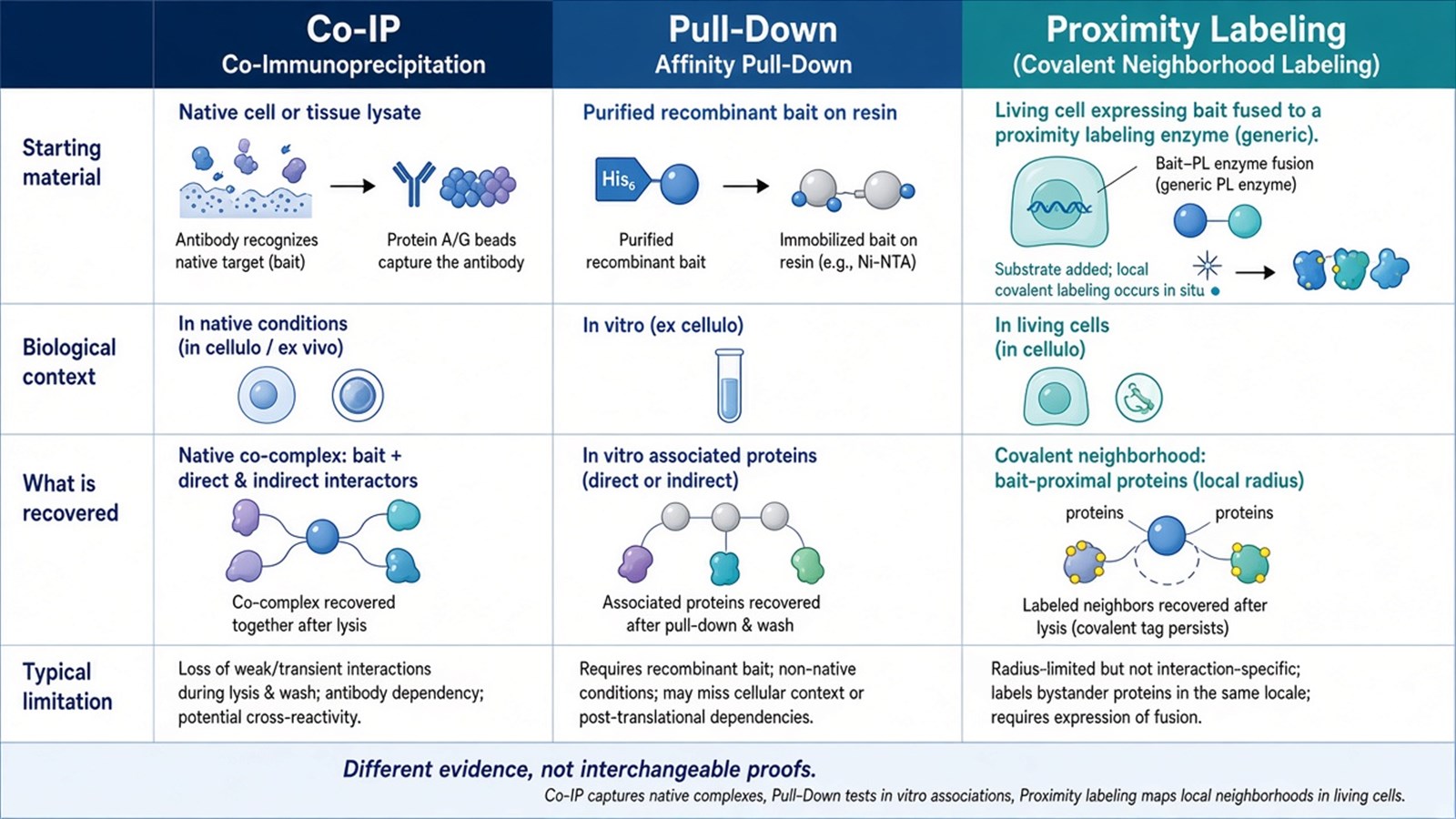
Figure 1. Co-IP, Pull-Down, and proximity labeling differ in starting material, biological context, and the interaction relationship they can observe.
Comparing Interaction Evidence and Method Limitations
Co-IP evidence supports co-complex membership in the recovered extract. Its main limitations are antibody background, loss of weak partners during washing, and indirect recovery through bridging proteins. A protein that disappears after more stringent washing is not automatically a contaminant; it may also be a weakly retained partner.
Pull-Down evidence supports bait-dependent recovery in the chosen in vitro system. Its main limitations are non-native bait activity, tag-dependent adsorption, missing cellular modifications, and the gap between in vitro association and intracellular interaction. A positive Pull-Down therefore often needs a native-context test if the claim concerns a cellular complex.
Proximity labeling evidence supports a local proteome. Its main limitations are labeling radius over time, compartment background, fusion-dependent localization artifacts, and the inability of proximity to prove physical contact. A highly ranked neighborhood protein may be a true partner, a bystander in the same organelle, or a protein encountered during trafficking.
Choosing a Method for Different PPI Research Scenarios
Unknown Partner Discovery
If the bait is endogenous and an IP-grade antibody is available, Co-IP-MS is a common starting route for native-complex discovery. If no suitable antibody exists but a tagged or recombinant bait is available, Pull-Down-MS may be more practical. If relevant protein associations may be disrupted during extraction, proximity labeling can help identify proteins near the bait in the cellular environment. The starting method should still be treated as a candidate generator.
Candidate Validation
When a candidate protein has already been identified, the next experiment should address the specific relationship that requires verification. For example, a candidate discovered by proximity labeling may be examined using Co-IP to determine whether it can be recovered in association with the bait. A candidate identified by in vitro Pull-Down may be evaluated using Co-IP to investigate its association in a cell-derived protein complex.
When direct binding between two proteins is the research objective, experiments using purified proteins, such as a defined pairwise Pull-Down assay or a suitable biophysical binding measurement, may provide more direct evidence. The choice of validation method should follow the conclusion being tested. Biological replicates establish whether an observation is reproducible, while complementary methods can provide different types of interaction evidence.
Weak or Transient Interactions
Weak or transient protein associations can be difficult to investigate using conventional affinity capture because the relevant complexes may dissociate during extraction or washing. Proximity labeling may be useful when the objective is to identify proteins located near a bait within a cellular environment, including proteins associated with dynamic or membrane-related processes.
Crosslinking-based approaches may also be considered when preserving labile protein associations or investigating spatial relationships is important. The appropriate strategy depends on whether the study aims to identify candidate associated proteins, retain complexes during purification, or obtain structural information about protein contacts.
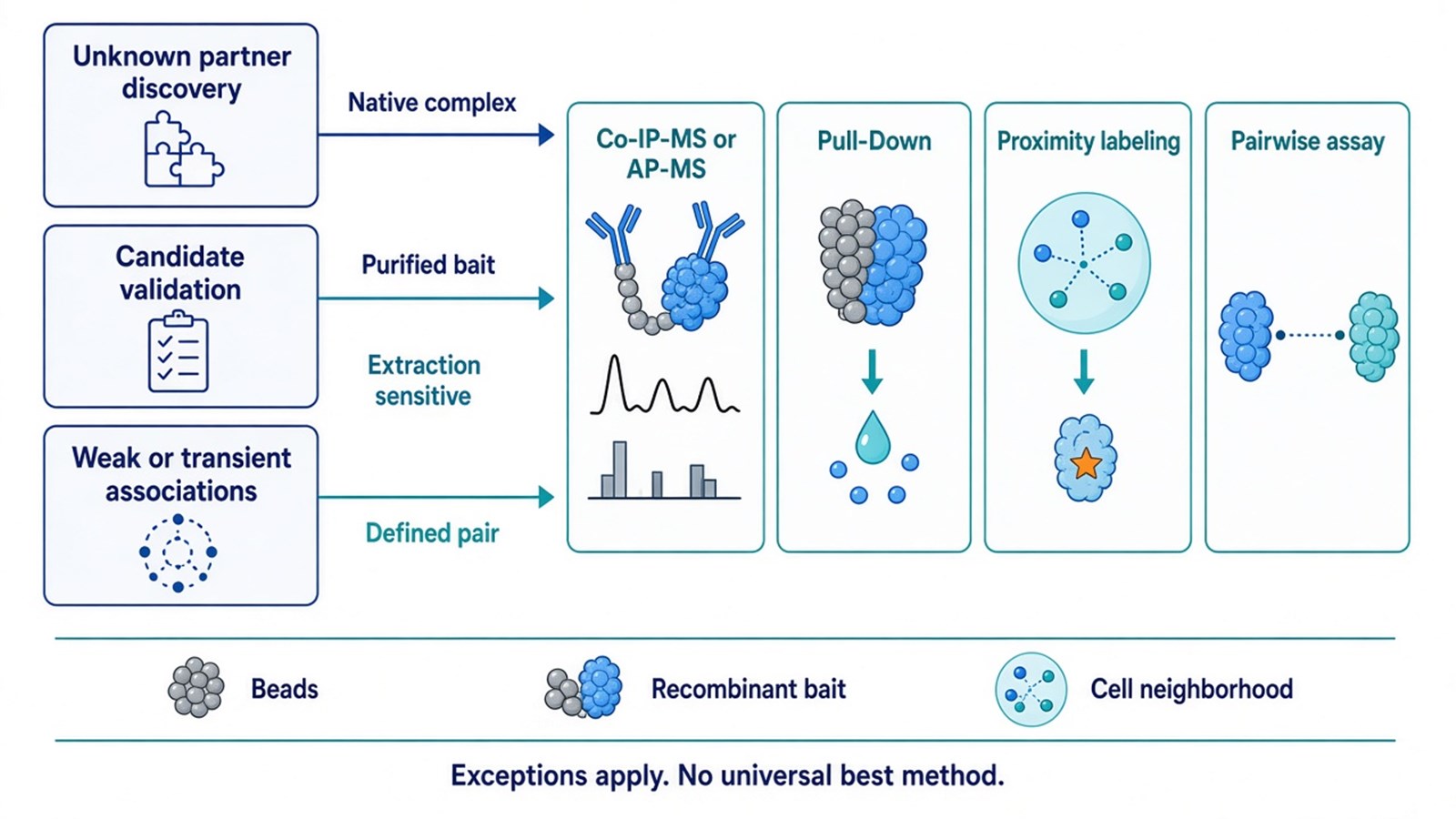
Figure 2. Method choice is conditional: native antibody availability, recombinant bait quality, and whether the relevant relationship survives extraction all change the preferred starting route.
Frequently Asked Questions
1. If no IP-grade antibody is available, should the study start with Pull-Down or proximity labeling?
It depends on whether a recombinant bait can be produced in an active form and whether the biologically relevant relationship is expected to survive in vitro capture. A tagged cellular bait with proximity labeling or AP-MS may be more suitable when native context matters. A purified bait favors Pull-Down when the claim can be answered in vitro.
2. Can GST Pull-Down replace Co-IP for a cellular interaction claim?
It can support bait-dependent in vitro association, but it does not automatically establish that the same relationship occurs in the original cellular context. A native-context experiment is still needed if the intended claim is intracellular co-complex membership.
3. What information is needed to choose among the three methods?
Provide the research goal, bait identity, antibody or recombinant-bait status, biological system, whether the relevant interaction is expected to survive extraction, available controls, and the evidence the result must support.
Conclusion
Co-IP, Pull-Down, and proximity labeling are complementary because they observe co-complex recovery, in vitro bait-mediated association, and cellular proximity. The suitable starting method depends on antibody or bait availability, biological context, and the claim that the result must support. Researchers comparing these routes can consult the MtoZ Biolabs Protein-Protein Interaction Analysis Service for project-specific method scoping.
Reference
- K.J. Roux, D.I. Kim, M. Raida, B. Burke (2012). A promiscuous biotin ligase fusion protein identifies proximal and interacting proteins in mammalian cells. Journal of Cell Biology, 196, 801-810. https://doi.org/10.1083/jcb.201112098
