



Tobacco Co-IP and IP-MS ask which proteins remain with an endogenous bait in Nicotiana after antibody capture, Input and IgG contrast, and a blot or LC-MS/MS readout. The experiment fits N. tabacum or N. benthamiana leaves when an IP-competent antibody exists and the claim is co-recovery, not binary direct binding (Hein et al. 2015). Transient tagging in tobacco is a different handle, not a more specific Co-IP. Prefer this reading when organ-matched Input and IgG were processed with the bait IP. Reassess when the antibody is Western-only, only an empty-vector lane is used, or phenolics block bait recovery.
Researchers who already have a Nicotiana bait, leaf or organ type, and a written interaction claim can also review the MtoZ Biolabs IP-Mass Spectrometry Service for project-specific tobacco Co-IP review.
What a Tobacco Co-IP Experiment Can Claim
A tobacco Co-IP experiment is still antibody capture of a native bait and the proteins that remain with it. Nicotiana leaf walls, phenolics, and abundant photosynthetic proteins change extraction and background. They do not change the result sentence. That sentence is: protein B is enriched with bait A versus matched IgG in this leaf extract, after bait recovery was shown versus Input.
N. tabacum is the usual endogenous-leaf matrix. N. benthamiana is often used for transient expression. Transient Flag, HA, or GFP fusions in tobacco should be read as tagged AP-MS, not as a more sensitive version of endogenous Co-IP. Identification depth in a Co-IP-style eluate is typically hundreds to about a thousand proteins, depending on the sample. A longer list is not a stronger tobacco interaction. Broader plant-tissue design is covered in How to Conduct Co-IP Experiments Using Plant Tissues?.
The experiment fits leaves or other Nicotiana organs when the antibody is supplied by the study and a tobacco protein reference database exists for an MS ending. It is a poor first experiment when no IP-competent antibody exists, when only an empty-vector control is planned, or when the claim is reconstituted binding of a purified domain. Vector construction and overexpression are not added onto a tobacco Co-IP request to manufacture a tag.
A tobacco Co-IP experiment reports candidate co-recovery under stated controls. It does not certify that two proteins contact each other.
Antibody Specificity in Nicotiana Extracts
Antibody specificity is the first tobacco gate. If the capturing reagent does not recover the intended native bait from the planned leaf lysate, later bands or protein names are not Co-IP results. Application-specific validation remains necessary because Western performance does not establish IP performance (Uhlen et al. 2016). How to qualify that reagent is covered in How to Choose the Right Antibody for Co-IP Assays?.
Many commercial antibodies were validated on blot or on a different species. A clone that worked in Arabidopsis can fail in N. tabacum because the epitope or the phenolic load differs. Record species, organ, clone, lot, and bead pairing. Extra leaf mass raises Rubisco and phenolic background faster than it creates bait-specific enrichment. Empty-tag controls from AP-MS do not replace antibody documentation on an endogenous tobacco Co-IP.
If no IP-competent antibody exists, stop calling the experiment Co-IP. Move to a tagged Nicotiana handle only when tagging is acceptable, and keep empty-tag controls.
Input and IgG Must Match the Tobacco Organ
Input and IgG are the denominators of a tobacco Co-IP experiment. They are not decorative lanes.
Input is taken before capture from the same leaf batch. It shows whether the bait, and when relevant the named prey, existed in that extract. A missing IP band is an expression or extraction problem if Input is empty. It is a capture problem if Input is positive.
IgG or bead controls must use the same organ, lysis, wash, elution, and, for IP-MS, the same digestion and search. A young-leaf bait IP cannot be scored against an old-leaf or root IgG. Preclearing is not a substitute for IgG. An empty-vector or uninfiltrated lane belongs to transient tagged capture. It does not replace IgG when the handle is an antibody against an endogenous tobacco bait.
Tobacco check |
What a pass looks like |
What the result cannot say |
|---|---|---|
Antibody specificity |
Native bait recovered from this Nicotiana lysate |
Partner names from an off-target or cross-species clone |
Input |
Bait present in the same leaf batch before capture |
A missing IP read as a missing interaction |
IgG or bead |
Organ-matched background without bait-specific recovery |
An empty-vector lane as IgG |
Enrichment efficiency |
Bait higher in bait IP than in Input and IgG |
A long MS table or a single remaining blot band |
Same-protein comparison |
One protein compared across matched leaf arms |
Unrelated proteins ranked as tighter binders |
A practical tobacco sequence is:
- Write the co-recovery claim for this Nicotiana organ.
- Confirm native bait recovery versus Input from the same leaf batch.
- Compare the same bait and prey against organ-matched IgG.
- Rank only names that pass that contrast.
- Keep a shortlist for an orthogonal pair assay.
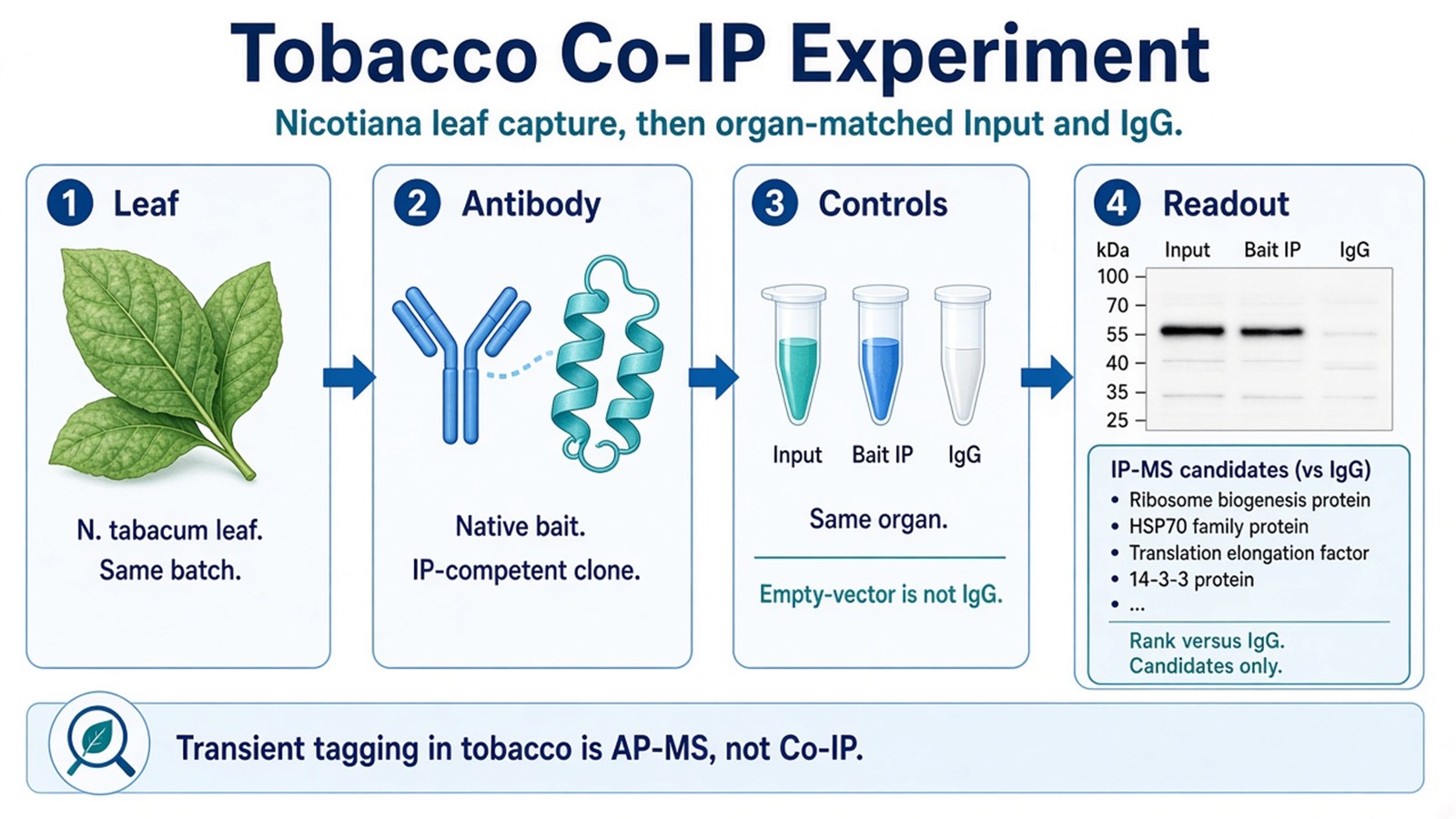
Figure 1. A tobacco Co-IP experiment starts after bait recovery is shown in the same leaf batch. A homogenization cartoon is not an interpreted result.
Enrichment Efficiency and Mass Spectrometry Credibility
Enrichment efficiency decides whether capture worked in the tobacco extract. If the bait is weak versus Input, stop partner interpretation. Relative intensity can compare the same protein across Input, IgG, and bait IP only when every arm used one leaf batch and one wash. Intensity does not rank unrelated proteins as tighter binders.
For blot reading, a prey band in the bait IP, reduced in IgG, and consistent with Input can support a relative co-enrichment sentence for that named protein. A missing band can mean the prey was absent, the prey antibody failed, phenolics blocked detection, or wash chemistry stripped the pair.
For IP-MS, identification of a protein is not a confidence call. Ranking requires bait recovery, Input-aware enrichment, and a declared contrast against IgG. Probabilistic scoring such as SAINT uses bait versus control counts to assign a probability that a prey is specifically co-purified (Choi et al. 2011). A contaminant catalog such as the CRAPome is a prior on control frequency (Mellacheruvu et al. 2013). Rubisco and other high-abundance leaf proteins can dominate the table. Pathway software can annotate a shortlist. It cannot repair a missing IgG arm or convert an empty-vector lane into endogenous Co-IP. How to read the finished result sentence is covered in Co-IP Results.
A tobacco Co-IP or IP-MS table supports candidate co-recovery after antibody, Input, IgG, and bait enrichment are shown. It does not certify a binary interactome.
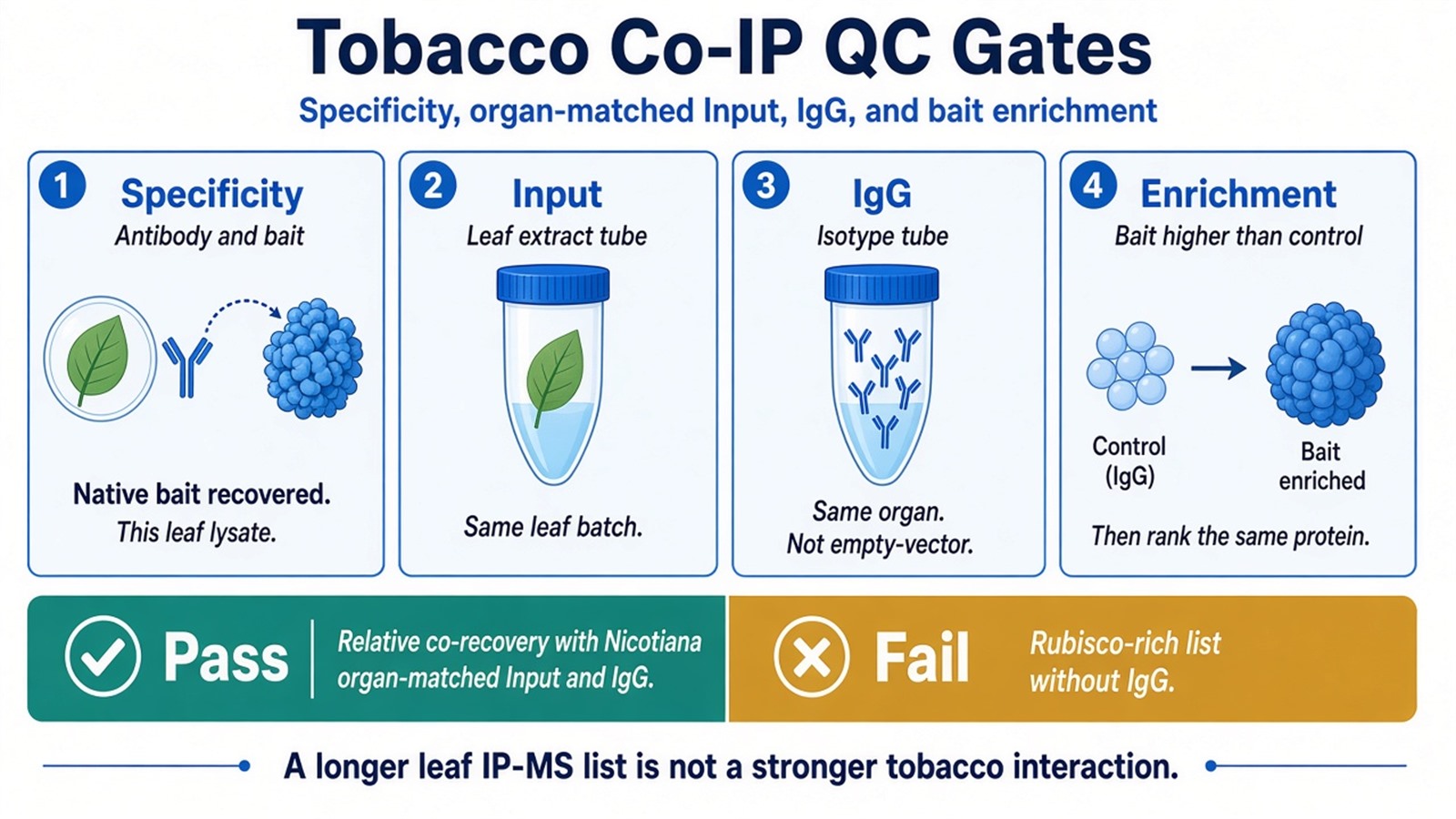
Figure 2. Mass spectrometry credibility in Nicotiana is an analysis outcome. Network enrichment does not replace leaf-matched Input and IgG.
Common Tobacco Biases and Result Boundaries
The common bias is writing a tobacco Co-IP as highly specific because a leaf antibody was used. Another bias is treating transient agroinfiltration in N. benthamiana as endogenous N. tabacum Co-IP. Over-washing phenolic-rich extracts can erase the association the claim needed. Under-washing leaves Rubisco in both bait IP and IgG, so subtraction makes every name look specific.
Do not write a successful bait IP as proof that remaining proteins contact the bait. Do not write a negative tobacco Co-IP as proof that no interaction exists in the plant. Absence can mean the wrong antibody, epitope masking, phenolic interference, over-washing, or a bait that is not expressed in the tested leaf state.
Prefer endogenous tobacco Co-IP or IP-MS when native bait recovery can be shown. Prefer tagged Nicotiana AP-MS when no IP-competent antibody exists and tagging is allowed. Prefer a defined-pair assay when the next sentence is direct contact.
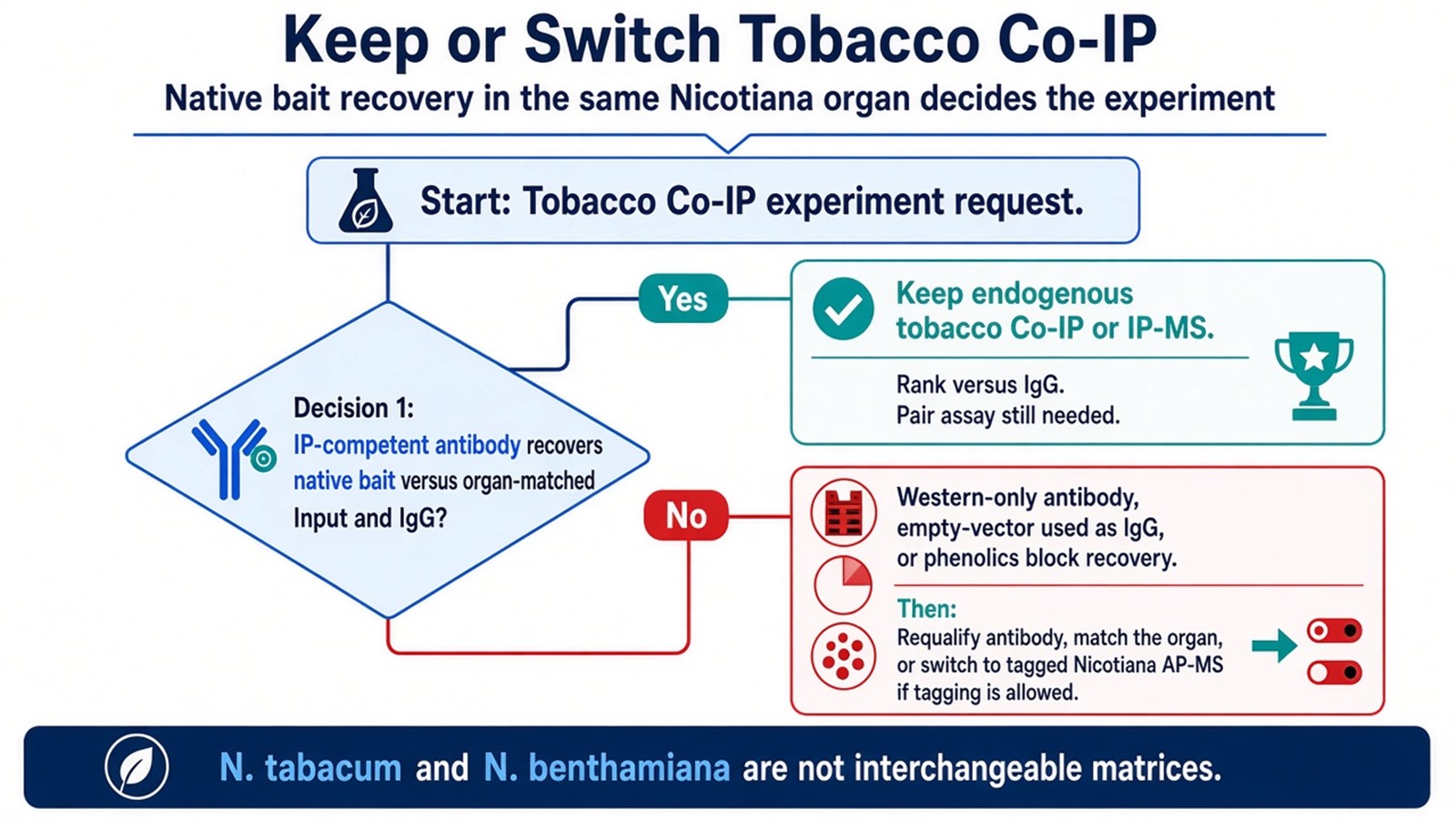
Figure 3. Keep a tobacco Co-IP experiment only while native bait recovery is documented in the same organ. An empty-vector blot is not a completed Co-IP.
Once the claim, Nicotiana species, antibody status, organ-matched Input and IgG, and the blot or IP-MS readout are defined, the project can be scoped as tobacco Co-IP or IP-MS. Researchers can review the MtoZ Biolabs IP-Mass Spectrometry Service for sample evaluation and tobacco Co-IP planning.
Frequently Asked Questions
1. Does a tobacco Co-IP experiment require a Flag or HA tag?
No. Endogenous Co-IP uses an IP-competent antibody. A tag in N. benthamiana is AP-MS, not a more specific Co-IP.
2. Can an empty-vector lane replace IgG in tobacco Co-IP?
No. Empty-vector controls belong to transient tagged capture. Native antibody Co-IP still needs organ-matched IgG.
3. Are N. tabacum and N. benthamiana interchangeable for this experiment?
No. Treat them as different matrices. Match Input and IgG to the same species and organ.
4. Does a longer leaf IP-MS list mean a stronger tobacco interaction?
No. Depth depends on the sample. Rubisco-rich lists without IgG are not a stronger result.
5. When should a tobacco Co-IP move to a pair assay?
Move when the next written sentence is direct contact or affinity. Keep the Co-IP shortlist as the input to that assay, not as the proof.
Reference
- M. Uhlen, A. Bandrowski, S. Carr, A. Edwards, J. Ellenberg, E. Lundberg, D. L. Rimm, H. Rodriguez, T. Hiltke, M. Snyder, T. Yamamoto (2016). A proposal for validation of antibodies. Nat. Methods, 13, 823-827. https://doi.org/10.1038/nmeth.3995
- M.Y. Hein, N.C. Hubner, I. Poser, J. Cox, N. Nagaraj, Y. Toyoda, I.A. Gak, I. Weisswange, J. Mansfeld, F. Buchholz, et al. (2015). A human interactome in three quantitative dimensions organized by stoichiometries and abundances. Cell, 163, 712-723. https://doi.org/10.1016/j.cell.2015.09.053
- H. Choi, B. Larsen, Z.Y. Lin, A. Breitkreutz, D. Mellacheruvu, D. Fermin, Z.S. Qin, M. Tyers, A.C. Gingras, A.I. Nesvizhskii (2011). SAINT: probabilistic scoring of affinity purification-mass spectrometry data. Nat. Methods, 8, 70-73. https://doi.org/10.1038/nmeth.1541
- D. Mellacheruvu, Z. Wright, A.L. Couzens, J.P. Lambert, N.A. St-Denis, T. Li, Y.V. Miteva, S. Hauri, M.E. Sardiu, T.Y. Low, et al. (2013). The CRAPome: a contaminant repository for affinity purification-mass spectrometry data. Nat. Methods, 10, 730-736. https://doi.org/10.1038/nmeth.2557
