Sequential Window Acquisition of All Theoretical Mass Spectra (SWATH) is a data-independent acquisition (DIA) method used for quantitative proteomics. The mass spectrometer steps through predefined mass-to-charge (m/z) windows and fragments the precursors in each window, instead of selecting only the most intense ions in real time (Gillet et al. 2012). Peptide quantities are then extracted as fragment-ion chromatograms, usually against a spectral library. SWATH is an acquisition choice. It is not a labeling chemistry, not a colorimetric total-protein assay, and not an absolute concentration method. The valid claim is relative change of the same protein across samples that share one chromatographic and extraction plan. Search titles that say quantitative proteomics detection using SWATH point to that windowed DIA experiment, not to proteomics quantification in general.
Researchers who already have defined samples, comparison groups, or a specific project objective can also review the MtoZ Biolabs Label-Free DIA Quantitative Proteomics for project-specific feasibility and analysis planning.
What SWATH Can Answer
SWATH can support treatment, genotype, time-point, or tissue-state contrasts in which the same protein is compared across independently injected unlabeled digests. Because fragmentation is scheduled, a peptide that would be missed by stochastic data-dependent acquisition (DDA) can still leave fragment chromatograms. Completeness is the design reason to choose SWATH. Completeness is not the same as accuracy, and it is not a copy-number ranking across different proteins.
A predefined peptide panel with a calibration curve belongs to a targeted assay such as multiple reaction monitoring (MRM) or parallel reaction monitoring (PRM). Many conditions that must share one pooled injection belong to isobaric labeling. Ordinary DDA label-free quantification (LFQ) remains a match when MS1 peak area under a stable chromatographic plan is sufficient and a spectral library is not part of the plan.
SWATH does not convert a protein list into a diagnostic marker, a clinical cutoff, or a personalized-medicine readout. Pathway maps interpret a differential list. They do not repair window interference or a confounded run order.
SWATH supports relative protein change from scheduled fragment chromatograms, not an amount without standards.
How Windowed DIA Differs from DDA
In DDA, the instrument ranks precursors in a survey scan and fragments a top-N set. Low-intensity peptides are identified in some runs and missed in others. Missing values then often track abundance. SWATH does not wait for that intensity ranking. Each window records fragment ions from all precursors that fell inside it, so later extraction can query the same peptide across the cohort.
The cost of that schedule is mixed fragmentation. Peptides that share a window are fragmented together. Fragment ions can overlap, and an extracted chromatogram can contain interference from a neighbor. Narrower windows reduce co-fragmentation and increase cycle time. Wider windows do the reverse. Window design is part of the quantitative method, not a software afterthought.
Labeling remains a separate axis. An unlabeled digest is the usual SWATH sample. A labeled digest can also be acquired with DIA. Calling SWATH a label-free method confuses acquisition with sample chemistry.
For studies focused primarily on unlabeled MS1 peak-area comparison, What Is Label-Free Quantification in Proteomics? provides a more detailed explanation of alignment, normalization, and missing values.
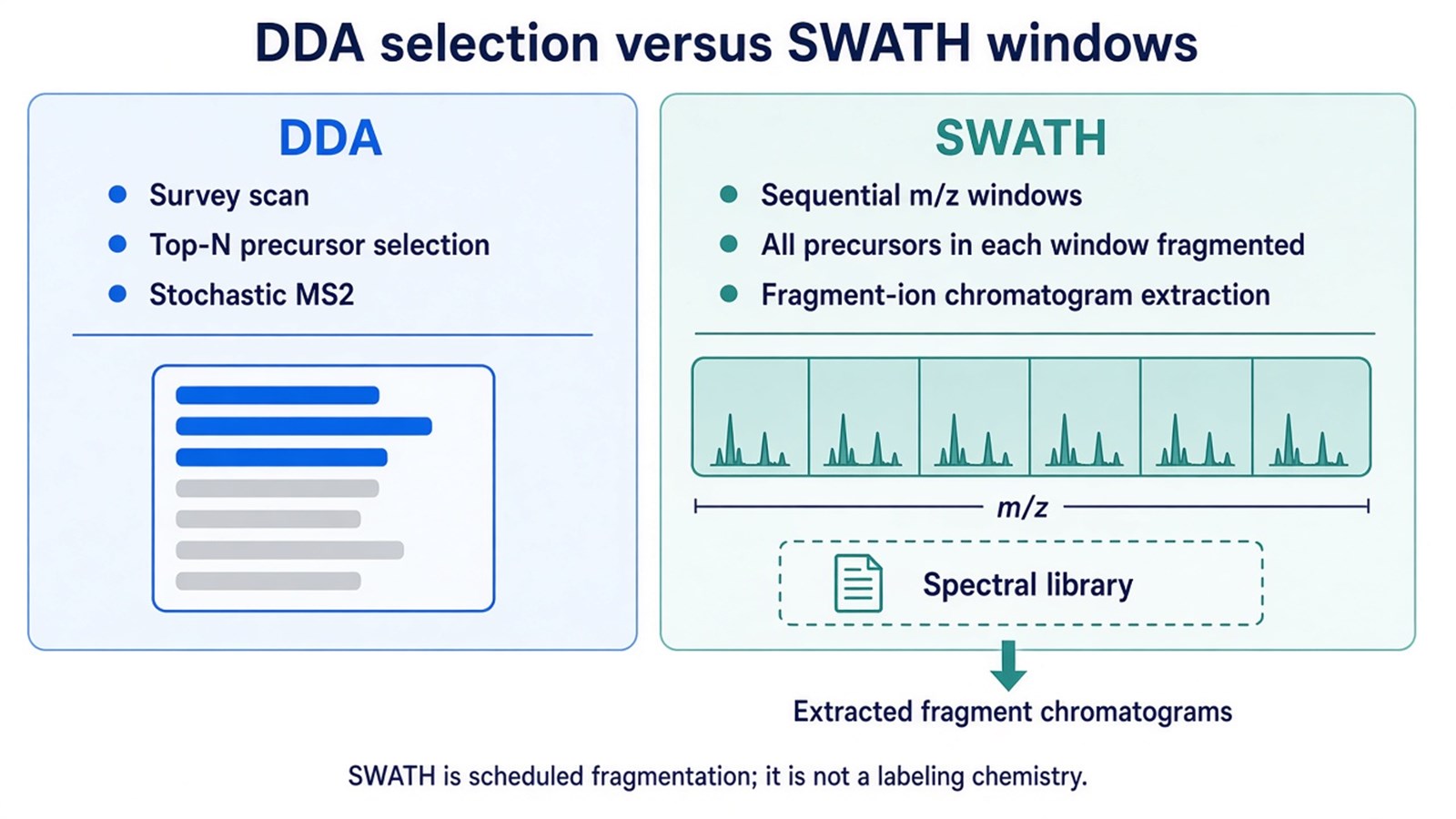
Figure 1. DDA fragments a ranked precursor subset; SWATH fragments scheduled m/z windows and extracts peptide quantities from fragment-ion chromatograms.
Spectral Libraries, Extraction, and Interference
Identification in a typical SWATH workflow is not a live DDA search of each precursor. Fragment chromatograms are scored against a spectral library that supplies expected fragments, intensity patterns, and retention-time information. Libraries are often built from matched DDA files of the same sample type. Library-free or predicted-spectrum workflows can reduce that requirement. They do not remove the need to control false matches in a dense fragment map.
Extraction quality depends on library coverage, chromatographic alignment, and the scoring of competing peak groups. A peptide absent from the library, or represented by a poor spectrum, will not appear as a confident SWATH value even if ions were recorded. Retention-time calibration, commonly with indexed retention-time peptides, keeps extraction windows on the correct chromatographic peak. Alignment does not prove that two peak groups are free of interference.
Software such as OpenSWATH, Spectronaut, or DIA-NN implements those extraction steps. Naming a package does not standardize results across laboratories. The processing trail, library version, and false-discovery control belong with the protein table. Exporting identifications from one tool and intensities from another, without a shared peak-group map, breaks that trail.
When SWATH Is the Matching Route
SWATH tends to fit when the study needs relative discovery on independently injected samples, and when DDA missingness would undermine the contrast. Larger unlabeled cohorts, biofluids, and projects that will requery the same raw files later are common cases, because the windowed record can be mined again without repeating acquisition.
Reassess SWATH when samples can enter a closed isobaric plex and the comparison should sit in one mixed run, when the organism can incorporate heavy amino acids for stable isotope labeling by amino acids in cell culture (SILAC), or when the endpoint is a short calibrated peptide list. Chromatography still has to stay one plan. A column change or a long interruption creates a new analytical block. Ordinary normalization does not merge that block into the original SWATH matrix.
Study need |
Route that often fits |
Main quantitative signal |
Reassess when |
|---|---|---|---|
Relative discovery with fewer DDA gaps |
SWATH or other DIA |
Fragment-ion chromatograms |
A spectral library or extraction plan cannot be maintained |
Relative discovery on independent DDA runs |
Unlabeled MS1 peak-area LFQ |
Precursor chromatograms |
Missing identifications dominate the contrast |
Relative comparison inside one pooled run |
Isobaric tags such as TMT |
Reporter ions |
Samples cannot be labeled |
Predefined peptides, amount or confirmation |
MRM or PRM |
Scheduled transitions |
The protein list is still open |
Researchers can refer to Protein Quantification Measured by Mass Spectrometry for how relative change differs from an amount claim across those routes.
In MtoZ quantitative offerings, SWATH is treated as a DIA acquisition route on unlabeled digests, not as a separate labeling product. Service configuration is not an academic rule that other laboratories must copy.
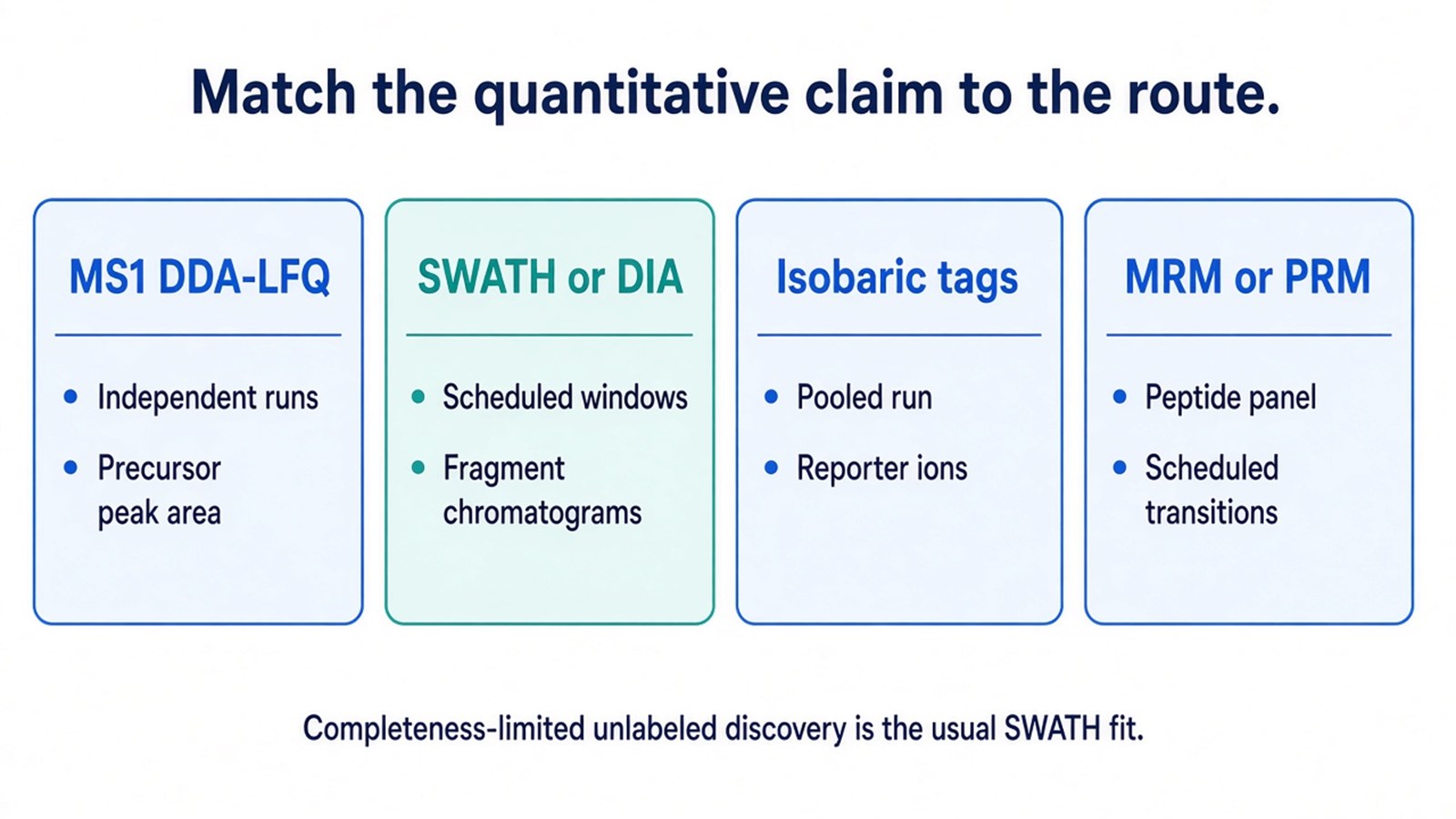
Figure 2. SWATH fits unlabeled relative discovery when scheduled fragmentation is needed; MS1 DDA-LFQ, isobaric labeling, and targeted MS remain different claims.
What a SWATH Result Can Support
After extraction, protein summarization, and the stated normalization, a SWATH value can support a relative statement: protein A is higher or lower in group 1 than in group 2 inside this study. Peptide support, peak-group quality, library coverage, and missingness belong next to that statement. Ordinary SWATH intensities should not rank different proteins by copy number, infer a diagnostic cutoff, or transfer a ratio from one instrument, window scheme, or library to another study as a calibrated quantity.
A later requery of the same files can add peptides that the first library missed. It cannot repair a run order in which all controls were acquired before all treated samples. Quality-control injections can monitor drift. They cannot license a retrospective merge of unrelated SWATH batches.
A SWATH table supports relative change of one protein inside one extraction plan, not a proteome-wide concentration certificate.
Frequently Asked Questions
1. Is SWATH the same as DIA?
SWATH is a windowed DIA method. DIA is the generic acquisition class that fragments precursors in scheduled windows rather than by live intensity ranking. Other DIA implementations exist. SWATH is not a second physical analyzer sitting beside DIA.
2. Is SWATH the same as label-free quantification?
No. Label-free means isotopic or isobaric labels were not used. SWATH means the instrument acquired windowed fragment maps. Unlabeled samples are often run as SWATH, but the two terms are not synonyms.
3. Does SWATH report absolute protein amounts?
Not from ordinary extracted intensities. Absolute or copy-number claims need spike-in standards, a calibration model, or a targeted quantitative assay. SWATH supports relative change of the same protein across comparable runs.
4. Is a DDA spectral library mandatory?
A matched DDA library is a common and often robust route. Library-free or predicted-spectrum analysis can proceed without that extra DDA set. Either route still needs false-match control, retention-time alignment, and disclosure of the library or model version.
Once the comparison design, unlabeled sample set, and expected fragment-level readout are defined, the project can be evaluated as a SWATH quantitative study. Researchers can review the MtoZ Biolabs Label-Free DIA Quantitative Proteomics for project-specific sample evaluation, feasibility assessment, and workflow planning.
