



An RNA pull-down assay uses a defined RNA bait to capture associated proteins from a protein source. Candidate proteins can be examined by immunoblotting or identified more broadly by LC-MS/MS. The method is especially useful when the RNA is known but its protein partners are not. Its interpretive strength depends on bait design, biological context, negative controls, and a clear distinction between specific enrichment and direct physical contact.
The broader choice among RNA-centered and protein-centered methods is discussed in Protein Interaction Analysis. If you need to identify proteins associated with a defined RNA, explore the MtoZ Biolabs RNA Pull-Down Service.
What RNA Pull-Down Can Identify
RNA pull-down can test whether a named candidate protein is recovered with an RNA bait or discover proteins enriched with that bait relative to controls. The RNA may represent a full transcript, a functional domain, a motif-containing fragment, or matched wild-type and mutant sequences. This flexibility makes the method useful for long noncoding RNAs, circular RNA regions, untranslated regions, viral RNAs, and regulatory elements.
When coupled to LC-MS/MS, the assay produces a list of proteins identified in captured material, together with peptide and signal information that can support relative comparisons. Quantitative proteomics has been used to compare RNA bait enrichment against control capture in an unbiased screen (Butter et al. 2009). Candidate ranking should focus on reproducible enrichment over biologically relevant controls, not on presence in the bait sample alone. Common RNA-binding proteins, abundant cytoskeletal proteins, bead binders, and proteins with broad nucleic acid affinity can all appear without sequence-specific recognition.
Recovery supports association under the assay conditions. It does not establish that every candidate contacts the RNA directly. Proteins may be connected through another protein or may bind nonspecifically to the RNA, label, bead, or matrix. The in vitro setting also differs from the intracellular environment, where localization, competition, RNA modification, and complex assembly constrain access.
RNA pull-down is therefore well suited to candidate generation and comparative bait experiments. A claim of direct binding, endogenous cellular association, or functional regulation normally requires additional evidence tailored to that specific claim.
RNA Bait Design and Biological Context
RNA bait design should reflect the region or structural feature being investigated. Full-length RNA preserves more of the transcript's structural context, whereas shorter fragments help focus the analysis on specific regions but may disrupt long-range structural elements. Wild-type and mutant baits can be compared to investigate whether protein recovery depends on a particular sequence or structural feature.
The labeling strategy also affects bait preparation. Biotinylated RNA is commonly captured using streptavidin beads, but the labeling position may influence RNA structure or protein accessibility. Before interpreting protein identification results, confirm that the RNA bait remains intact and can be recovered under the selected capture conditions.
The protein source should match the biological question. Cell or tissue lysates provide a complex mixture of proteins and preserve a broader range of potential RNA-associated partners. Purified proteins offer a more defined system for examining selected candidates but exclude cellular cofactors and competing molecules. Protein expression, subcellular localization, treatment conditions, and developmental stage can all influence which proteins are available for capture.
In vitro-transcribed RNA may lack endogenous modifications and may not fully reproduce the structure of native RNA. Synthetic RNA allows precise control over sequence and mutation design. When the research objective concerns RNA–protein associations in intact cells, an endogenous capture approach or a complementary protein-centered assay may help establish whether the observed association also occurs in the cellular context.
Controls for Distinguishing Specific Enrichment from Background
Appropriate controls help determine whether proteins recovered in an RNA pull-down are enriched specifically by the bait or arise from nonspecific interactions.
- Beads-only control: Identifies proteins that bind to the capture matrix or associated reagents.
- Unrelated or scrambled RNA control: Estimates background associated with general RNA-binding properties, provided the control is reasonably matched to the bait.
- Mutant RNA bait: Tests whether candidate protein enrichment depends on a selected sequence or structural feature.
- Competition assay: Examines whether excess unlabeled RNA reduces protein recovery, providing additional evidence of RNA-dependent association.
Background can also arise from abundant proteins, nonspecific protein–matrix interactions, residual nucleic acids, excessive bait loading, or insufficient washing. More stringent washing may reduce background but can also remove weak or transient associations. Washing conditions should therefore be selected according to the study objective and the types of interactions being investigated.
Biological replicates are essential for evaluating the reproducibility of candidate enrichment, particularly in LC-MS/MS experiments. Bait and control samples should be processed under matched conditions, including lysate source, bead chemistry, incubation, washing, digestion, and analytical settings wherever possible. Comparing the results across replicates and controls helps prioritize proteins with consistent bait-associated enrichment rather than proteins detected because of background binding or procedural variation.
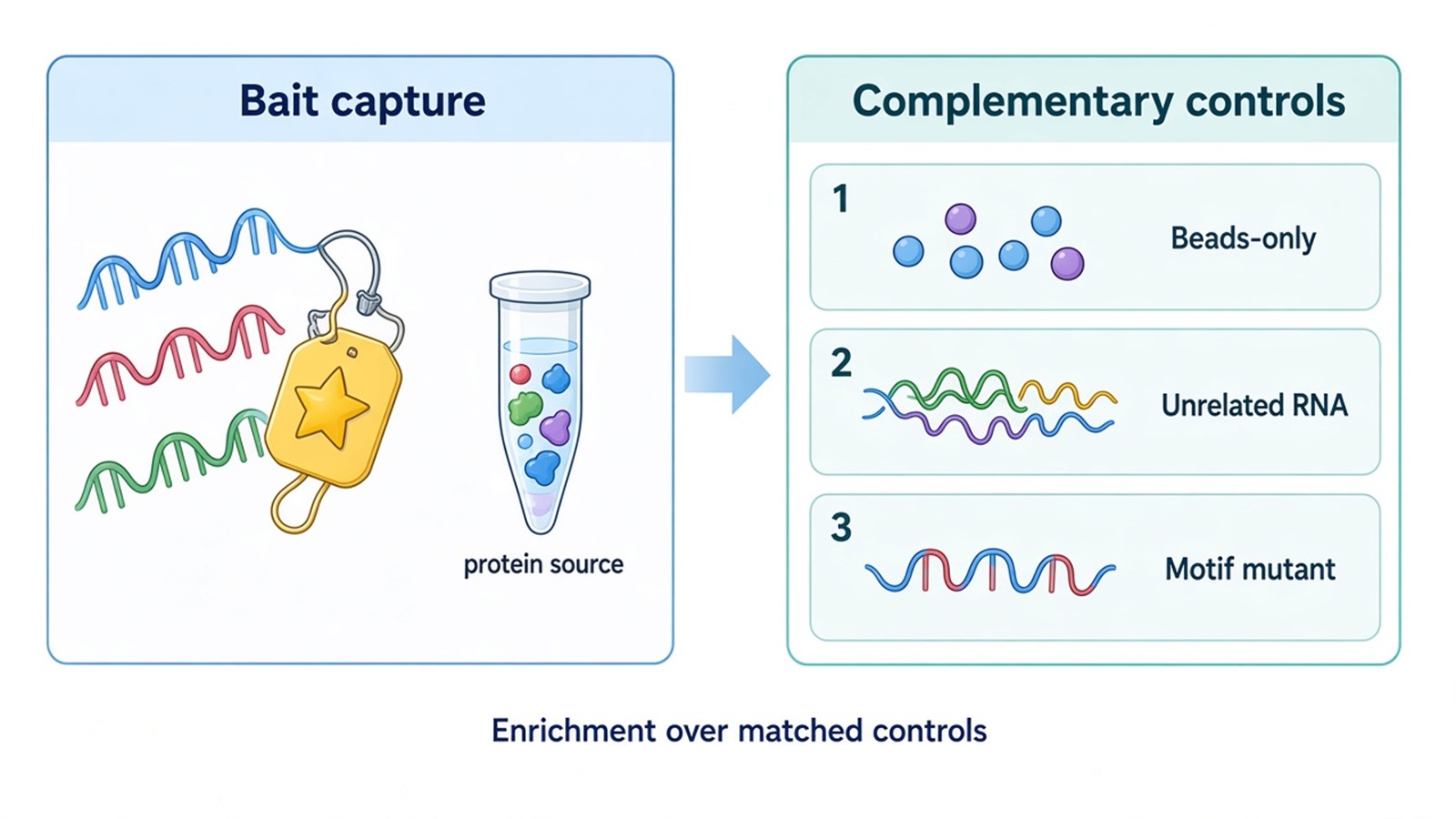
Figure 1. Bait design and complementary negative controls separate reproducible RNA-associated candidates from matrix, sequence-independent, and structural background.
Interpreting Protein Identification by MS
Mass spectrometry identifies proteins through peptides detected in the captured material. A protein found only in the bait condition may be interesting, but absence from a control can also reflect stochastic sampling near the detection limit. Stronger prioritization uses replicate consistency, relative signal, peptide evidence, control behavior, and compatibility with the expected cellular location.
Candidate lists should not be filtered through one universal fold-change or significance threshold. Experimental depth, missing values, replicate number, bait recovery, and background distribution influence what can be supported. Statistical analysis is useful when the design permits it, but it does not replace review of the underlying peptide and sample quality evidence.
Functional enrichment and protein interaction network analysis can help organize a long candidate list and identify biological processes for further investigation. However, these analyses generate hypotheses rather than establish direct RNA binding. Global studies of RNA-binding proteins also show that experimental context and capture chemistry influence the proteins detected (Castello et al., 2012). Candidate proteins should therefore be prioritized using the enrichment data, experimental controls, and biological context before mechanistic conclusions are drawn.
Validation should address the next unresolved claim. Immunoblotting after an independent pull-down can confirm recovery of a selected protein. Reciprocal RNA immunoprecipitation can test whether the protein captures the RNA in cells. A mutant or competition design can test sequence dependence. Purified components can assess direct binding, while perturbation can evaluate whether the candidate changes RNA behavior or a relevant phenotype.
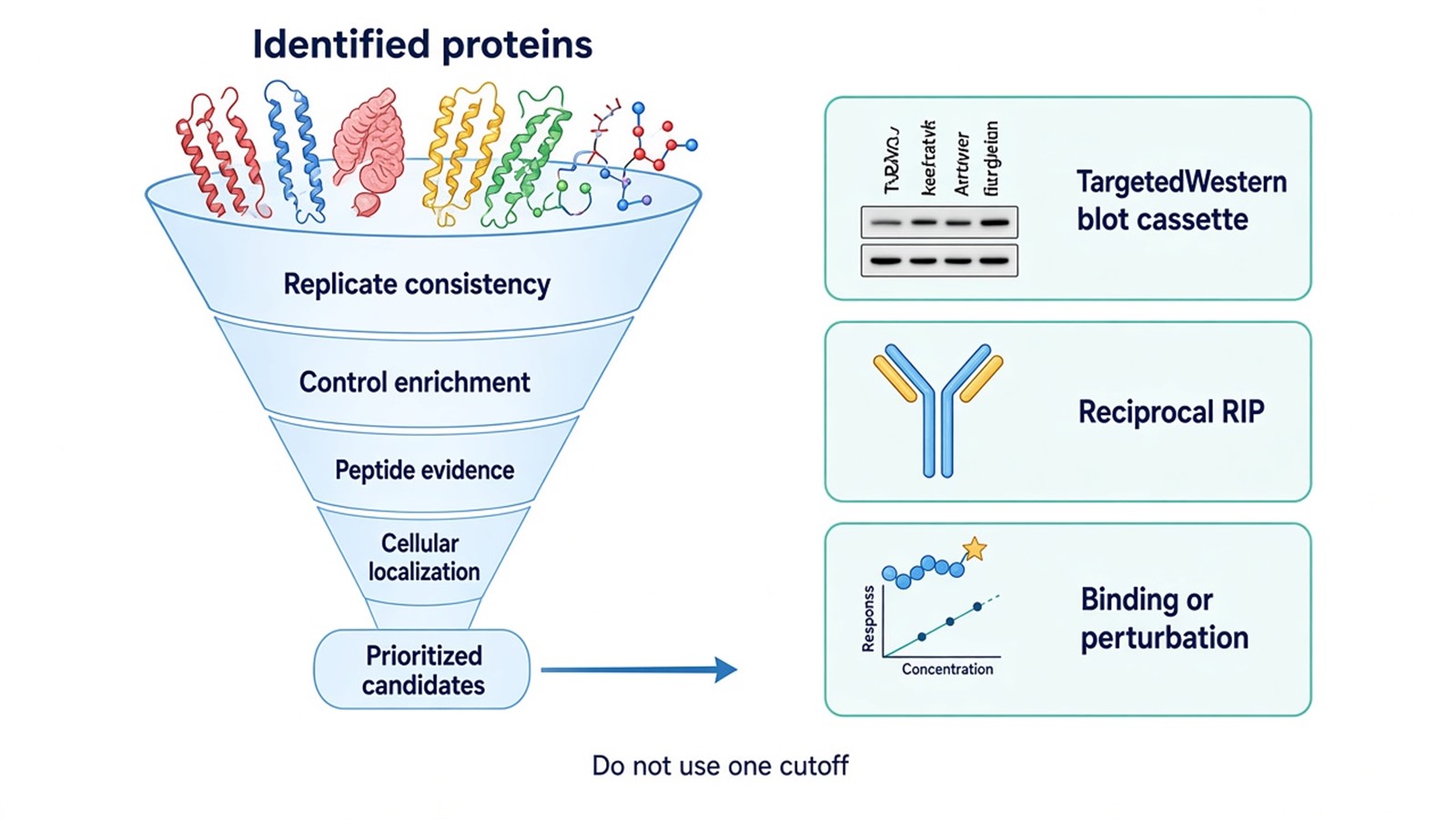
Figure 2. Candidate prioritization combines replicate enrichment, control behavior, peptide evidence, biological context, and a follow-up matched to the unresolved claim.
Frequently Asked Questions
1. What if the RNA bait is short and protein yield is low?
First, confirm bait integrity, immobilization, and recovery. Low protein yield may reflect limited binding regions in a short RNA, but it can also result from low target abundance, RNA folding, label placement, or stringent washing. Depending on the likely cause, increasing input material, redesigning the bait, or using a targeted detection method may improve candidate recovery or assessment.
2. Which negative control is best for a sequence-specific RNA interaction?
A carefully designed mutant bait is often informative when a defined motif is being tested, provided the mutation does not globally alter folding. An unrelated or scrambled RNA can estimate broader RNA-binding background, and beads-only can expose matrix binders. Using complementary controls is valuable when each addresses a distinct source of nonspecific recovery.
3. How should high background in the protein list be handled?
First inspect whether background is consistent across controls and replicates. Improve the control match, review bait loading and wash conditions, and distinguish abundant matrix binders from candidates with reproducible bait-specific enrichment. Adding a competition or mutant-bait comparison can be more informative than applying an arbitrary cutoff to a poorly controlled list.
Conclusion
RNA pull-down is an RNA-centered approach for identifying proteins associated with a defined RNA. Its practical value lies in generating and prioritizing candidate proteins for further investigation. Reliable results depend on an appropriate RNA bait, a suitable protein source, well-matched controls, and reproducible protein identification by LC-MS/MS.
If you need to identify proteins associated with a specific RNA, explore the MtoZ Biolabs RNA Pull-Down Service. The service supports RNA-centered protein identification, helping researchers generate candidate protein lists for subsequent validation and biological investigation.
Reference
- F. Butter, M. Scheibe, M. Mörl, M. Mann (2009). Unbiased RNA-protein interaction screen by quantitative proteomics. Proceedings of the National Academy of Sciences of the United States of America, 106, 10626-10631. https://doi.org/10.1073/pnas.0812099106
- A. Castello, B. Fischer, K. Eichelbaum, R. Horos, B.M. Beckmann, C. Strein, N.E. Davey, D.T. Humphreys, T. Preiss, L.M. Steinmetz, J. Krijgsveld, M.W. Hentze (2012). Insights into RNA biology from an atlas of mammalian mRNA-binding proteins. Cell, 149, 1393-1406. https://doi.org/10.1016/j.cell.2012.04.031
