



Protein function validation asks whether a nominated protein contributes to a declared biological process, phenotype, or disease-associated mechanism. Parallel reaction monitoring (PRM) supports that path as a targeted abundance layer: it quantifies predefined proteotypic peptides with high-resolution fragment spectra after the candidate list is closed. PRM can confirm whether expression or site-level peptide abundance reproduces across matched samples. It does not, by itself, prove enzymatic activity, localization, binding partners, or a clinical diagnostic role.
Researchers who already have a shortlist of proteins or peptides for confirmation can review the MtoZ Biolabs Parallel Reaction Monitoring (PRM) Service for panel feasibility and assay scoping before validation cohorts are queued.
What PRM Contributes to Protein Function Validation
PRM isolates scheduled peptide precursors, fragments them, and records full product-ion spectra on a high-resolution analyzer. Quantitative and qualifier fragments are extracted after acquisition, which helps review interference in complex matrices. The default claim is relative change of the same peptide under matched preparation. Absolute amount requires stable isotope-labeled standards and a declared calibration model.
In a function-validation project, PRM usually sits between open discovery and orthogonal biology assays. Discovery nominates candidates. PRM tests whether those candidates remain quantitatively credible on a closed panel. Genetics, activity assays, imaging, or interaction experiments then address mechanism beyond abundance. Treating PRM peak areas as complete function proof collapses those stages.
Mechanism detail for precursor isolation and parallel product-ion readout is covered in Mechanism of Parallel Reaction Monitoring.
PRM validates scheduled peptide abundance; full protein function validation still needs orthogonal biological evidence.
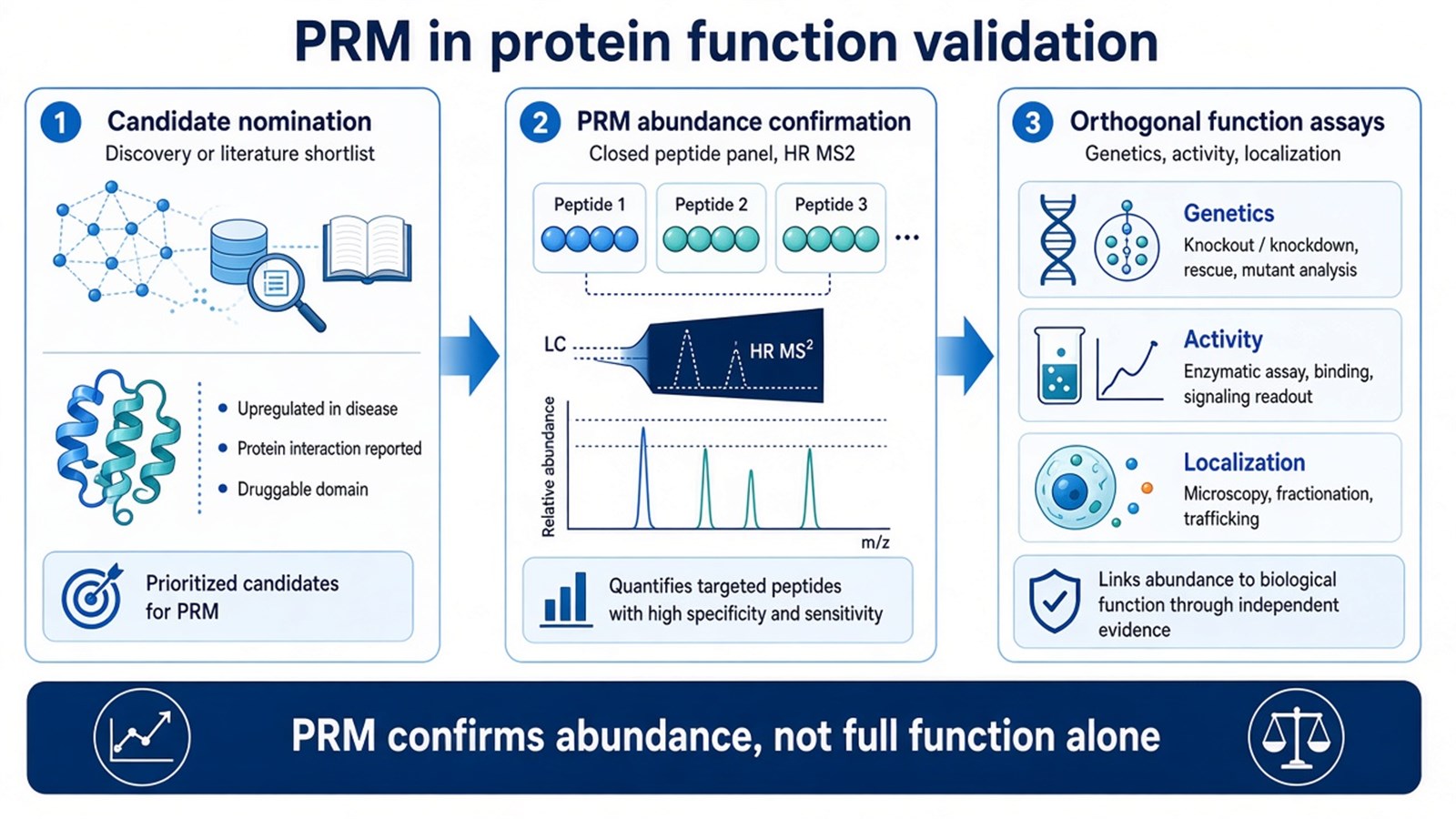
Figure 1. PRM contributes fragment-level abundance confirmation after candidates are nominated; genetics, activity, and localization assays address function beyond quantity.
How PRM Is Used in Function-Oriented Confirmation
1. Close the Candidate Peptide List
Select proteotypic peptides from discovery proteomics, literature, or pathway panels. Prefer unique sequences with usable chromatography and fragment ions. Shared peptides and sparse detections should be flagged before scheduling because precise wrong peptides still mislead function interpretation.
2. Decide Relative Versus Absolute Readout
Same-peptide peak areas support relative confirmation when digestion and loading stay comparable across contrast arms. Absolute concentration needs matched standards. An amount claim is still not an activity claim.
3. Acquire Scheduled High-Resolution MS2
Place precursor m/z and retention-time windows on an inclusion list. Panel size is limited by chromatographic peak width and MS2 cycle time. Concurrent monitoring of a focused panel is useful for pathway-linked shortlists; it is not unlimited proteome surveying.
4. Integrate Fragments and Keep Claims Separate
Extract quantitative and qualifier chromatograms, review interference, and report only peptides that pass peak-shape and retention checks. Abundance confirmation belongs in the PRM report. Mechanism wording should wait for orthogonal assays declared in the study plan.
Biomarker-oriented confirmation staging after discovery is discussed in How PRM Proteomics Supports Biomarker Validation.
Applications in Protein Function Verification Projects
1. Disease-Associated Candidate Confirmation
When discovery studies nominate proteins linked to pathogenesis hypotheses, PRM can quantify those candidates across disease and control research samples. Reproducible abundance differences strengthen the case for later functional experiments; they do not establish diagnostic cutoffs by themselves.
2. Confirmation of Discovery Proteomics Hits
Large-scale DDA, DIA, or labeled discovery matrices often over-nominate. PRM provides fragment-level remeasurement of a shortlist so function teams invest follow-up assays on peptides that survive targeted confirmation.
3. Pathway and Perturbation Panels
Drug treatment, gene perturbation, or signaling studies may need simultaneous monitoring of a defined protein set. PRM supports that closed panel when cycle time allows and prep remains matched across conditions.
Validation need |
PRM often fits |
Reassess |
|---|---|---|
Candidate status |
Closed shortlist from discovery or literature |
Open inventory still required |
Evidence type |
Abundance or site-peptide confirmation |
Enzymatic activity or binding proof alone |
Matrix |
Complex digests needing accurate-mass fragment review |
Unit-resolution transition panel already mature |
Claim |
Relative confirmation; absolute with SIS |
Clinical decision cutoff |
Panel size |
Focused pathway or biomarker shortlist |
Hundreds of targets without split methods |
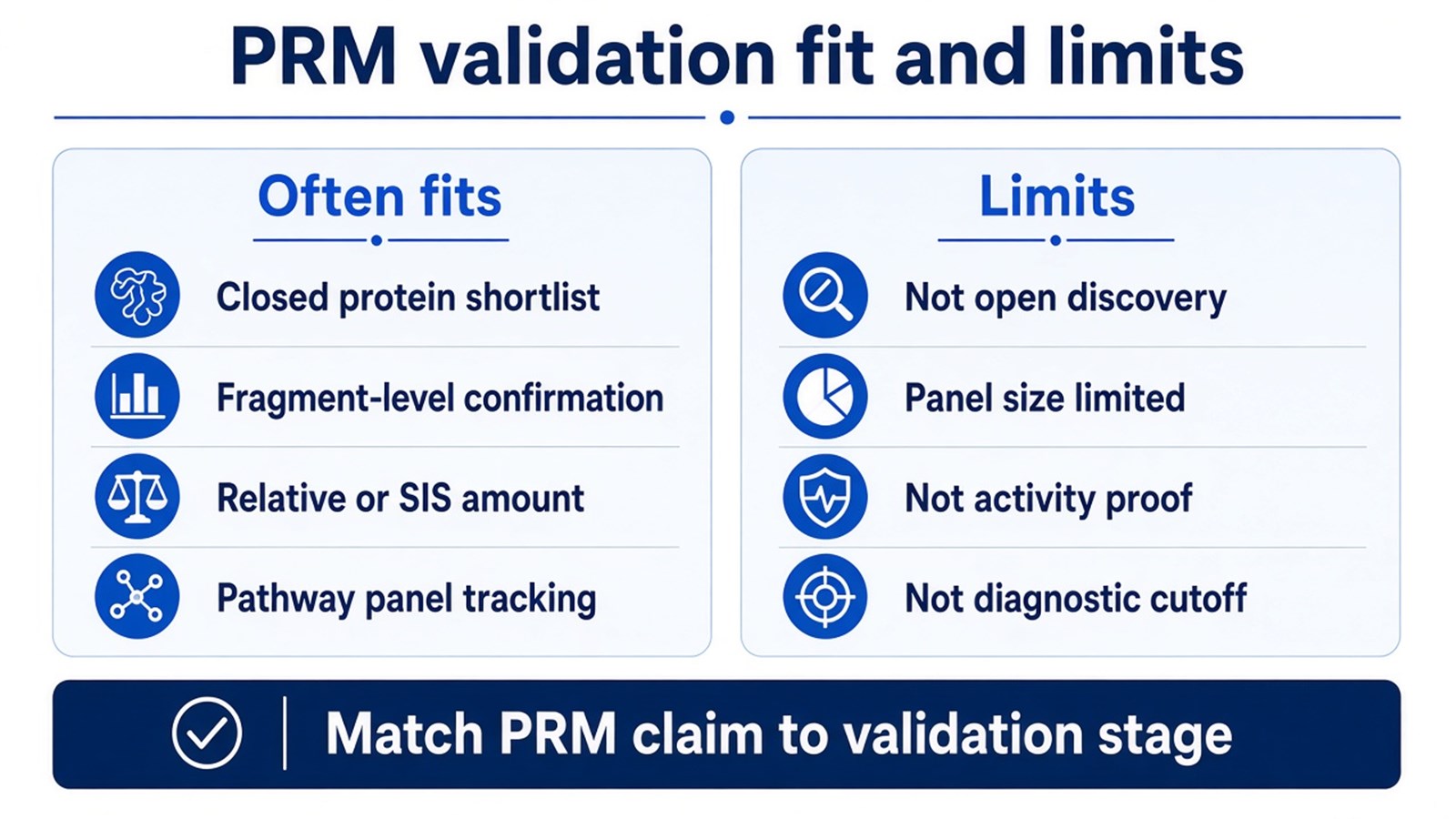
Figure 2. PRM fits closed-list abundance confirmation in function-validation projects; it does not replace activity assays or diagnostic validation frameworks.
Advantages and Limits of PRM in This Context
PRM offers high selectivity for predefined peptides because multiple high-resolution fragment ions can be reviewed after acquisition. That selectivity helps confirm candidates in complex biological matrices and supports multi-protein shortlists in one scheduled method when duty cycle allows. Compared with open discovery alone, PRM focuses analytical time on the proteins that matter for the next functional decision.
Limits remain project-defining. Off-panel proteins are not measured. Co-isolation inside the precursor window can still admit interference if qualifier fragments are ignored. Relative fragment areas are not molar concentrations without standards. Abundance confirmation is not functional proof. Diagnostic or companion-diagnostic claims sit outside ordinary research PRM reporting unless a separately validated assay framework is declared.
Conclusion
Protein function validation and PRM connect most clearly when PRM is used to confirm the abundance layer of nominated proteins before or alongside orthogonal functional assays. The technique supports disease-candidate verification, discovery-hit confirmation, and focused pathway panels through scheduled high-resolution fragment quantification. Reliable projects close the peptide list early, state relative versus absolute claims explicitly, and keep mechanism conclusions dependent on biology assays beyond PRM peak areas. Researchers planning that confirmation step can contact MtoZ Biolabs to review target peptides, matrix type, and reporting needs, and can also consult the MtoZ Biolabs Parallel Reaction Monitoring (PRM) Service for project-specific feasibility and method planning.
