



Protein-DNA interaction analysis can begin with either side of the molecular relationship. Researchers who know a DNA sequence may need to discover proteins associated with that sequence. Researchers who know a transcription factor, chromatin protein, or histone mark may instead need to locate associated genomic regions. These starting points require different assays, controls, and interpretations.
Protein-DNA Interaction Questions and Research Approaches
Protein-DNA research includes three questions that should not be collapsed. One asks which proteins associate with a defined DNA element such as a promoter, enhancer, repeat, or SNP-containing sequence. Another asks where a known transcription factor binds or occurs across the genome. A third maps chromatin occupancy, including histone-modification features, rather than sequence-specific protein-DNA recognition.
The assay must match that starting point. When the DNA sequence is known and the proteins are unknown, a DNA-centered capture experiment produces a candidate protein list. When the protein or chromatin mark is known and the genomic regions are unknown, a protein-centered occupancy assay produces enriched regions. These outputs cannot be substituted for one another. A candidate list does not reveal genome-wide occupancy, and an occupancy peak does not identify every protein assembled on the DNA element.
Direct binding is a further question. DNA pull-down can recover proteins through direct contact or through a retained complex. ChIP-Seq and CUT&Tag can detect target-associated chromatin without identifying the exact nucleotide contact or proving that the target directly recognizes DNA. Functional regulation requires additional evidence, such as perturbation of the protein or DNA element together with a relevant molecular or phenotypic readout.
The broader resource page for Protein Interaction Analysis places protein-DNA studies alongside protein-protein, protein-RNA, and protein-ligand questions.
Starting from a DNA Sequence or a Known Protein
DNA-Centered
A DNA-centered study begins with a defined sequence and asks which proteins are preferentially recovered with it. Typical baits include promoters, enhancers, response elements, repetitive regions, and alternative alleles. A biotinylated DNA probe is immobilized on streptavidin material, exposed to a protein source, washed, and analyzed by immunoblotting or mass spectrometry. MtoZ Biolabs’ DNA Pull-Down Assay Service supports this sequence-to-protein workflow.
Probe design should preserve the biological comparison. For a variant element, matched wild-type and variant probes can distinguish allele-dependent recovery. For a motif question, a sequence-disrupted probe can test whether enrichment depends on the motif. Probe length, strand configuration, nuclear protein source, and the position of the label may affect accessibility and complex assembly. These variables should be chosen around the hypothesis rather than copied from an unrelated system.
Mass spectrometry produces protein identification and relative abundance evidence for the recovered material. Candidate priority should consider enrichment over controls, reproducibility, protein detectability, known localization, and compatibility with the biological system. Recovery from a probe does not establish direct binding because proteins can be bridged by another protein or nucleic acid.
Protein-Centered
A protein-centered study begins with a known transcription factor, chromatin protein, or histone modification and asks where the target is enriched in the genome. ChIP-Seq uses immunoprecipitation of target-associated chromatin followed by sequencing. It has been used to map transcription factor occupancy and chromatin features at genome scale since early sequencing-based studies (Johnson et al. 2007). The ChIP-Sequencing Service provides a corresponding workflow for project design and interpretation.
CUT&Tag uses an antibody to position a protein A/G-Tn5 fusion near the chromatin target, where local tagmentation creates sequencing-ready fragments. It can provide focused chromatin profiles with low background under suitable conditions (Kaya-Okur et al. 2019). Researchers evaluating this approach may refer to the CUT&Tag analysis guide and the page of CUT&Tag Analysis Service.
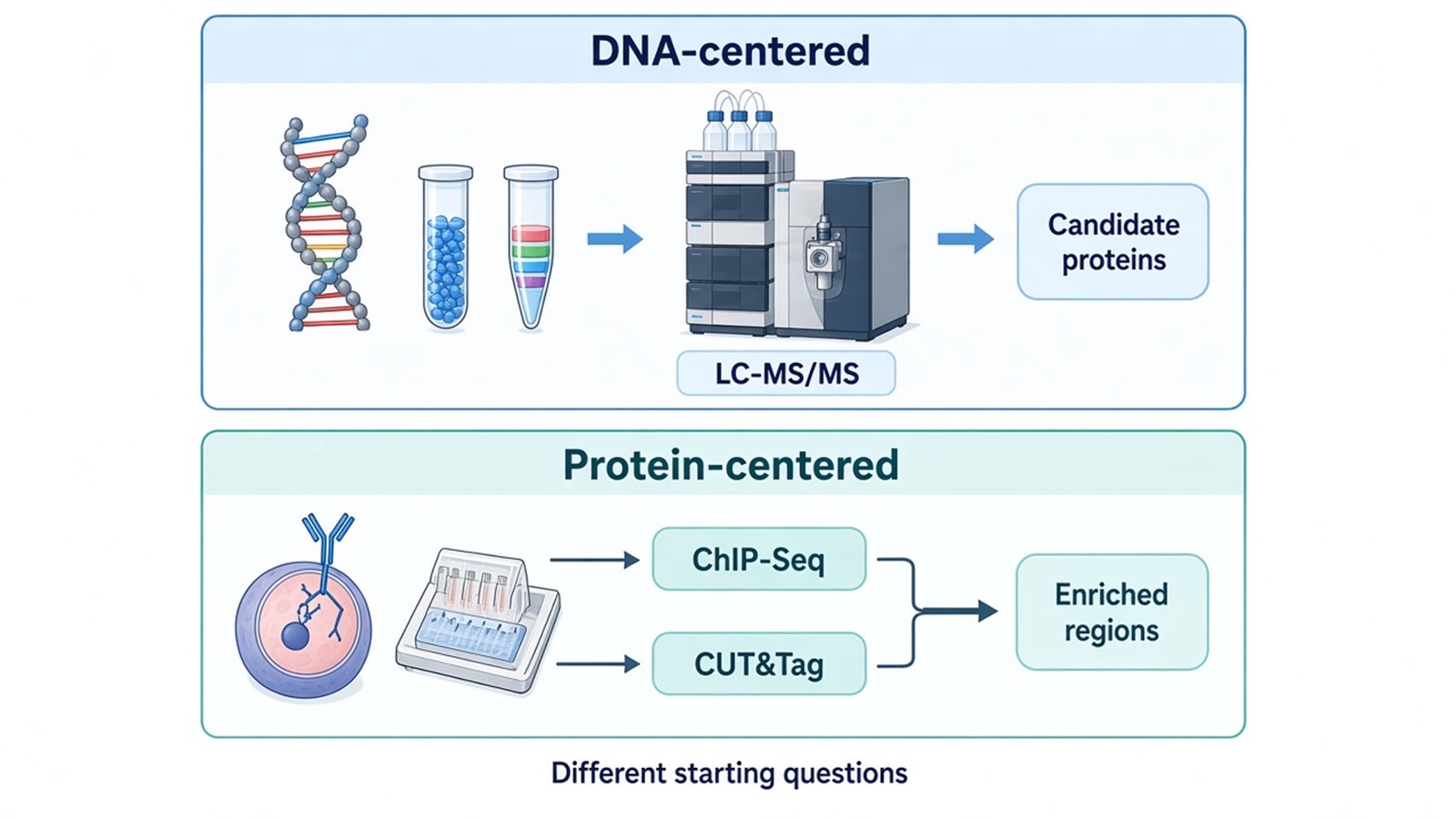
Figure 1. DNA-centered studies identify proteins associated with a defined sequence, while protein-centered studies map genomic regions associated with a known chromatin target.
Controls and Experimental Context
Controls help distinguish target-associated enrichment from nonspecific recovery, but their roles differ by method. In DNA pull-down, beads-only controls assess adsorption to the capture matrix, while unrelated or scrambled DNA sequences help identify sequence-independent recovery. Motif-mutant probes can test whether enrichment depends on a specific DNA motif, and competition assays can provide additional evidence of sequence-dependent binding. Matched biological replicates help determine whether enrichment patterns are reproducible.
The protein source also matters. Nuclear extracts preserve a broader set of potential DNA-associated proteins than a purified candidate, but they increase the possibility of indirect recovery. Tissue, cell type, treatment, developmental state, and extraction conditions influence which proteins are available and which complexes remain intact. A sequence-specific candidate absent from the relevant biological material cannot be recovered regardless of probe quality.
For ChIP-Seq and CUT&Tag, antibody specificity is a primary determinant of interpretability. An antibody that recognizes the target on an immunoblot may not perform adequately on chromatin. Input DNA, IgG, or target-appropriate positive and negative controls can address different background sources. The useful combination depends on whether the target is a transcription factor, chromatin-associated protein, or histone mark.
Comparative occupancy studies require biological replicates and a clearly defined contrast. Treatment and control samples should be processed consistently to limit batch effects. Differences in cell composition, chromatin accessibility, target abundance, or antibody performance can alter observed enrichment and complicate the interpretation of occupancy changes. Sample amounts and cross-linking conditions should be determined by the target, sample characteristics, and experimental design, while peak-calling thresholds should reflect signal properties and the analysis strategy.
Interpreting Binding Partners and Genomic Occupancy
A pull-down followed by mass spectrometry yields identified proteins, peptide evidence, and relative signal across bait and control conditions. ChIP-Seq or CUT&Tag yields mapped reads, enriched genomic regions, quality metrics, and annotations linking regions to genomic features. Combining these outputs can generate a stronger hypothesis.
For DNA pull-down, candidate selection should not rely on presence or absence alone. Proteins that bind beads, biotin, abundant nucleic acids, or probe ends can appear as background. Reproducible enrichment over relevant controls is more informative, and prior annotation should not replace experimental comparison.
For ChIP-Seq and CUT&Tag, a peak represents enrichment relative to a defined background and analysis model. Peak location can suggest promoter, enhancer, or distal occupancy, but assigning a peak to the nearest gene is not proof that the target regulates that gene. Differential peaks require careful normalization and assessment of replicate consistency, signal distribution, and global changes.
Neither assay automatically establishes direct DNA contact. A transcription factor may be tethered through another protein. A pull-down candidate may be part of a larger assembly. Independent tests can include targeted immunoblotting of pull-down material, reciprocal enrichment, sequence mutation, competition, another occupancy assay, or a defined-molecule binding experiment. Functional claims require perturbation and a relevant downstream readout.
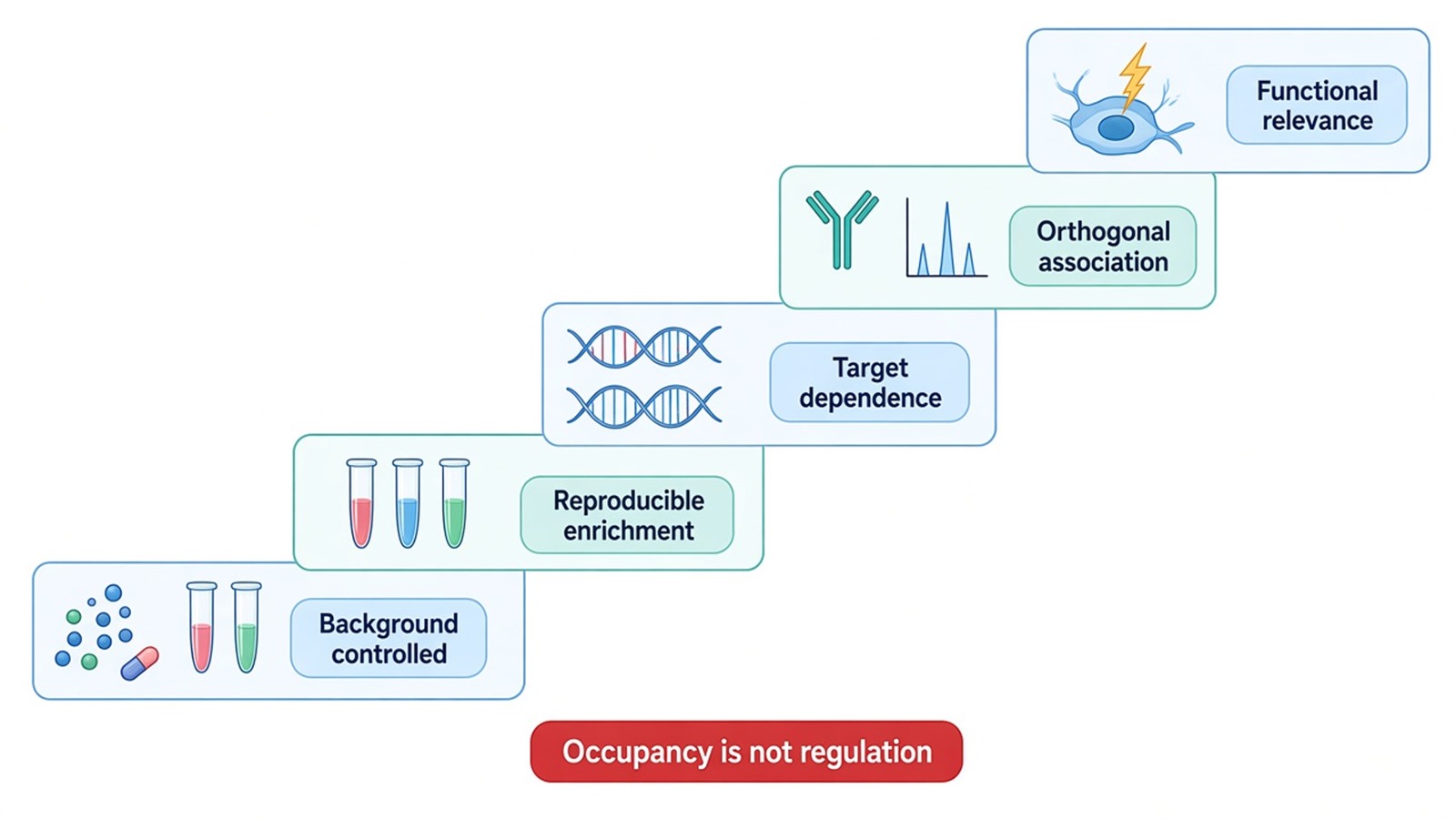
Figure 2. Input, IgG, replicate, and orthogonal controls help separate enrichment from background, while functional claims require evidence beyond occupancy.
Choosing a Follow-Up Strategy
The next experiment should address the main uncertainty left by the initial result.
- After DNA Pull-Down-MS: Prioritize candidate proteins enriched over appropriate controls. Targeted immunoblotting can verify their recovery, while competition assays or motif-mutant probes can help assess sequence dependence. Defined binding assays using purified components can further investigate direct protein-DNA interactions.
- After ChIP-Seq or CUT&Tag: Select representative genomic regions for targeted validation, such as ChIP-qPCR where appropriate. Prioritize regions with reproducible enrichment and a clear relationship to the research question.
- When regulatory function is the next question: Combine occupancy or binding evidence with gene expression analysis. Perturbation of the candidate protein or DNA element can help determine whether it contributes to the observed regulatory effect.
Frequently Asked Questions
Can allele-specific DNA pull-down distinguish proteins that prefer a variant sequence?
It can prioritize proteins that show reproducible differential recovery between matched allele probes. Probe design, equal loading, nuclear extract consistency, and sequence-disrupted controls are important. Differential recovery remains a candidate association and should be followed by targeted or orthogonal evidence.
Should bead-bound material or an eluted fraction be submitted for mass spectrometry?
Either format may be feasible, but the preferred choice depends on bead chemistry, elution reagents, detergents, salts, and total recovered material. Researchers should provide the capture workflow and buffer composition before submission so that compatibility and cleanup needs can be assessed.
What if a transcription factor antibody works for western blotting but has not been validated for chromatin assays?
Western blot performance does not guarantee ChIP-Seq or CUT&Tag performance because the target epitope and background context differ. Antibody suitability should be evaluated for the selected chromatin method, and a different strategy may be needed if specific enrichment cannot be demonstrated.
Can a genomic peak be assigned directly to the nearest gene?
The nearest gene is an annotation, not a proven regulatory target. Distal elements can contact other genes, and occupancy may not change transcription. Perturbation, chromatin context, expression data, or other functional evidence is needed to support regulation.
Conclusion
Protein-DNA interaction analysis is most informative when the molecular starting point determines the assay. DNA pull-down addresses which proteins associate with a defined sequence. ChIP-Seq and CUT&Tag address where a known protein or chromatin feature is enriched across the genome. Controls, biological context, and evidence limits determine whether the resulting candidates or peaks can support the intended claim.
MtoZ Biolabs can evaluate project-specific feasibility through its DNA Pull-Down Assay Service, with ChIP-Seq or CUT&Tag considered when genome-wide occupancy is the required output.
Reference
- D.S. Johnson, A. Mortazavi, R.M. Myers, B. Wold (2007). Genome-wide mapping of in vivo protein-DNA interactions. Science, 316, 1497-1502. https://doi.org/10.1126/science.1141319
- H.S. Kaya-Okur, S.J. Wu, C.A. Codomo, E.S. Pledger, T.D. Bryson, J.G. Henikoff, K. Ahmad, S. Henikoff (2019). CUT&Tag for efficient epigenomic profiling of small samples and single cells. Nature Communications, 10, 1930. https://doi.org/10.1038/s41467-019-09982-5
