



Parallel reaction monitoring mass spectrometry (PRM-MS) is a targeted method that isolates a scheduled peptide precursor, fragments it, and records a high-resolution product-ion spectrum of that precursor in one scan (Peterson et al. 2012). The quantitative value comes from extracted fragment chromatograms of chosen product ions, not from a proteome-wide discovery matrix. PRM-MS and PRM mass spectrometry name the same assay. The abbreviation is parallel reaction monitoring, not product ion monitoring. PRM is not data-dependent discovery, not unlabeled peak-area LFQ, and not an intact-mass identity check. The valid claim is relative change of a predefined peptide, or an amount only when a matched heavy standard and a calibration model are part of the design.
Researchers who already have defined peptide targets, comparison groups, or a specific project objective can also review the MtoZ Biolabs Parallel Reaction Monitoring (PRM) Service for project-specific feasibility and analysis planning.
What PRM-MS Can Answer
PRM answers whether selected peptides, used as surrogates of selected proteins or modification sites, change as expected across a defined contrast. The peptide list is closed before acquisition. That is the opposite of a discovery search that reports whatever was identified. A PRM peak group can support a relative statement about that peptide inside one chromatographic and scheduling plan. It cannot invent proteins that were never targeted.
Discovery tables from label-free quantification, tandem mass tags (TMT), or stable isotope labeling by amino acids in cell culture (SILAC) often supply the candidate list. PRM then tests those candidates with scheduled isolation. Candidate confirmation is not clinical validation and not a diagnostic cutoff. Antibody assays such as Western blot or enzyme-linked immunosorbent assay (ELISA) remain useful when an antibody and a linear range already exist. PRM does not require an antibody. It still requires a unique, LC-MS-compatible peptide.
Researchers can refer to Protein Quantification Measured by Mass Spectrometry for how relative change differs from an amount claim across discovery and targeted routes.
PRM-MS quantifies predefined peptide transitions recorded in parallel, not a proteome-wide discovery matrix.
How Parallel Product-Ion Recording Differs from MRM
Selected reaction monitoring (SRM) and multiple reaction monitoring (MRM) isolate one precursor-to-product transition at a time on a triple quadrupole. The third quadrupole passes a prechosen fragment. Method building includes transition selection and collision-energy work for each pair.
PRM keeps the quadrupole isolation of a scheduled precursor and the collision cell. A high-resolution mass analyzer then records all, or nearly all, product ions from that precursor in one spectrum (Peterson et al. 2012; Gallien et al. 2012). Transitions can be chosen after acquisition from the same product-ion record. Interference that sits on one fragment can often be rejected by inspecting neighboring fragments at high resolving power. PRM does not, by that fact, become more sensitive in every matrix, and it does not create an unlimited linear range.
A typical cycle is: schedule the peptide retention window, isolate the precursor, fragment it, and extract chromatograms for several product ions. Isolation width, fill time, and the number of concurrent precursors set how many targets fit in one method. Those are method-capacity limits, not proof that PRM monitors an entire proteome.
Quadrupole-Orbitrap instruments are the usual PRM hardware in current targeted proteomics. Equivalent full-scan product-ion targeting can be implemented on other high-resolution platforms. Naming an analyzer family does not define the scientific claim.
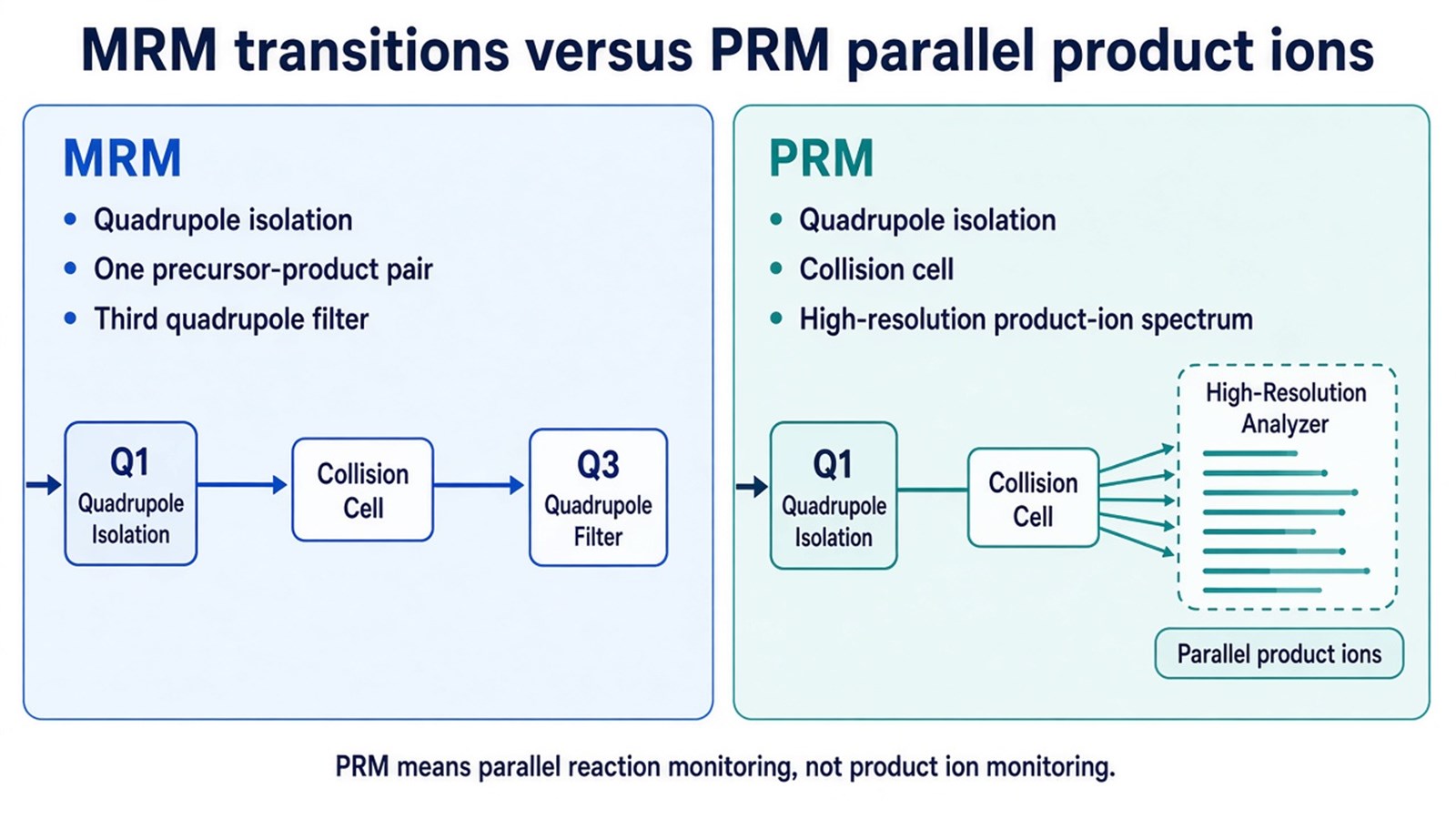
Figure 1. MRM records one preselected transition at a time; PRM isolates a scheduled precursor and records product ions in parallel for later extraction.
When PRM Is the Matching Assay
PRM fits when the protein or site list is already short enough to schedule, and when the needed claim is repeated measurement of those peptides across samples. Medium-size candidate panels after discovery, confirmation of a modified peptide, and relative follow-up of a drug or genotype contrast are common cases. Absolute or copy-number claims need a matched isotope-labeled peptide added at a point that matches the claim, plus a calibration model in the study matrix.
Reassess PRM when the protein list is still open. Unlabeled discovery or isobaric labeling remains the matching route for proteome-wide relative change. Reassess PRM when a laboratory already has a validated MRM method on a triple quadrupole and does not need post-acquisition fragment inspection. Reassess PRM when the endpoint is intact-protein mass or a colorimetric total-protein reading.
Unlabeled discovery still needs independent-run alignment if that is how candidates were generated.
Researchers can refer to What Is Label-Free Quantification in Proteomics? for alignment, missingness, and interpretation limits of that unlabeled matrix.
Study need |
Assay that often fits |
Main recorded signal |
Reassess when |
|---|---|---|---|
Predefined peptides, relative follow-up |
PRM-MS |
High-resolution product-ion chromatograms |
The protein list is still open |
Predefined transitions on a triple quadrupole |
MRM or SRM |
One precursor-product pair at a time |
Post-acquisition fragment review is required |
Proteome-wide relative discovery |
Unlabeled LFQ or TMT |
MS1 peak area or reporter ions |
Only a short candidate list remains |
Amount of a defined peptide |
PRM or MRM with a heavy standard |
Calibrated peak-area ratio |
No matched standard was added |
In MtoZ targeted offerings, PRM methods are typically built for a closed peptide panel on a quadrupole high-resolution platform and analyzed as extracted product-ion chromatograms. Service configuration is not an academic rule that other laboratories must copy.
What a PRM Result Can Support
After scheduling, extraction, and the stated normalization or calibration, a PRM value can support a relative statement: peptide A from protein B is higher or lower in group 1 than in group 2 inside this method. Peak shape, co-eluting interference, the number of qualifying fragments, and whether a heavy peptide was used belong next to that statement. Ordinary PRM intensities should not rank different proteins by copy number, infer a diagnostic cutoff, or transfer a ratio from one instrument method to another study as a calibrated quantity.
A heavy peptide spiked after digestion cannot correct digestion loss that already occurred. A PRM method that monitors an unmodified peptide does not report site occupancy for a modification on a different peptide. Metabolomics, environmental pollutant panels, and clinical diagnostic claims are different assays. They are not opened by renaming PRM as PRM-MS.
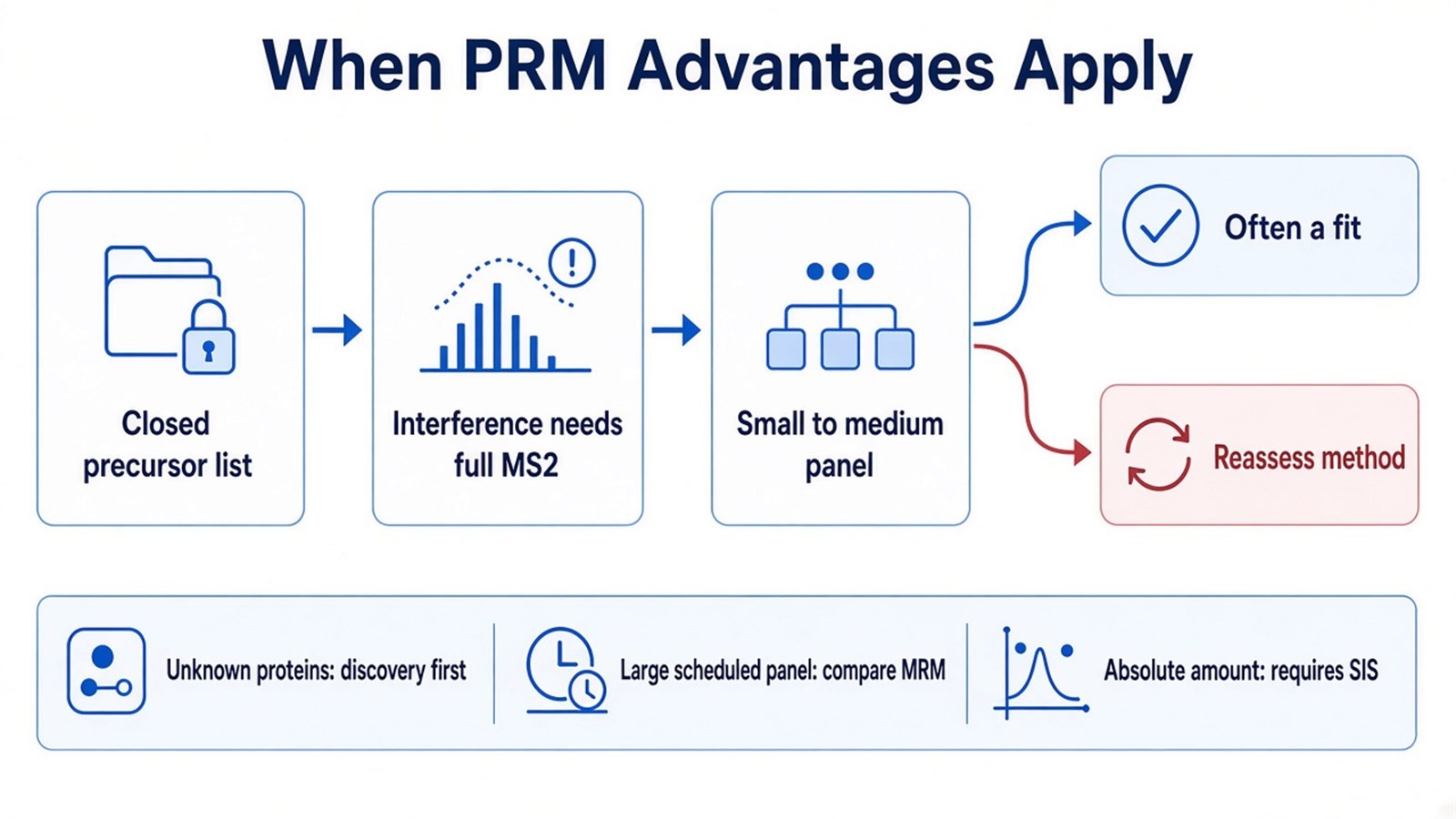
Figure 2. PRM fits a closed peptide panel that still needs fragment inspection; an open proteome stays in discovery quantification, and a locked transition list can stay on MRM.
A PRM table supports scheduled peptide measurements, not a discovery protein census or a diagnostic certificate.
Frequently Asked Questions
1. Does PRM-MS mean product ion monitoring?
No. PRM means parallel reaction monitoring. A product-ion scan is a different tandem-MS experiment. Search titles such as PRM-MS mass spectrometry and PRM mass spectrometry refer to the targeted parallel-fragment method.
2. Is PRM the same as MRM?
No. Both isolate a scheduled precursor. MRM records one or a few preselected fragments through a third quadrupole. PRM records a high-resolution product-ion spectrum and extracts fragments afterward.
3. Can PRM report absolute protein concentration without standards?
No. Extracted fragment chromatograms support relative change of the targeted peptide. Amount claims need a matched heavy standard and a calibration model that matches the claimed level.
4. Can PRM replace a discovery LFQ or TMT experiment?
No. PRM does not search an open proteome. It measures peptides that were already chosen. Discovery and targeted assays answer different sentences.
Once the peptide panel, contrast, and expected relative or calibrated readout are defined, the project can be evaluated as a PRM-MS study. Researchers can review the MtoZ Biolabs Parallel Reaction Monitoring (PRM) Service for project-specific sample evaluation, feasibility assessment, and workflow planning.
