



Cross-linking protein-protein interaction analysis writes a covalent bond between residues that sit close enough for a chosen reagent, then reads a named table. The table is a gel or blot shift, a capture-based partner list, or a residue-pair search. It is not a map of complex protein networks inside the cell, and it does not reveal the spatial structure or the dynamics of those interactions.
Chemical cross-linkers remain the original tool. They stabilize a contact that would otherwise fall apart when the cell is opened. Mass spectrometry remains one way to name what was linked. Naming the proteins in a digest is not the same job as naming the linked peptides. For the three readouts that use the same pulse, What Are the Specific Experimental Methods for Cross-Linking Protein Interaction Analysis provides a complementary methods page.
Researchers who already have a pulse planned and need a residue-pair table can also review the MtoZ Biolabs Crosslinking Mass Spectrometry Protein Interaction Analysis Service for project-specific feasibility and analysis planning.
What the Analysis Is Allowed to Report
A link reports that two compatible side chains could react under that dose, buffer, and time. The pair can sit on a direct contact. It can also sit on two proteins held near each other by a third subunit or a shared compartment. For that limit, Can Crosslinking MS Prove a Direct Protein Interaction? provides a complementary proof page.
Signal transduction, metabolic regulation, and cell-cycle control remain biological contexts in which a nominated pair may be tested. They are not outputs of the file. Disease-related networks, drug targets, virus–host infection mechanisms, chaperone inventories, and misfolded structures in neurodegeneration are later overlays. A covalent pair does not identify those objects.
In structural work the pairs can be used as distance-compatible restraints if they reproduce and survive a no-crosslinker arm. They do not supplement low-resolution images by adding missing density, and they do not convert a sparse table into a complete complex architecture.
When the next sentence should be an open partner list rather than a residue pair, the project is closer to capture than to a structural pulse. For that split, Co-IP-MS vs XL-MS: Which Protein Interaction Workflow Should You Choose? provides a complementary workflow page.
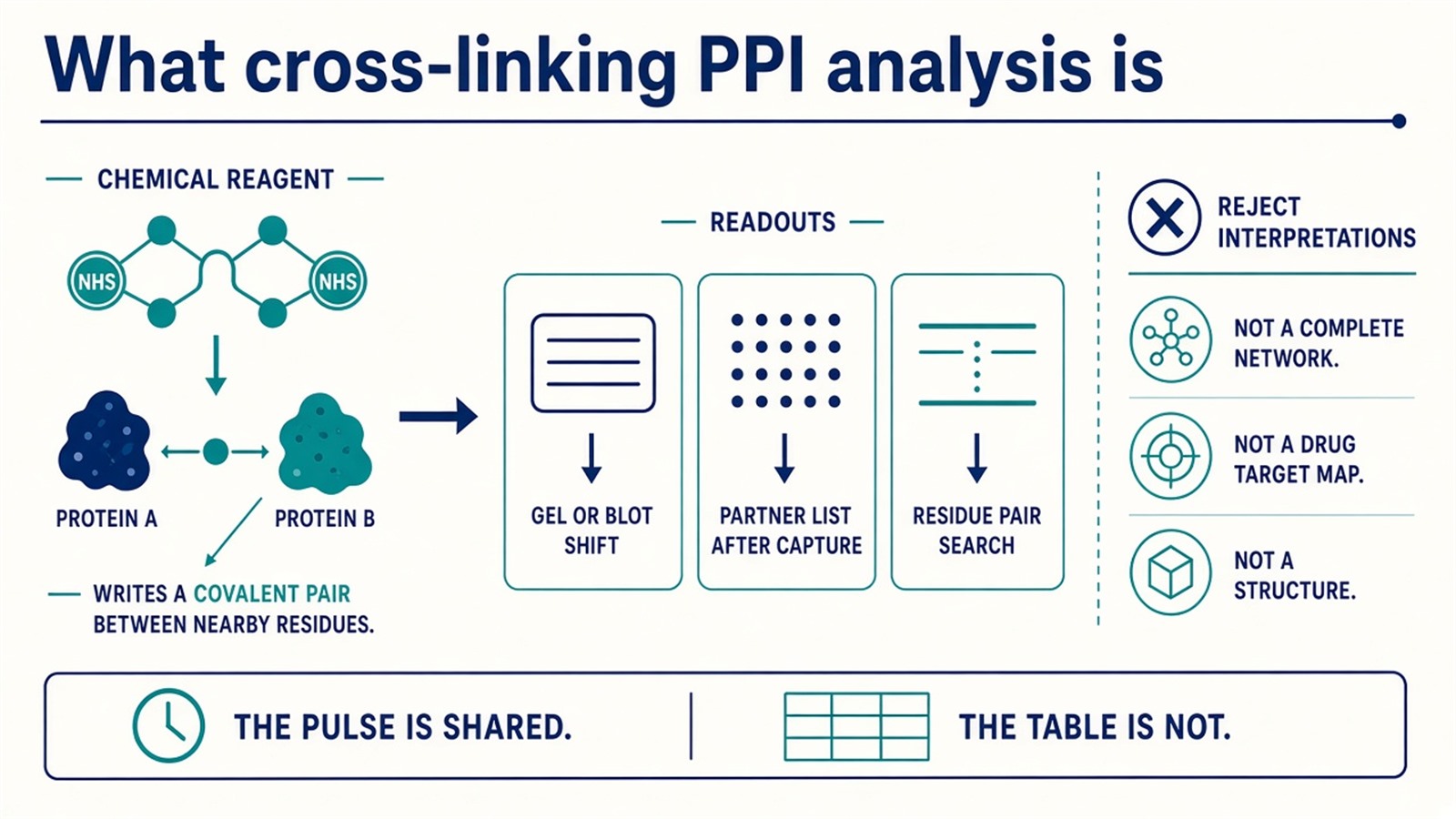
Figure 1. Shared pulse. Three tables: shift, partner list, or residue pair. Not granted: a complete network, a drug-target map, or a structure.
Name the table before naming the analysis. A covalent bond is not a network construction step.
The Original Three Process Headings
These headings stay. The verbs inside them change.
1. Sample preparation and the cross-linking reaction
The sample can be a lysate, a purified complex, or intact cells. Lysate-or-purified is not the only start. Reagents differ in residue class, permeability, and spacer. Chain length is a reach estimate, not a length chosen to match a known interface. Adjacent proteins can be linked. So can two amines on one chain. Stabilizing an interaction is the intent. It is not proof that the contact was native or direct. For the written wet order, What Is the Protocol for Crosslinking-Based Protein Interaction Analysis? provides a complementary protocol page.
2. Separation and mass spectrometry
Gel electrophoresis and liquid chromatography can enrich larger species or clean the digest. They do not reliably separate cross-linked complexes from every unlinked protein. Liquid chromatography–tandem mass spectrometry (LC-MS/MS) identifies linked peptides only when the search is written for pairs. A high-resolution mass-to-charge ratio is a measured peak. It does not by itself determine the cross-linked peptide or quantify the proteins in a complex.
3. Data analysis, not network construction
Specialized software assigns candidate pairs under a declared false-discovery rule. Protein identification, site assignment, and a later spatial-constraint model remain possible uses of those pairs. The search does not construct an interaction network or assign biological function. A model that accepts a restraint is a later overlay.
A no-crosslinker arm travels through the same quench, cleanup, and search. Changing only the treated sample mixes a handling effect with a reagent effect.
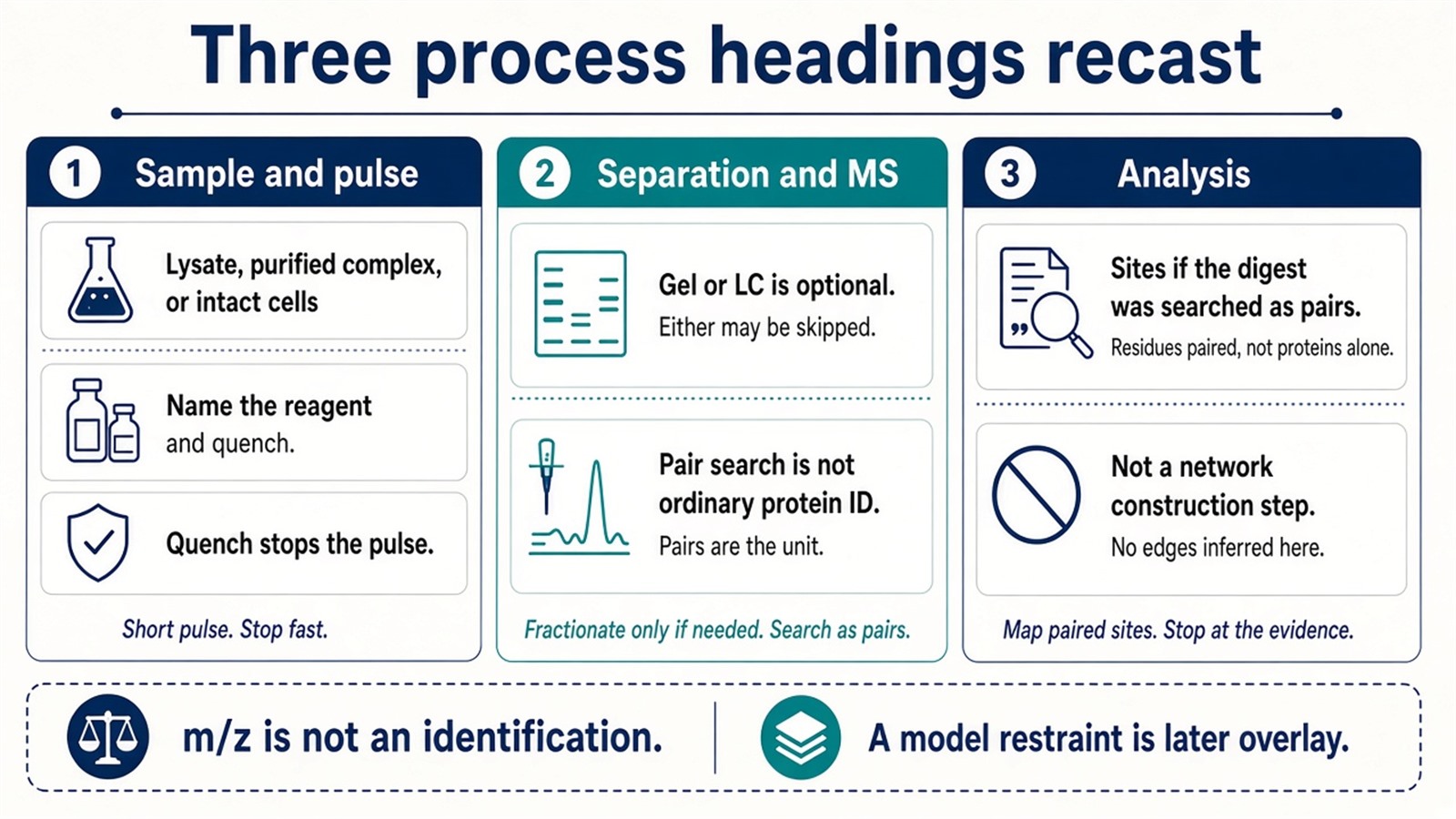
Figure 2. Sample and pulse, optional gel or LC, then a pair search if that is the claim. m/z is not an identification. A network is not step 3.
Advantages and Challenges, as Conditions
High sensitivity and high specificity are not properties of the method name. A residue-pair search can recover low-occupancy links that survive a digest. It can also miss accessible contacts whose peptides do not ionize. Complex lysates still carry background amines. Extensive purification is not automatically unnecessary.
Spatial information relative to affinity purification is the useful contrast. Affinity purification reports who co-enriched with a bait. Cross-linking can add residue-level proximity on the same or a different sample. It does not replace the bait pellet, and it does not grant a geometry that affinity methods cannot see as a class.
The original challenges remain. Pair identification needs a high-resolution instrument and software that scores linked peptides. Reaction conditions and reagent choice still decide whether the intended amines are marked. Those are experimental limits, not a call for interdisciplinary collaboration as a solution.
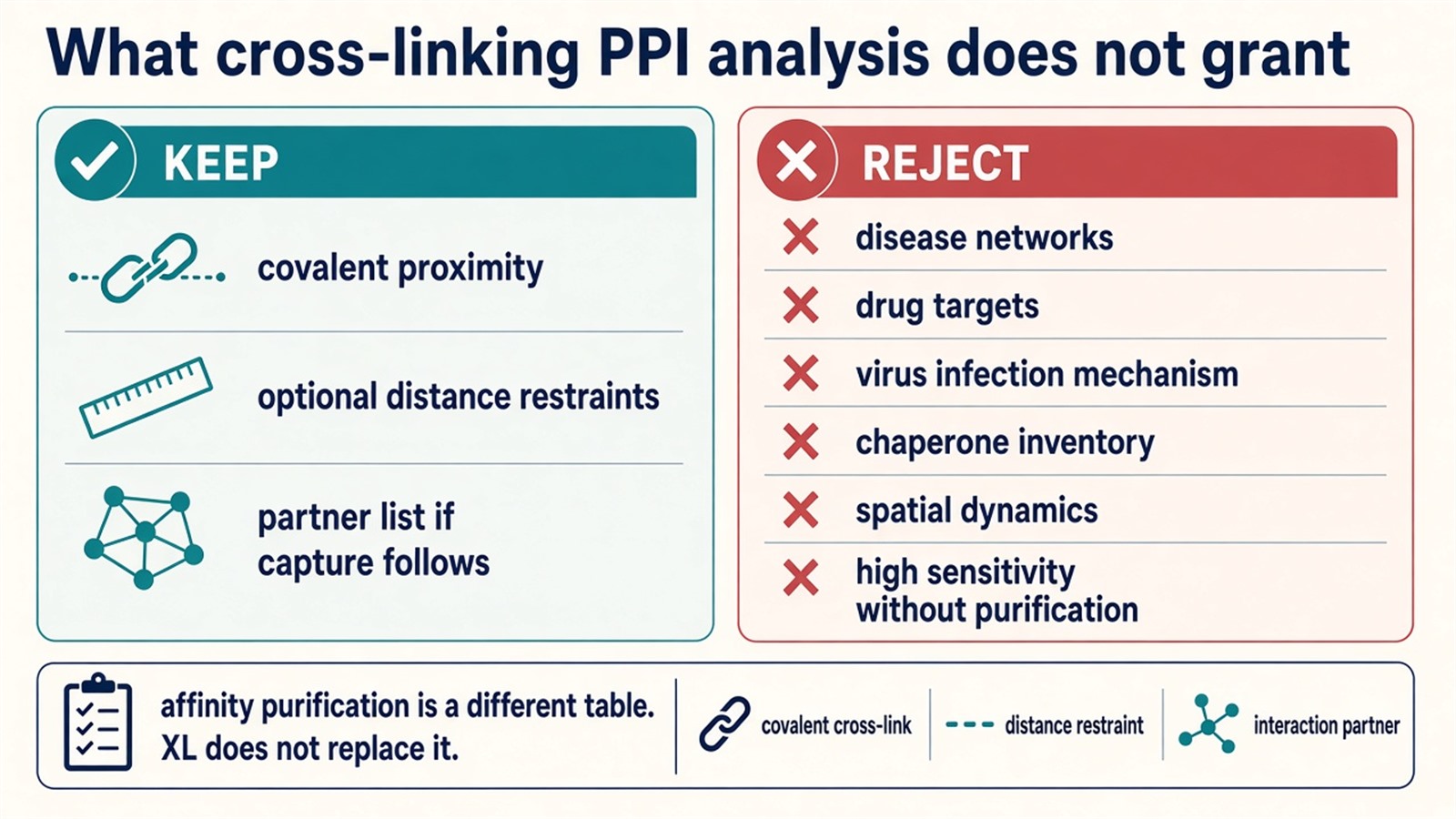
Figure 3. Keep: covalent proximity and optional restraints. Not granted: disease networks, drug targets, infection mechanisms, or spatial dynamics.
Experimental Limits
The analysis reduces a sample to one reagent, one quench, and one named table. Diagnostic language about biological systems, drug targets, or complete architectures sits outside ordinary research reporting unless a separately validated assay is in place.
Project Planning and Service Scope
A usable plan names the sample state, the reagent class, the quench, and the table that will be allowed, before the first pulse. MtoZ Biolabs scopes crosslinking MS with Orbitrap-class LC-MS/MS. Interpretability still follows those arms, not a network-and-drug-target slogan.
Once the next sentence is a cellular partner list without a residue-pair claim, the project should not be forced through this analysis name. Researchers who need that pellet can review the MtoZ Biolabs Protein-Protein Interaction Analysis Service for project-specific sample evaluation, feasibility assessment, and workflow planning.
Frequently Asked Questions
1. What does cross-linking protein-protein interaction analysis report?
A covalent pair that a named assay can read: a shift, a partner list, or a residue-pair table. It does not report a complete network.
2. Does the method reveal spatial structure and dynamics?
No. Pairs can constrain a model. They do not supply a structure or a time course.
3. Can it identify disease networks and drug targets?
No. Those are later biological claims. A cross-link is a chemical event.
4. Does gel electrophoresis separate cross-linked complexes from unlinked protein?
Not as a reliable split. A gel can enrich larger species. It is optional.
5. Is high sensitivity and specificity guaranteed in complex lysates?
No. Recovery depends on the reagent, the digest, and the search. Background amines remain.
Reference
- Leitner A., Walzthoeni T., Kahraman A., et al. (2014). Probing native protein structures by chemical cross-linking, mass spectrometry, and bioinformatics. Nat. Protoc., 9, 120-135. https://doi.org/10.1038/nprot.2013.168
- O'Reilly F.J., Rappsilber J. (2018). Cross-linking mass spectrometry: methods and applications in structural, molecular and systems biology. Nat. Struct. Mol. Biol., 25, 1000-1008. https://doi.org/10.1038/s41594-018-0147-0
- Yu C., Huang L. (2018). Cross-linking mass spectrometry: an emerging technology for interactomics and structural biology. Anal. Chem., 90, 144-165. https://doi.org/10.1021/acs.analchem.7b04431
- Sinz A. (2018). Cross-linking/mass spectrometry for studying protein structures and protein-protein interactions: where are we now and where should we go from here? Angew. Chem. Int. Ed., 57, 6390-6396. https://doi.org/10.1002/anie.201709559
- Merkley E.D., Rysavy S., Kahraman A., et al. (2014). Distance restraints from crosslinking mass spectrometry: mining a molecular dynamics database to evaluate lysine-lysine distances. Protein Sci., 23, 747-759. https://doi.org/10.1002/pro.2458
