



Co-Immunoprecipitation Pull-Down Assay
A co-immunoprecipitation (Co-IP) pull-down assay title names two capture chemistries, not one hybrid method. Co-IP uses an antibody to recover a bait and wash-surviving partners from a lysate (Kaboord and Perr 2008). A pull-down immobilizes a tagged or recombinant bait, often glutathione S-transferase (GST) or polyhistidine, and offers lysate or purified prey (Vikis and Guan 2004). Co-immunoprecipitation and pull-down assays name the same comparison. They do not name chromatin immunoprecipitation, a phospho-site Western blot, or a diagnostic autoantibody test. The valid result is the association evidence that the chosen capture can support. Antibody capture and tag capture are not interchangeable proofs.
Researchers who already have a defined bait, an immunoprecipitation-capable antibody, or a tagged construct can also review the MtoZ Biolabs Co-IP-MS Protein Interaction Analysis Service for project-specific feasibility and analysis planning.
What Each Capture Can Claim
Co-IP asks which proteins remain associated with an antibody-bound bait after wash. The bait is often endogenous. The claim is co-recovery in that lysate, not a kinetic constant and not a direct binary interface. Isotype immunoglobulin and bead-only incubations show reagent background.
A pull-down asks which proteins bind an immobilized bait under the buffer that was used. The bait concentration, tag, and folding are set by the experimenter. Empty-tag resin and bait-minus prey controls show whether a hit needs the fused domain. Direct or reconstituted binding is a stronger default claim than in Co-IP only when the prey is a purified protein. A lysate pull-down can still recover indirect partners.
Neither assay measures phosphorylation as its primary output. A phospho-specific blot can be run on an elution. That blot is a modification readout, not a reason to rename the capture. Neither assay becomes a serum diagnostic for autoantibodies.
Researchers who need the antibody-capture definition before comparing it with a pull-down can refer to What Is Co-Immunoprecipitation (Co-IP)? for more detailed guidance.
Co-IP and pull-down differ by how the bait is held, not by a shared clinical or pathway certificate.
How the Two Assays Are Set Up
Both start from a non-denaturing mixture and end in Western blot or liquid chromatography-tandem mass spectrometry (LC-MS/MS). The handle differs. Co-IP adds an immunoprecipitation-capable antibody, then Protein A or Protein G beads. Pull-down binds the tag to glutathione, nickel, or an equivalent ligand, then incubates prey. Washes set which contacts survive. Harsh salt or detergent favors stable pairs and loses weak contacts in both formats.
Antibody quality dominates Co-IP. Western-blot reactivity does not guarantee immunoprecipitation performance. An epitope on the partner interface can block the contact. Tag choice dominates pull-down. GST can dimerize. Histidine tags can bind metal-sticky proteins. The tag can occlude a surface or create a new one. Testing more than one tag or orientation is a planning step, not proof that the untagged protein uses the same partners.
Design |
Bait handle |
Typical question |
Default limit |
|---|---|---|---|
Co-IP |
Antibody to endogenous or tagged bait |
Which proteins co-recover with the cellular bait |
Antibody background; indirect partners |
Pull-down |
Immobilized recombinant or tagged bait |
Can this defined bait bind a prey |
Non-native concentration and fold |
Empty IgG or bead Co-IP |
Reagent only |
What binds antibody or resin |
Not a substitute for a second method |
Empty-tag pull-down |
Tag without the fused domain |
What binds the tag or ligand |
Not a cellular neighborhood map |
Co-IP-MS or pull-down-MS |
Same handles plus LC-MS/MS |
Open candidate list after controls |
Contaminant-dominated degree |
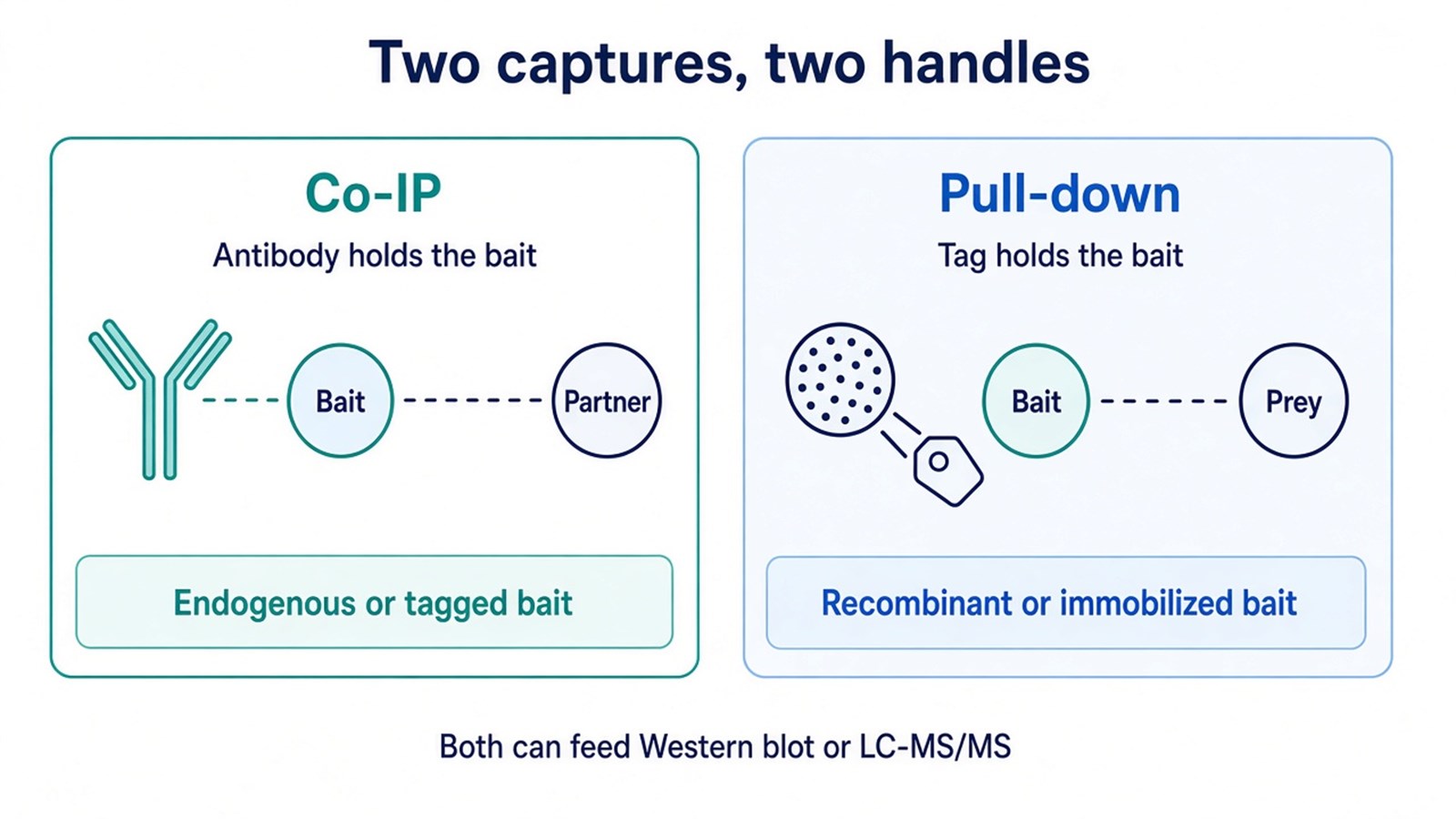
Figure 1. Co-IP holds the bait with an antibody; a pull-down holds a tagged or recombinant bait on affinity resin.
When Co-IP or Pull-Down Fits
Co-IP fits when an immunoprecipitation-capable antibody exists and the paper needs the bait in its cellular expression context. A closed pair with a prey antibody can stop at blot. An open list fits Co-IP-MS after IgG and bead controls.
Pull-down fits when a well-behaved recombinant or tagged bait is available and the paper needs a controlled binding test, a domain or mutant comparison, or a screen that does not depend on a bait-specific antibody. A purified prey supports a more direct-binding sentence than a whole-lysate elution.
Sequence the two assays when both claims matter. Co-IP can nominate physiological candidates. A pull-down can then test whether a defined construct still binds a prioritized prey. The reverse order also works when no antibody exists yet and an endogenous confirmation is planned later.
Reassess both captures when the needed claim is an interface map, a sensor Kd, or protein-DNA occupancy. Cross-linking mass spectrometry, surface plasmon resonance, and chromatin immunoprecipitation answer those questions. Reassess Co-IP when tagging a systematic mutant series is easier than antibody screening. Affinity purification-mass spectrometry (AP-MS) then becomes the closer tagged-cell route.
When the remaining decision is endogenous antibody capture versus a tagged recombinant bait, researchers can refer to Endogenous IP-MS vs Tagged Pull-Down MS Strategies for a more detailed strategy-selection framework.
In MtoZ Biolabs Co-IP-MS offerings, antibody capture and tagged-bait pull-down are typically treated as alternative enrichment routes into LC-MS/MS, each with its own empty-reagent control. Service configuration is not an academic rule that other laboratories must copy, and it does not include a diagnostic or GMP release intended use.
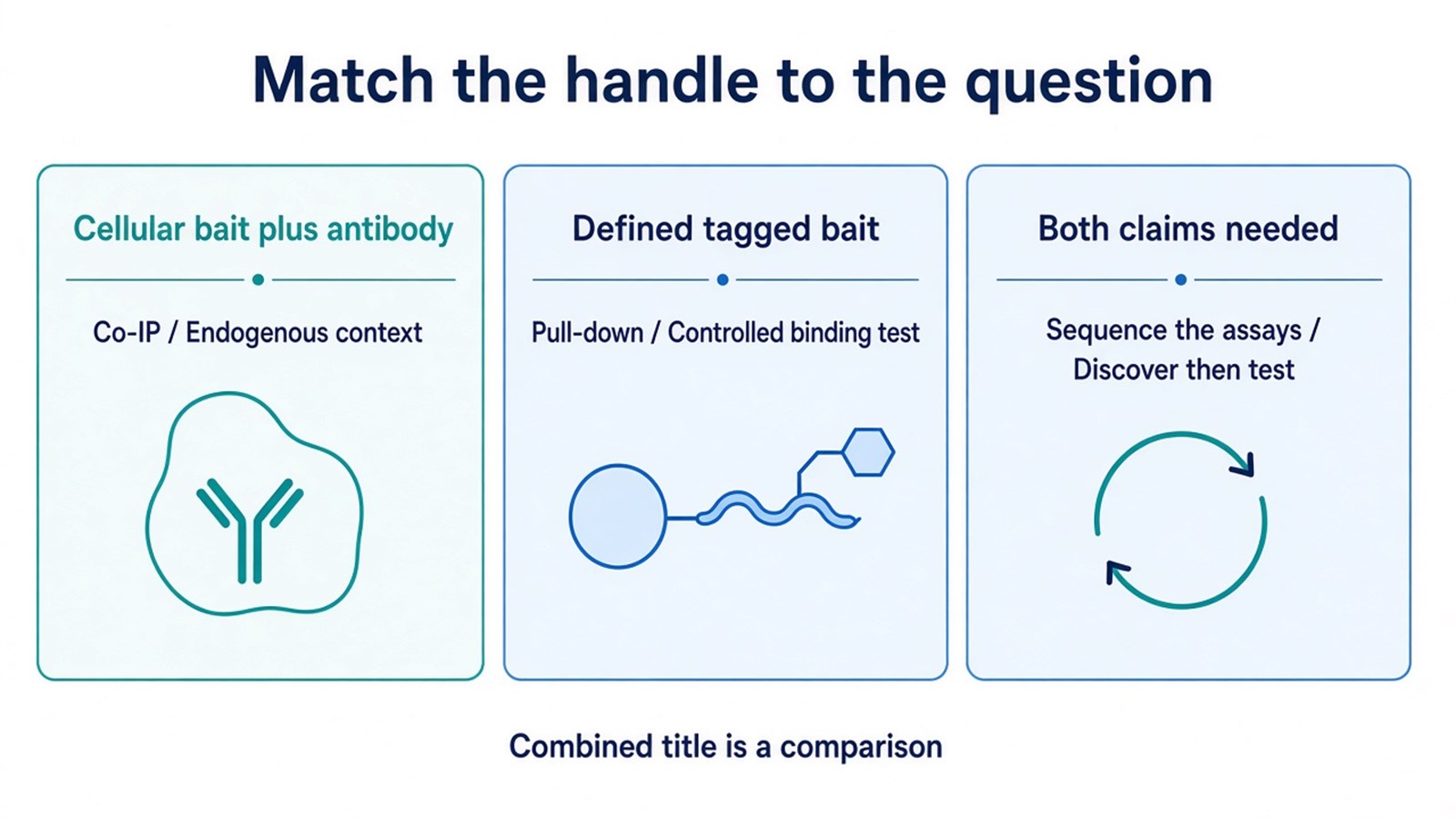
Figure 2. Choose Co-IP when the antibody and cellular context matter; choose pull-down for a controlled bait; use both when discovery and binding tests are separate claims.
The hyphenated assay name does not merge antibody capture and tag capture into one proof.
How Combined Results Should Be Read
Read the handle before the biology sentence. A Co-IP prey that fails a pull-down may need cellular cofactors. A pull-down prey that fails Co-IP may bind only the overexpressed or tagged construct. Agreement across handles raises confidence. Disagreement is data, not a reason to discard one elution without checking bait recovery.
Input, flow-through, and bound fractions show whether the bait was captured and whether the prey was depleted. A hit present in the empty-IgG or empty-tag lane is not bait-specific. Pathway or cancer-network language added after either elution is annotation. It does not convert the capture into a treatment or diagnostic map.
Frequently Asked Questions
1. Is a Co-IP pull-down assay a single method?
No. Co-IP is antibody capture. Pull-down is immobilized-bait capture. The combined title is a comparison, not a hybrid chemistry.
2. Which assay is better for transient interactions?
Neither is reliable for weak contacts by default. Both lose partners in harsh washes. Cross-linking or proximity labeling is the usual reassessment when transience is the claim.
3. Can a pull-down replace Co-IP if no antibody exists?
It can test binding of a defined construct. It does not report the untagged cellular neighborhood that Co-IP would have asked.
4. Does either assay detect autoantibodies in patient serum as a diagnostic test?
No. A research elution is not a locked diagnostic intended use.
Once the bait handle, controls, and Western versus MS endpoint are defined, the project can be evaluated as a Co-IP study, a pull-down study, or a sequenced pair. Researchers can review the MtoZ Biolabs Co-IP-MS Protein Interaction Analysis Service for project-specific sample evaluation, feasibility assessment, and workflow planning.
