



Astral DIA is a data-independent acquisition (DIA) quantitative proteomics route implemented on the Orbitrap Astral platform for unlabeled, independently injected digests. DIA fragments precursors in scheduled m/z windows and extracts fragment-ion chromatograms, which can improve matrix completeness relative to intensity-triggered data-dependent acquisition (DDA) in larger cohorts. SWATH-MS is one historically influential DIA implementation that uses sequential precursor windows and targeted extraction from spectral libraries; it is a member of the DIA family, not a separate labeling chemistry, and it is not a synonym for Astral. Astral DIA is therefore best read as a platform-specific DIA workflow for relative discovery when coverage completeness and run-to-run consistency matter. It does not create calibrated absolute protein concentrations by itself.
Researchers who already have defined samples, comparison groups, or a specific project objective can also review the MtoZ Biolabs Deep DIA Proteomics Service for project-specific feasibility and analysis planning.
What Astral DIA Combines: Platform, Acquisition, and Claim
Three layers must stay separate. The Orbitrap Astral instrument is the analyzer platform. DIA is the acquisition schedule that isolates and fragments ions in predefined windows rather than only the currently most intense precursors. The scientific claim remains relative protein change across samples that share one coherent chromatographic and processing plan. Narrow-window DIA on Astral-class analyzers has been shown to support fast, deep label-free proteome coverage under published method conditions (Guzman et al. 2024). Those literature results describe what the acquisition architecture can enable. They are not automatic guarantees for every sample matrix, gradient, or library strategy.
In MtoZ unlabeled discovery offerings, switching an unlabeled digest from DDA-based MS1 peak-area LFQ to DIA is an acquisition decision when completeness, not labeling chemistry, is the limiting need. Service configuration is not an academic rule that other laboratories must copy.
How DIA Differs from DDA in Practice
DDA selects precursors in real time for fragmentation. Stochastic sampling is a major source of missing values in unlabeled DDA matrices, especially at low abundance. DIA cycles through scheduled windows so that fragment evidence is recorded for ions across the precursor range in every cycle, enabling later extraction of peptide transitions even when a precursor was not chosen as a top peak (Gillet et al. 2012). The quantitative object in many modern DIA workflows is a fragment-ion chromatogram, not only an MS1 peak area.
DIA does not remove interference. Co-isolated peptides inside a window still contribute fragments. Narrower windows can reduce mixing but consume more cycle time or demand higher MS/MS speed and sensitivity. Wider windows increase multiplexing and can raise chimeric spectra. Window scheme, cycle time, and chromatography therefore belong in the methods record with the protein table.
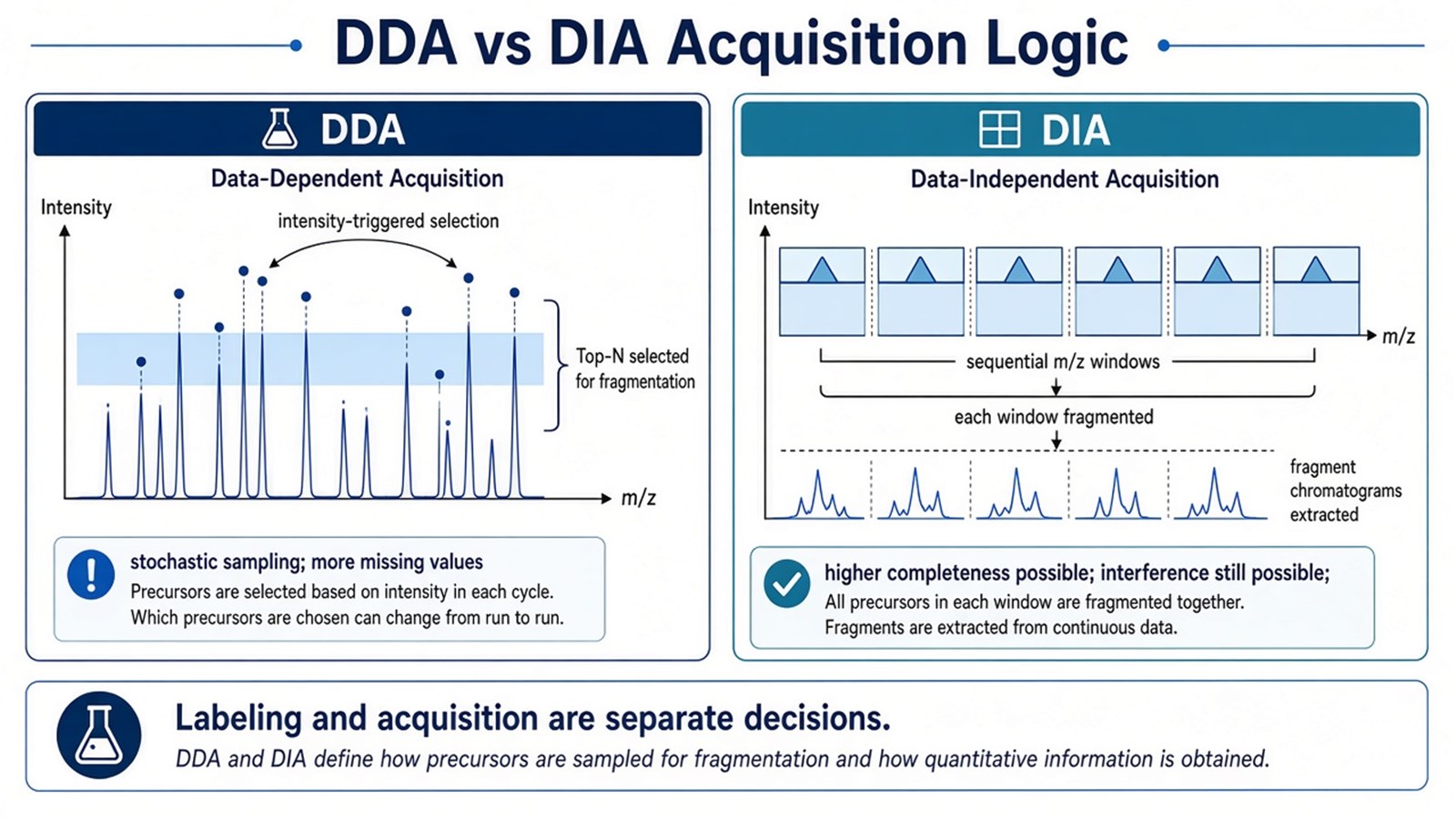
Figure 1. DDA fragments intensity-selected precursors; DIA fragments scheduled m/z windows and extracts fragment chromatograms, which can improve completeness while leaving window interference possible.
DIA is an acquisition class. It is not proof that labels were unused, and it is not defined by any single vendor platform.
Where SWATH Fits Inside the DIA Family
SWATH-MS (sequential window acquisition of all theoretical fragment ion spectra) is a DIA design that repeatedly cycles through consecutive precursor isolation windows and recovers peptide quantities by targeted extraction against a spectral library (Gillet et al. 2012). Library quality, retention-time calibration, and false discovery control strongly affect which peptides can be quantified. Library-free or direct-DIA search strategies are alternative analysis routes inside the broader DIA family. Naming SWATH does not specify the instrument, the window width, or whether the digest was labeled.
Astral DIA should not be rewritten as “SWATH on Astral.” Astral methods may use narrow isolation windows and high MS/MS rates to pursue deep unlabeled coverage (Guzman et al. 2024). SWATH names a windowed DIA logic and an extraction tradition. The useful comparison for project planning is whether the study needs DIA-style completeness at all, then which platform and analysis package can support the declared windowing and library plan.
Researchers who need a SWATH-centered workflow walkthrough can refer to Principles and Workflow of DIA Proteomics: A Case Study of SWATH-MS for acquisition and library-extraction concepts that still apply as DIA judgment criteria.
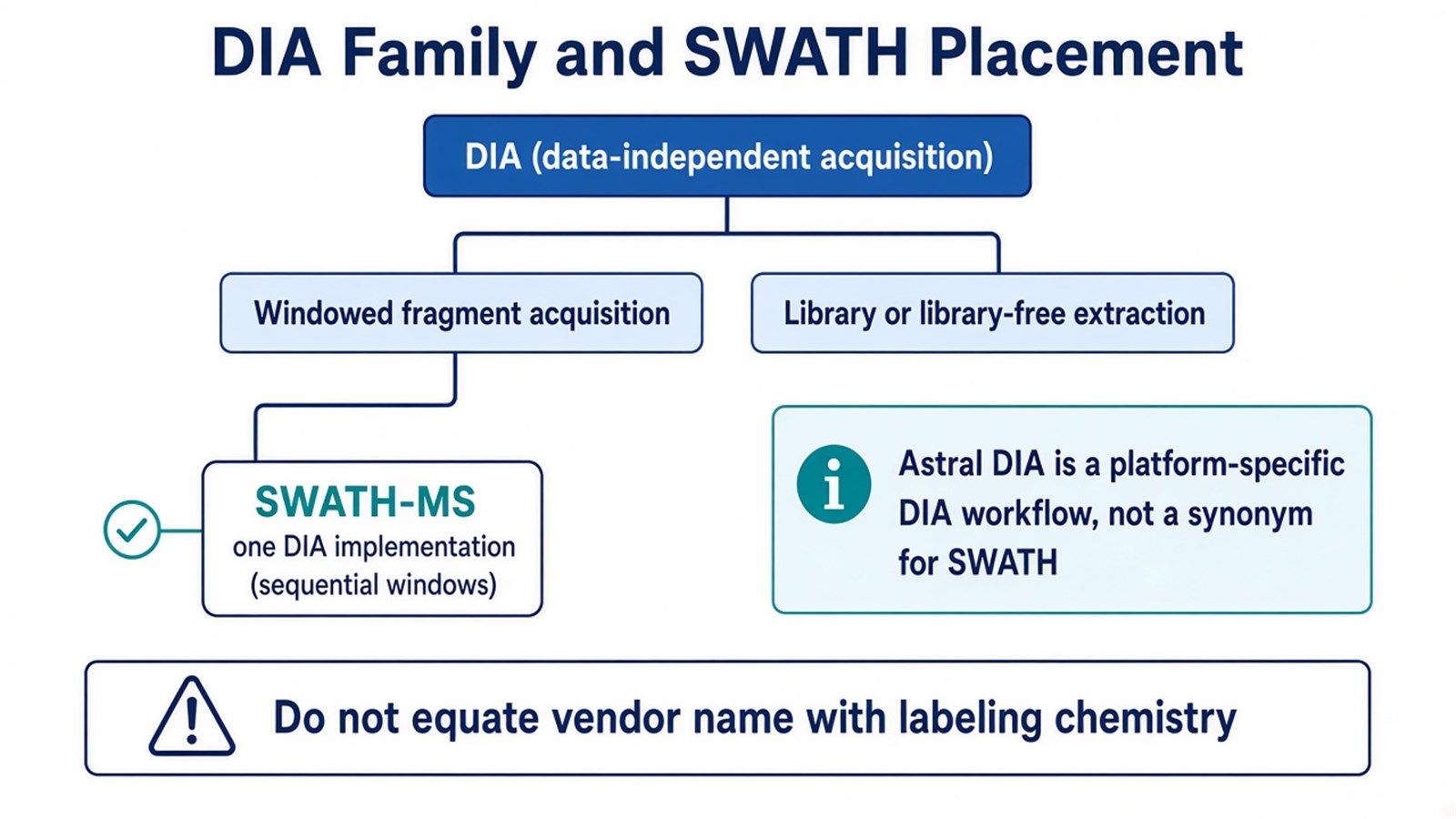
Figure 2. SWATH-MS is one DIA implementation; Astral DIA is a platform-specific DIA workflow and should not be treated as a SWATH synonym or as a labeling method.
Judgment Criteria: When Astral DIA or Other Unlabeled DIA Fits
Unlabeled DIA, including Astral DIA on compatible methods, is often useful when:
Study need |
DIA / Astral DIA often fits |
Reassess before committing |
|---|---|---|
Comparison structure |
Relative change across independently injected samples |
Absolute amount without matched standards |
Matrix completeness |
Larger cohorts where DDA missingness limits statistics |
Very small pilots where DDA depth is already sufficient |
Sample chemistry |
Digests that should stay unlabeled |
Closed multiplex contrasts that require isobaric labeling |
Analysis plan |
Library or library-free strategy can be declared and controlled |
No plan for FDR, alignment, or batch structure |
Follow-up |
Discovery matrix that may later feed a short targeted list |
Immediate need for a frozen peptide panel only |
Astral-class speed and sensitivity matter most when the design already needs DIA completeness and the laboratory can keep chromatography, injection order, and processing software consistent. Platform speed does not repair confounded groups, failed digestion, or undeclared batch effects.
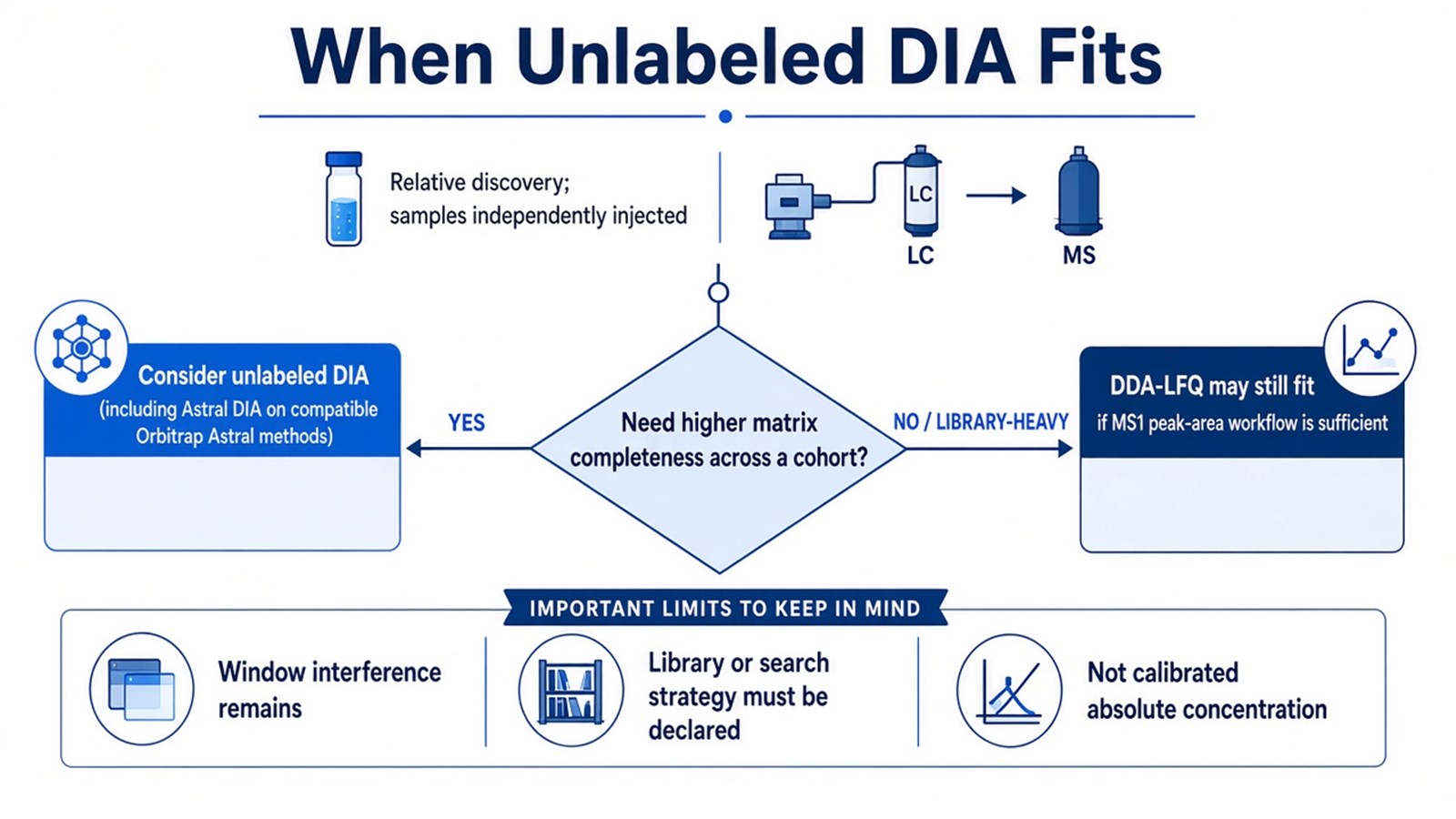
Figure 3. Prefer unlabeled DIA when relative discovery needs higher matrix completeness; keep DDA-LFQ when an MS1 peak-area plan is already sufficient for the claim.
Limits and Application Boundaries
Technical limits that remain after choosing DIA
Window interference, chimeric spectra, and incorrect transition assignment can still bias quantities. Very low-abundance peptides may remain hard to extract cleanly. Cross-batch DIA still needs bridging or careful normalization if acquisition periods differ. Reporting protein counts without window width, cycle time, library provenance, and FDR rules overstates comparability between studies.
Application contexts where DIA is commonly used
Unlabeled DIA is frequently applied to treatment screens, tissue-state comparisons, biomarker discovery cohorts, and multi-condition studies that need a more complete protein matrix than stochastic DDA sampling provides. Those applications still produce relative values. Pathway enrichment on a DIA candidate list reflects overrepresentation relative to a quantified background. It does not prove pathway activity. Diagnostic cutoffs and clinical decision rules sit outside ordinary discovery DIA claims.
For a broader unlabeled DIA methods overview beyond the Astral platform framing, researchers can also review Label-Free DIA Quantitative Proteomics.
Practical Workflow Elements Without Inflating Performance Claims
A workable Astral DIA project still follows a standard unlabeled path: matched protein input, digestion, liquid chromatography, DIA acquisition on the Astral platform, peptide and protein inference with a declared search or library strategy, normalization, and differential review. Automation, UHPLC coupling, and cloud visualization can improve operational consistency. They do not replace design controls. Exact identification depth, daily sample throughput, and detection limits depend on matrix, load, gradient, and analysis settings, and should be evaluated project by project rather than treated as fixed service constants.
Once the contrast, unlabeled constraint, and need for DIA-style completeness are defined, the project can be evaluated as an Astral DIA study with an explicit windowing and analysis plan. Researchers can review the MtoZ Biolabs Deep DIA Proteomics Service for sample evaluation, feasibility assessment, and workflow planning.
Frequently Asked Questions
1. Is Astral DIA the same method as SWATH?
No. Both belong to the DIA acquisition family. SWATH-MS refers to sequential-window DIA with targeted library extraction as classically described (Gillet et al. 2012). Astral DIA refers to DIA workflows on the Orbitrap Astral platform, often using narrow windows and high MS/MS rates (Guzman et al. 2024).
2. Does choosing DIA mean the experiment is label-free?
No. DIA names how fragmentation is scheduled. Unlabeled digests are commonly acquired as DIA in discovery work, but labeling and acquisition remain separate decisions.
3. Can Astral DIA replace TMT for every multi-sample study?
No. TMT is a labeling and multiplexing choice, typically read in DDA for reporter ions in many service settings. Astral DIA is an unlabeled independent-injection acquisition route. Choose based on whether samples must share one plex or remain separate runs.
4. Does DIA remove missing values completely?
No. DIA can reduce missingness relative to stochastic DDA sampling, but low signal, interference, and extraction failures still create missing cells. Completeness should be reviewed as a QC metric, not assumed.
5. Are DIA intensities absolute protein amounts?
No. Ordinary DIA quantities support relative comparison under a declared processing plan. Absolute concentration or copy-number claims need matched standards and a calibration model.
Reference
- L.C. Gillet, P. Navarro, S. Tate, H. Rost, N. Selevsek, L. Reiter, R. Bonner, R. Aebersold (2012). Targeted data extraction of the MS/MS spectra generated by data-independent acquisition: a new concept for consistent and accurate proteome analysis. Mol. Cell. Proteomics, 11, O111.016717. https://doi.org/10.1074/mcp.O111.016717
- U.H. Guzman, H. Martinez-Val, Z. Ye, E. Damoc, T.N. Arrey, A. Pashkova, E. Renuse, E. Denisov, J. Petzoldt, A.C. Peterson, E. Harking, O. Ostergaard, R. Rydbirk, S. Aznar, H. Stewart, Y. Xuan, D. Hermanson, S. Ryabokon, I. Hoi, M. Rasmussen, A. Madsen, J.V. Olsen (2024). Ultra-fast label-free quantification and comprehensive proteome coverage with narrow-window data-independent acquisition. Nat. Biotechnol. https://doi.org/10.1038/s41587-023-02099-7
