



Ligand-receptor analysis is a binding claim for a named ligand and a named receptor. It is not a crucial technique, and it is not one method. A ligand can be a small molecule, a peptide, or another protein. A receptor can be a membrane protein, a nuclear receptor, or a soluble receptor ectodomain. Predominant transmembrane location is a catalog remark, not a definition. Binding of that pair can be tested. It does not form the foundation of cellular communication, and it does not screen efficient and safe drug candidates.
Hormones, neurotransmitters, and drugs remain allowable study backgrounds. They do not make the analysis vital for signal-pathway investigation or disease-mechanism exploration. Researchers who already have a receptor construct and a ligand and need a project-matched binding format can review the MtoZ Biolabs Ligand Receptor Analysis Service for feasibility and format planning.
A Receptor Claim Is Not a Protein–Ligand File List
A protein–ligand interaction profile lists which files will be written for a pair: a sensorgram, a thermogram, a docked pose, or a Förster resonance energy transfer (FRET) trace. This page asks a narrower question: is the protein being treated as a receptor, and which physical event will support that sentence. For the four-file inventory, Protein Ligand Interaction Profile is the complementary profile page.
Single-cell ligand–receptor analysis is a different experiment. An inferred pair from transcript counts is not a binding file. Expression of a ligand and a receptor in neighboring cells does not report occupancy, affinity, or a site.
Native mass spectrometry (native MS) can sit next to this claim as an intact-mass occupancy file when the complex survives ionization. It is not the default service for ligand-receptor analysis, and it does not replace a kinetic or a cell-based occupancy assay.
Sample Preparation Is a Construct Choice
The original extraction sentence overreaches. Ligand-receptor analysis does not typically extract both partners from cells, tissues, or whole organisms. The receptor is often a recombinant ectodomain, a membrane vesicle, a solubilized receptor, or a cell that still displays the receptor. The ligand is often synthetic or recombinant. Purity and a functional check matter for the format that will be run. They do not directly determine the accuracy of the results.
Affinity chromatography and gel filtration can polish a soluble construct. They do not maintain structural and functional integrity as a general extraction program, and a detergent-solubilized membrane receptor is not a gel-filtration product in the same sense as a globular ligand. A membrane protein still has to name the lipid or detergent system that will be allowed on the instrument.
Binding Analysis Writes One File, Not a Site and a Pathway
Mass spectrometry, FRET, and surface plasmon resonance (SPR) remain usable names if each is read as a different file. They do not, as a set, assess binding properties or provide affinity, kinetics, and precise binding sites.
SPR can record association and dissociation of an immobilized receptor or ligand. Real-time means the sensorgram is collected during the injection. Dynamic data on molecular interactions is a later reading of that curve. FRET reports energy transfer between two labels. Mass spectrometry reports a mass, a selected ligand, or a covalent peptide, depending on the first event. None of those files is a precise binding site unless a separately validated structure or a localized adduct is already named.
For which physical event each detector is allowed to write, How to Detect Protein and Small Molecule Interactions is the complementary method-choice page. This page does not absorb that chooser.
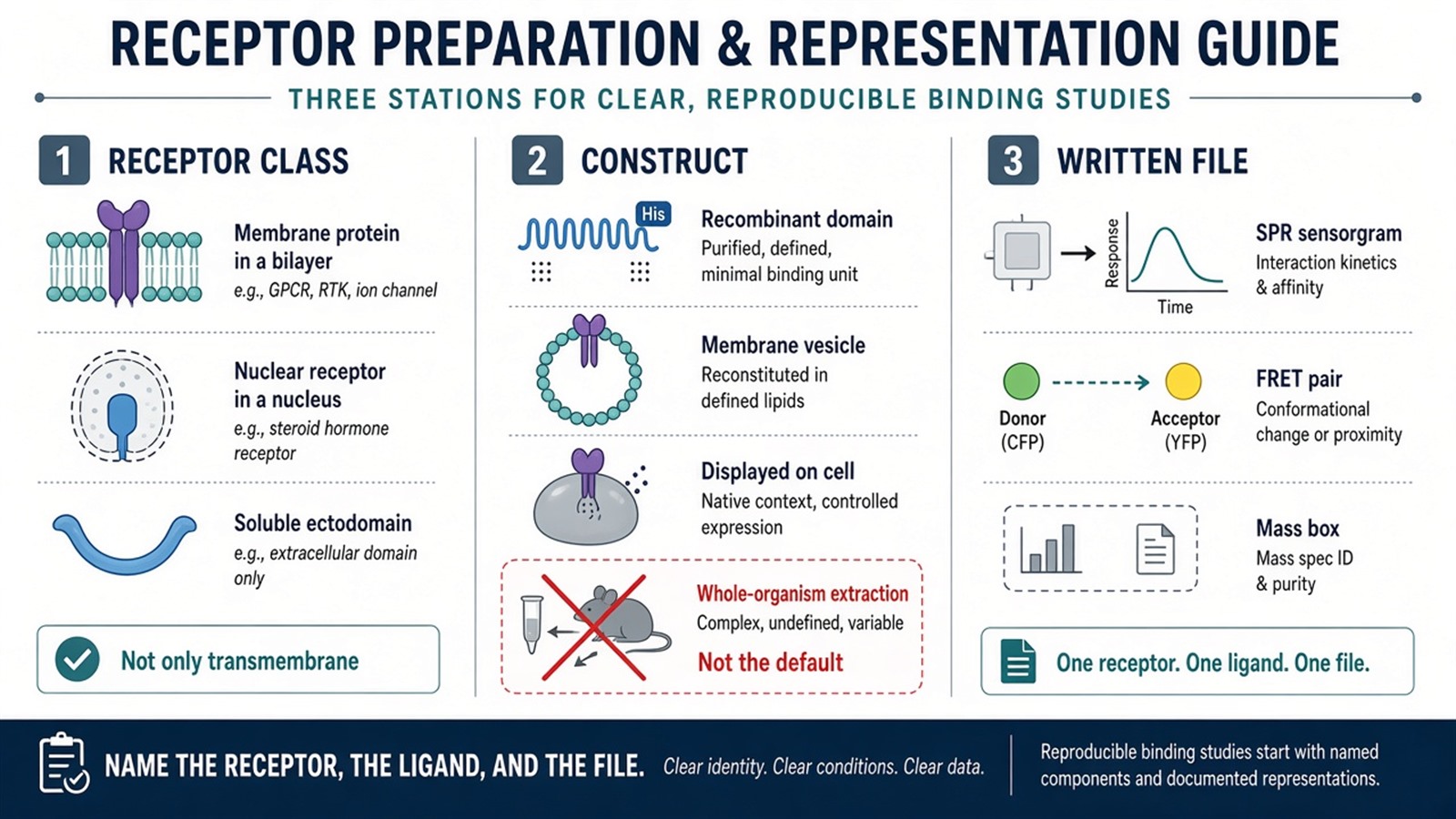
Figure 1. Name the receptor class and the construct. Then name the file: a sensorgram, a label trace, or a mass. Extraction from an organism is not the default first step.
Write the receptor, the ligand, and the file before any sentence that the analysis validated a drug target.
Advantages Do Not Attach to the Heading
High sensitivity at low concentration is a property of a written assay window, not of ligand-receptor analysis. High specificity that differentiates selective binding of various ligands is a comparison design across ligands or receptor subtypes. It is not granted by running one pair. Real-time kinetic data belong to formats that record a time course, chiefly SPR or a related optical biosensor. They are not crucial for understanding detailed mechanisms of molecular binding, and they do not make the heading an invaluable tool.
Purity and stability requirements are real for SPR and calorimetry. Those requirements do not, by themselves, create non-physiological conditions. An in-vitro file is an in-vitro file. Complex molecular interactions that fail to reproduce in a tube were not supposed to be granted by the heading. Complementary methods produce complementary files. They do not restore a physiological environment.
Proliferation, differentiation, and apoptosis remain later cell readouts. A binding file does not mediate intracellular responses. Abnormal signaling, diagnosis, and treatment are later claims.
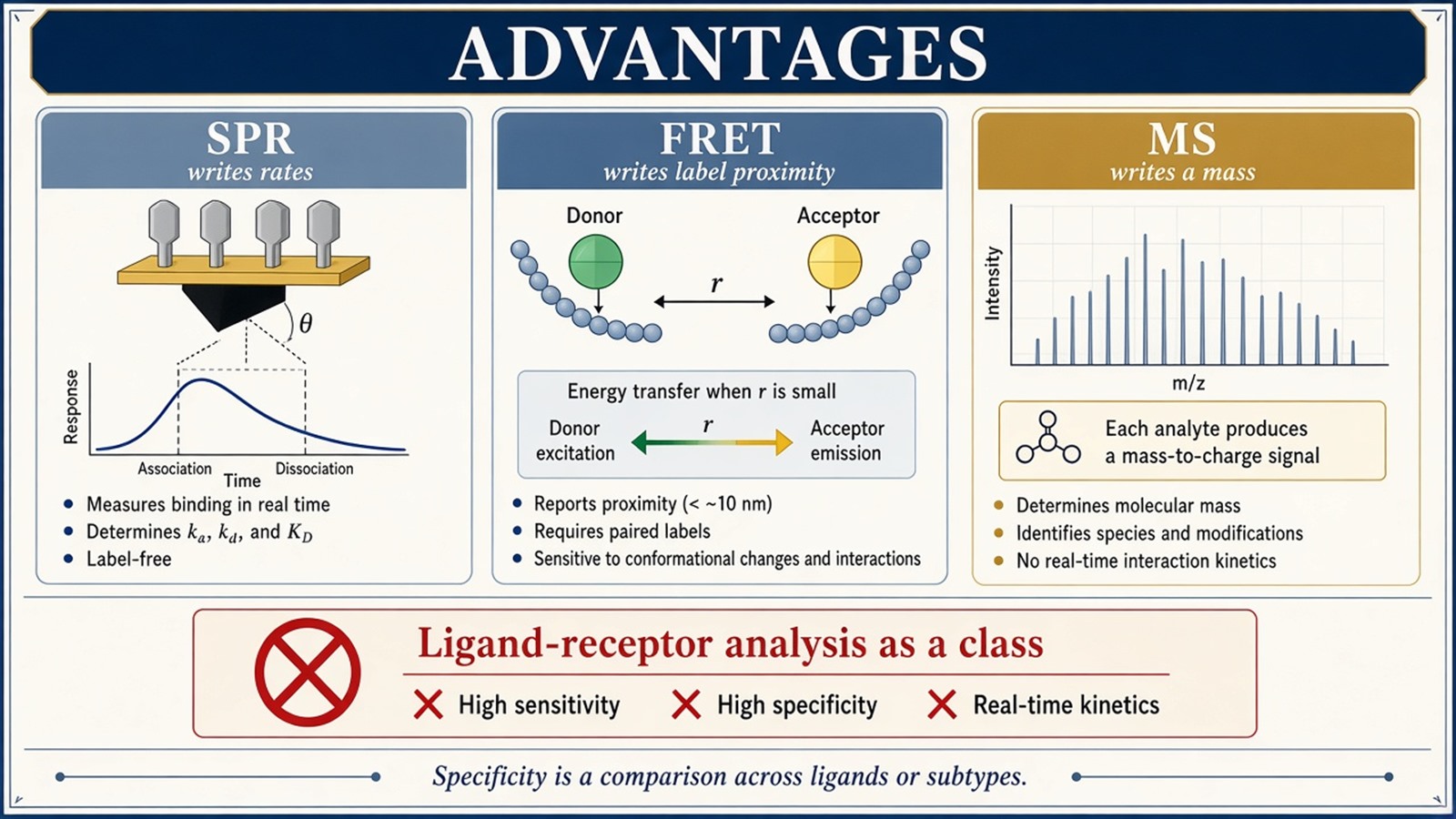
Figure 2. SPR can write rates. FRET can write label proximity. MS can write a mass. None of those attributes is an advantage of ligand-receptor analysis as a class.
Experimental Limits
This page reduces ligand-receptor analysis to one named pair and one named file. Screening candidates that are both efficient and safe, uncovering disease causes, and advancing biotechnology sit outside ordinary research reporting unless a separately validated phenotype is already named. A Native MS slogan at the foot of this page misnames the next experiment when the question is a receptor occupancy or a sensorgram.
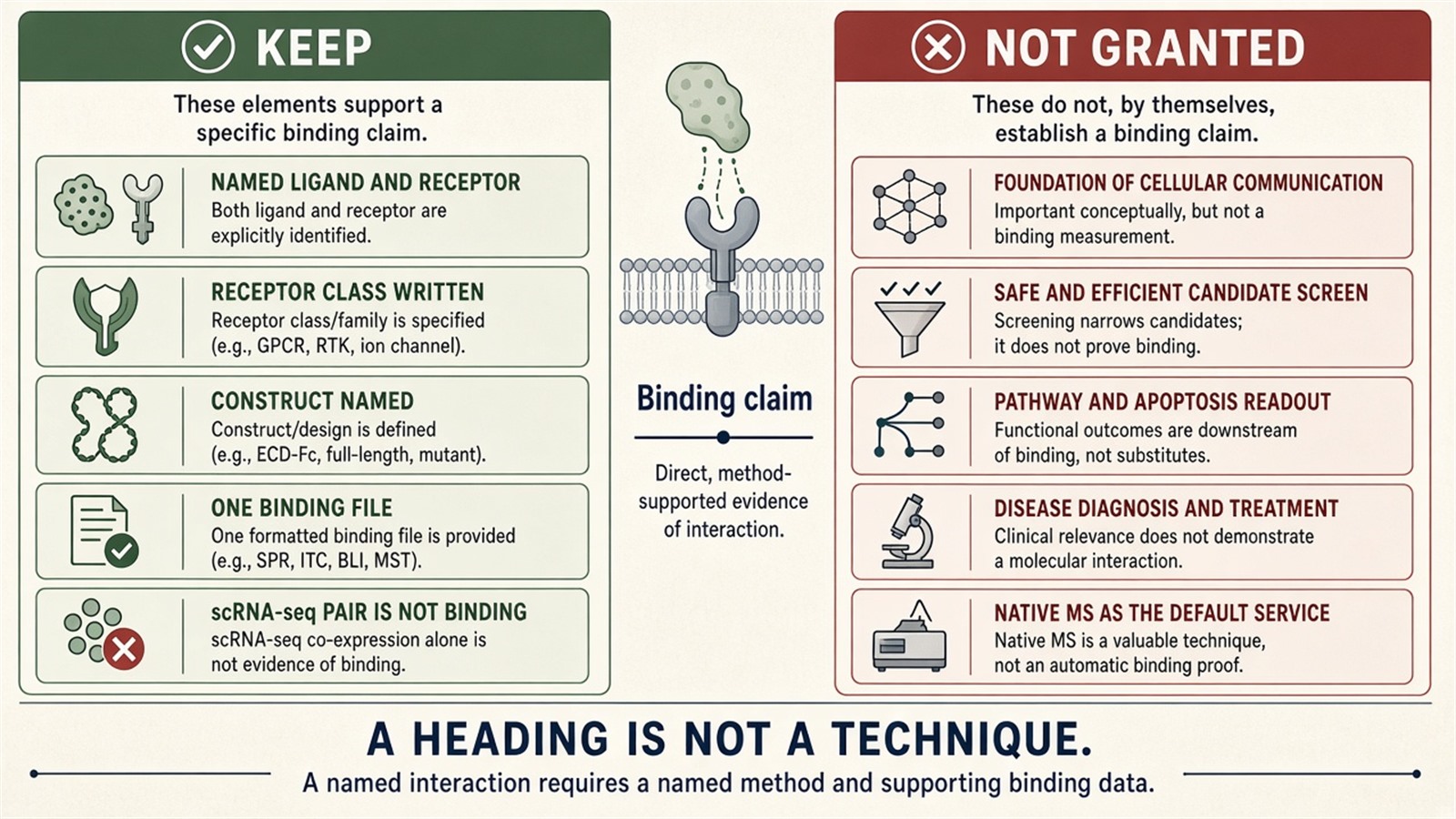
Figure 3. Keep: a named receptor, a named ligand, and a written file. Not granted: foundation of communication, safe-candidate screening, scRNA-seq pairs as binding, or Native MS as the related service by default.
Project Planning and Service Scope
A usable request names the receptor class (membrane, nuclear, or soluble), the construct, whether a cell, a vesicle, or a purified protein will be used, and which number would be allowed after a positive result. MtoZ Biolabs scopes receptor-binding arms on SPR, ligand-binding, or mass-spectrometry formats when those arms match the written question. Interpretability still follows that arm, not a high-sensitivity heading.
Once the next sentence is a receptor ligand-binding assay rather than a heading, this claim page should hand off. Researchers who need that assay file can review the MtoZ Biolabs Receptor Ligand Binding Assay Service for project-specific sample evaluation, feasibility assessment, and workflow planning.
Frequently Asked Questions
1. Is ligand-receptor analysis one technique?
No. It is a binding claim. The file still has to be named.
2. Are receptors predominantly transmembrane proteins?
Many are. Nuclear and soluble receptors are still receptors on this page.
3. Does the workflow start by extracting both partners from an organism?
Not as a default. The receptor is often a construct. The ligand is often synthetic.
4. Do MS, FRET, and SPR provide sites as well as affinity?
SPR can write rates. FRET can write label proximity. A site is a later file.
5. Is Native MS the related service for this heading?
Only when the next sentence is an intact-mass occupancy. A sensorgram or a cell occupancy is a different arm.
Reference
- Hulme E.C., Trevethick M.A. (2010). Ligand binding assays at equilibrium: validation and interpretation. Br. J. Pharmacol., 161, 1219-1237. https://doi.org/10.1111/j.1476-5381.2010.00831.x
- Renaud J.P., Chung C.W., Danielson U.H., et al. (2016). Biophysics in drug discovery: impact, challenges and opportunities. Nat. Rev. Drug Discov., 15, 679-698. https://doi.org/10.1038/nrd.2016.123
- Rosenbaum D.M., Rasmussen S.G.F., Kobilka B.K. (2009). The structure and function of G-protein-coupled receptors. Nature, 459, 356-363. https://doi.org/10.1038/nature08144
- Rich R.L., Myszka D.G. (2000). Advances in surface plasmon resonance biosensor analysis. Curr. Opin. Biotechnol., 11, 54-61. https://doi.org/10.1016/S0958-1669(99)00054-3
