



A protein–ligand interaction profile is a written set of files for a named protein and a named ligand. The original technique list remains usable if each item is read as one file: a surface plasmon resonance (SPR) sensorgram, an isothermal titration calorimetry (ITC) thermogram, a docked pose, or a Förster resonance energy transfer (FRET) trace. Those files can report rates, heat, a predicted geometry, or label proximity. They do not study relationships in biological systems, and they do not reveal binding modes, affinities, and mechanisms of action as one analysis.
A ligand on this page is the partner named in the request. Small molecules and ions fit the four-file list as written. A nucleic acid or another protein can also be called a ligand in some laboratories. That partner still needs its own format. Signal transduction, metabolic control, and gene-expression sentences remain study backgrounds. They are not outputs of the profile. Researchers who already have a purified protein and a compound and need a measured binding file can review the MtoZ Biolabs Protein Ligand Binding Assay Service for project-specific format matching.
Four Files, Not One Decoder
Surface plasmon resonance
SPR can report association and dissociation rates for an immobilized partner under a written flow. Affinity is then a fitted equilibrium from those rates or from a steady-state series. Real-time means the sensorgram is recorded during the injection. It does not make SPR well-suited for high-throughput screening or drug discovery. A small ligand produces a small response. Immobilization and residual solvent remain part of the file.
Isothermal titration calorimetry
ITC records heat absorbed or released as one partner is titrated into the other. The integral of that heat is an enthalpy (ΔH) under the cell conditions. A dissociation constant and a stoichiometry can be fitted when the c-value sits in a usable window. Free energy (ΔG) is calculated from that constant. It is not a second independent heat. Thermodynamic mechanisms behind molecular interactions are a later interpretation, not a granted ITC output.
Molecular docking
Docking places a ligand into a receptor coordinate set under a scoring function. The output is a predicted pose and a score. It is not the three-dimensional structure of the complex, and the score is not an estimated affinity. Speed does not make docking a vital tool in drug design or virtual screening. A later crystallographic or cryo-electron microscopy model is a different file.
Förster resonance energy transfer
FRET reports energy transfer between two fluorophores. Intensity or lifetime changes can support a proximity of those labels during a binding experiment. Real-time observation of the interaction, and multiplex analysis, are not granted by attaching probes. A labeled ligand is not the unlabeled compound.
Mass spectrometry can sit next to this list as an occupancy or peptide file. It is not a fifth profile technique on this page. For which physical event each detector is allowed to write, How to Detect Protein and Small Molecule Interactions is the complementary method-choice page.
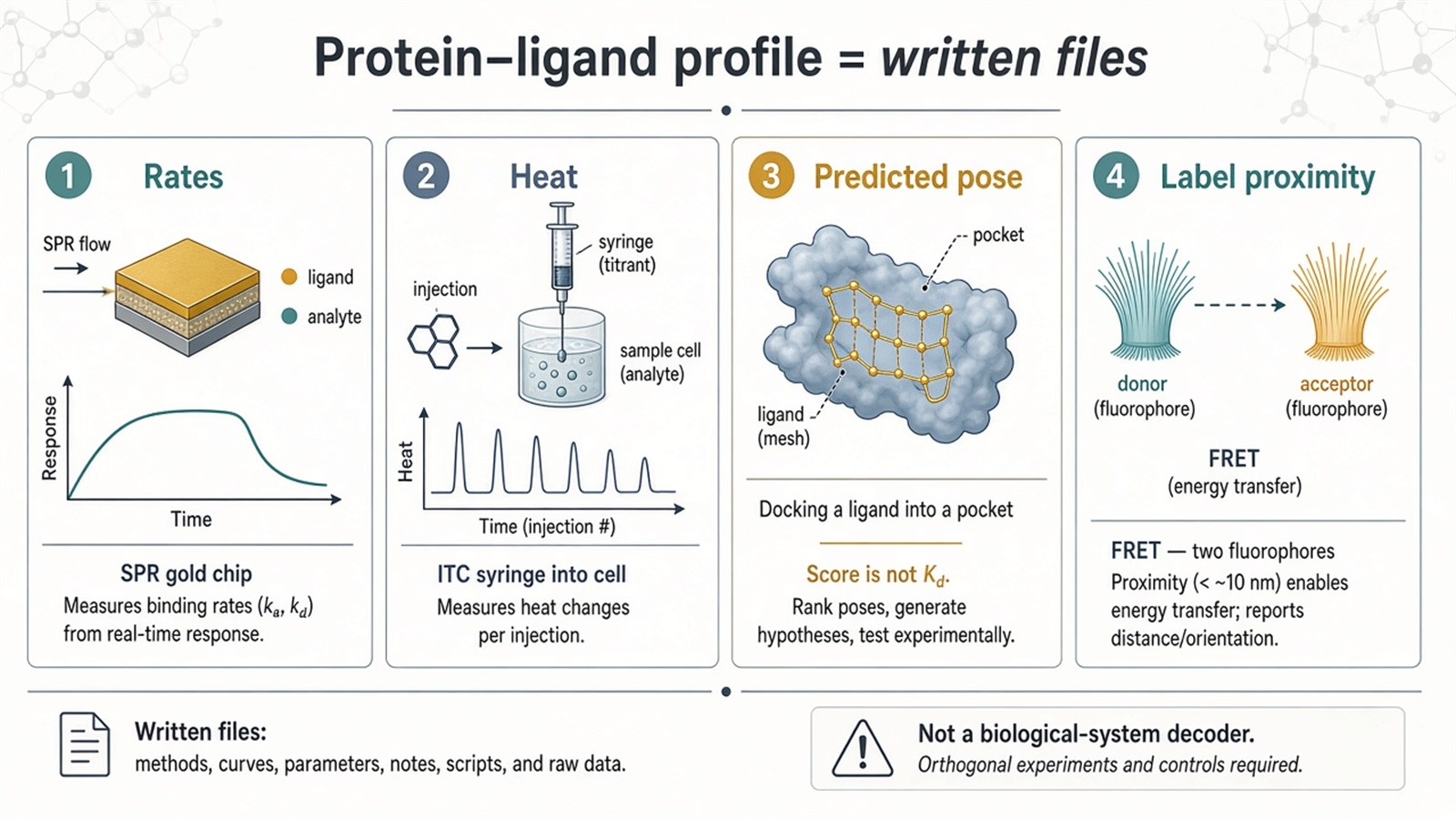
Figure 1. SPR writes rates. ITC writes heat. Docking writes a predicted pose. FRET writes label proximity. Affinity, a site, and a mechanism are later claims.
Name the protein, the ligand, and which of the four files will be allowed before the first run.
Workflow Reads as File Choice, Not Mechanism
Purified protein and a characterized ligand remain the usable first step. Quality here means concentration, buffer match, and a written purity check. It does not guarantee accurate experimental results.
Experimental design is the choice of which file will be collected. Selecting a platform depending on research objectives is empty until the objective names a sensorgram, a thermogram, a pose, or a FRET trace. Force classes that can operate in the pocket belong on a different page. Types of Interactions Between Proteins and Small Molecules is the complementary force inventory.
Background subtraction and data fitting are required inside SPR and ITC. They make that assay internally consistent. They do not make the numbers reflect the biological mechanisms being studied. Non-specific binding is reduced by a matched reference surface, a buffer blank, or an inactive analog. Minimizing it does not certify a cellular mechanism.
Low ligand affinity can place the constant outside the window of the chosen assay. That is a window problem, not a general loss of detection sensitivity. A conformational change in a new buffer can change the same file. It does not rewrite a systems-level interaction profile. Running SPR and ITC on the same pair produces two files. Complementary techniques do not, by themselves, improve robustness and reproducibility.
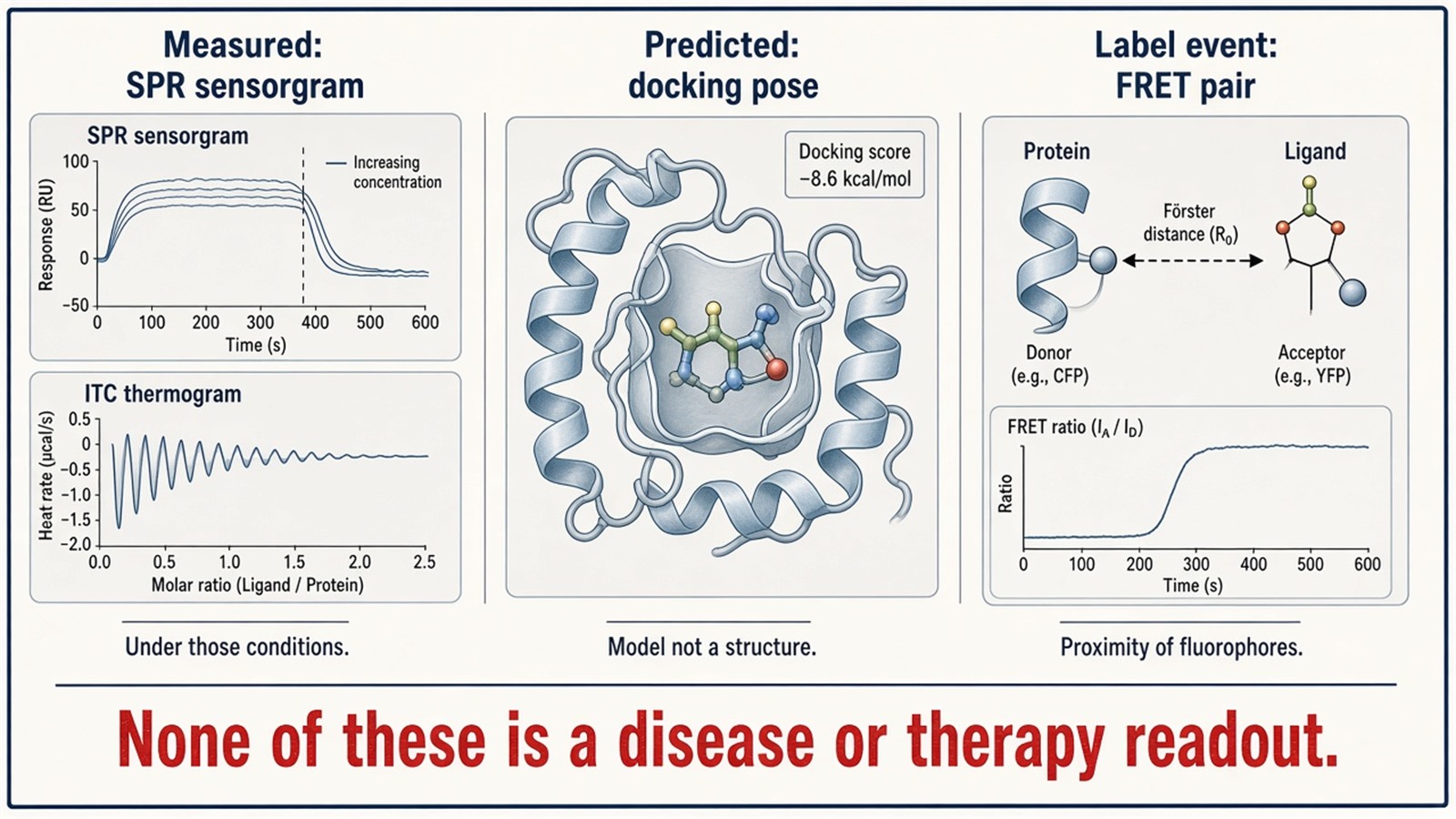
Figure 2. A sensorgram or a thermogram is a measurement under those conditions. A docked pose is a model. A FRET change is a label event. None of those files is a disease or therapy readout.
Experimental Limits
This page reduces a protein–ligand interaction profile to the files that were written. Binding-mode, site, specificity, and mechanism-of-action language sits outside ordinary research reporting unless a separately validated structure or competition assay is already named. Early diagnosis, targeted therapy, and immense potential for drug development are slogans, not steps after a fitted Kd.
A protein–protein recovery table is a different product. Related-service language that points this profile at protein–protein interaction analysis misnames the next experiment.
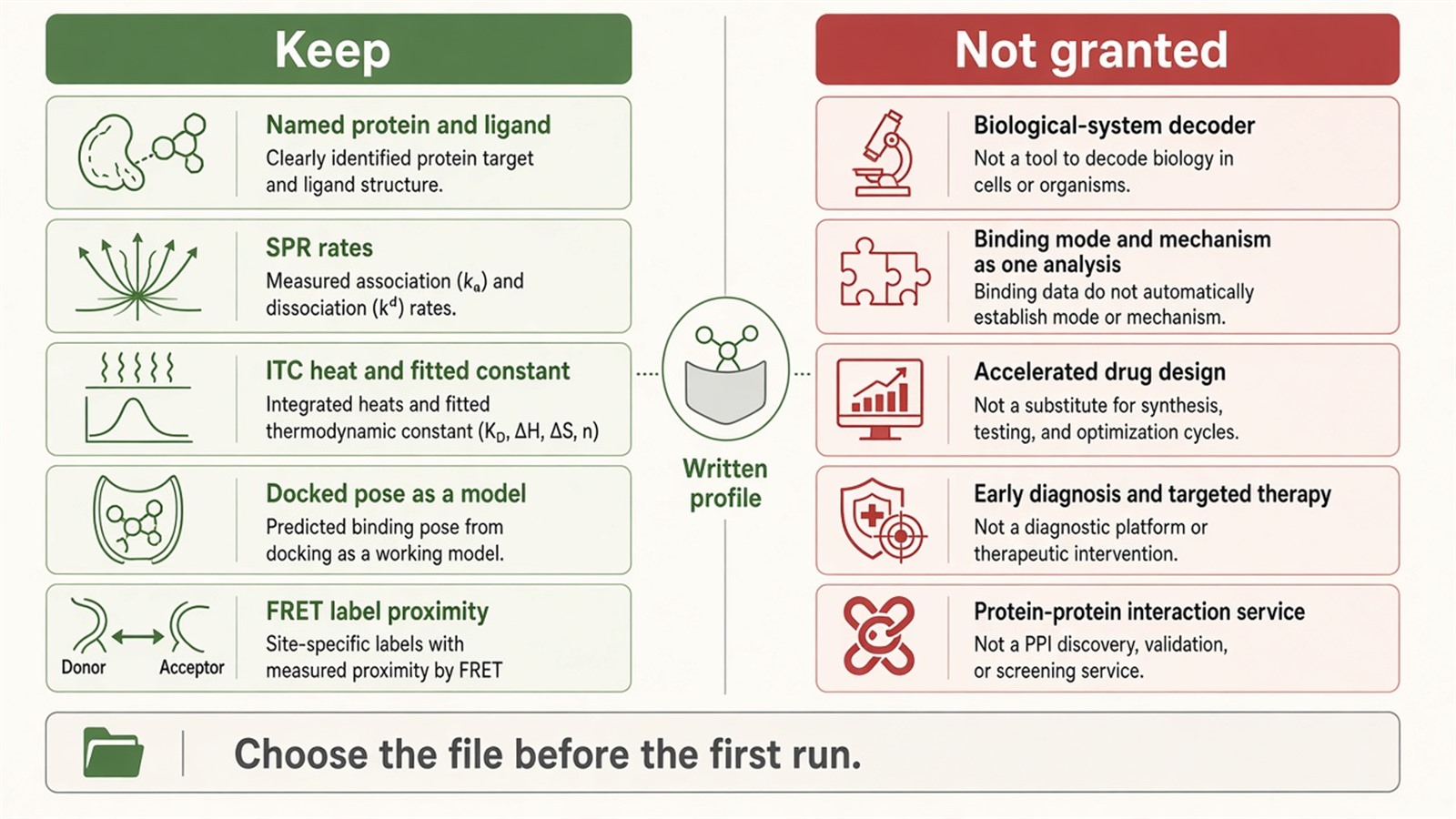
Figure 3. Keep: a named pair and a written SPR, ITC, docking, or FRET file. Not granted: biological-system decoder, accelerated optimization, disease diagnosis, or a protein–protein service handoff.
Project Planning and Service Scope
A usable request names the protein, the ligand class, whether immobilization or a fluorophore is acceptable, and which number would be allowed after a positive result: a rate, a heat, a score, or a FRET ratio. MtoZ Biolabs scopes ligand-binding arms on SPR, ITC, or mass-spectrometry formats when those arms match the written question. Interpretability still follows that arm, not a profile-analysis heading.
Once the next sentence is a heat titration rather than a four-file slogan, this profile page should hand off. Researchers who need that thermogram can review the MtoZ Biolabs Isothermal Titration Calorimetry (ITC) Analysis Service for project-specific sample evaluation, feasibility assessment, and workflow planning.
Frequently Asked Questions
1. Does a protein–ligand interaction profile reveal binding modes and mechanisms?
It reports the files that were written. A mode or a mechanism is a later claim.
2. Does SPR provide high-throughput drug-discovery kinetics?
It can record a sensorgram for a written pair. Throughput and discovery are later campaign words.
3. Does ITC provide ΔH and ΔG as two measured heats?
It measures heat. ΔH comes from that integral. ΔG is calculated from a fitted constant.
4. Does docking identify binding sites and estimate affinity?
It predicts a pose and a score. Neither is a measured site or a Kd.
5. Is a protein–protein interaction service the next step?
No. A bait-recovery table is a different experiment from a ligand-binding file.
Reference
- Renaud J.P., Chung C.W., Danielson U.H., et al. (2016). Biophysics in drug discovery: impact, challenges and opportunities. Nat. Rev. Drug Discov., 15, 679-698. https://doi.org/10.1038/nrd.2016.123
- Wiseman T., Williston S., Brandts J.F., Lin L.N. (1989). Rapid measurement of binding constants and heats of binding using a new titration calorimeter. Anal. Biochem., 179, 131-137. https://doi.org/10.1016/0003-2697(89)90213-3
- Kitchen D.B., Decornez H., Furr J.R., Bajorath J. (2004). Docking and scoring in virtual screening for drug discovery: methods and applications. Nat. Rev. Drug Discov., 3, 935-949. https://doi.org/10.1038/nrd1549
- Rich R.L., Myszka D.G. (2000). Advances in surface plasmon resonance biosensor analysis. Curr. Opin. Biotechnol., 11, 54-61. https://doi.org/10.1016/S0958-1669(99)00054-3
