


Plasma proteomics investigates proteins circulating in plasma by mass spectrometry, and, in narrower designs, by protein chips and bioinformatics. It can describe complexity in physiological and pathological processes, but only for the circulating proteome recovered after a stated collection and search plan. Two claims are often mixed on this topic. Biodiversity, in a plasma-proteomics sense, means comparative diversity of plasma proteins across species, individuals, or developmental stages. Protein expression, in the same matrix, means condition-dependent circulating abundance of those proteins. Neither claim is a tissue proteome, and neither is a clinical diagnosis.
Comparing plasma across species or conditions can support research on normal function and disease models. It does not, by itself, reconstruct human evolution, prove intracellular regulatory mechanisms, or treat disease.
Researchers who already have defined samples, comparison groups, or a specific project objective can also review the MtoZ Biolabs Plasma Proteomics Analysis Service for project-specific feasibility and analysis planning.
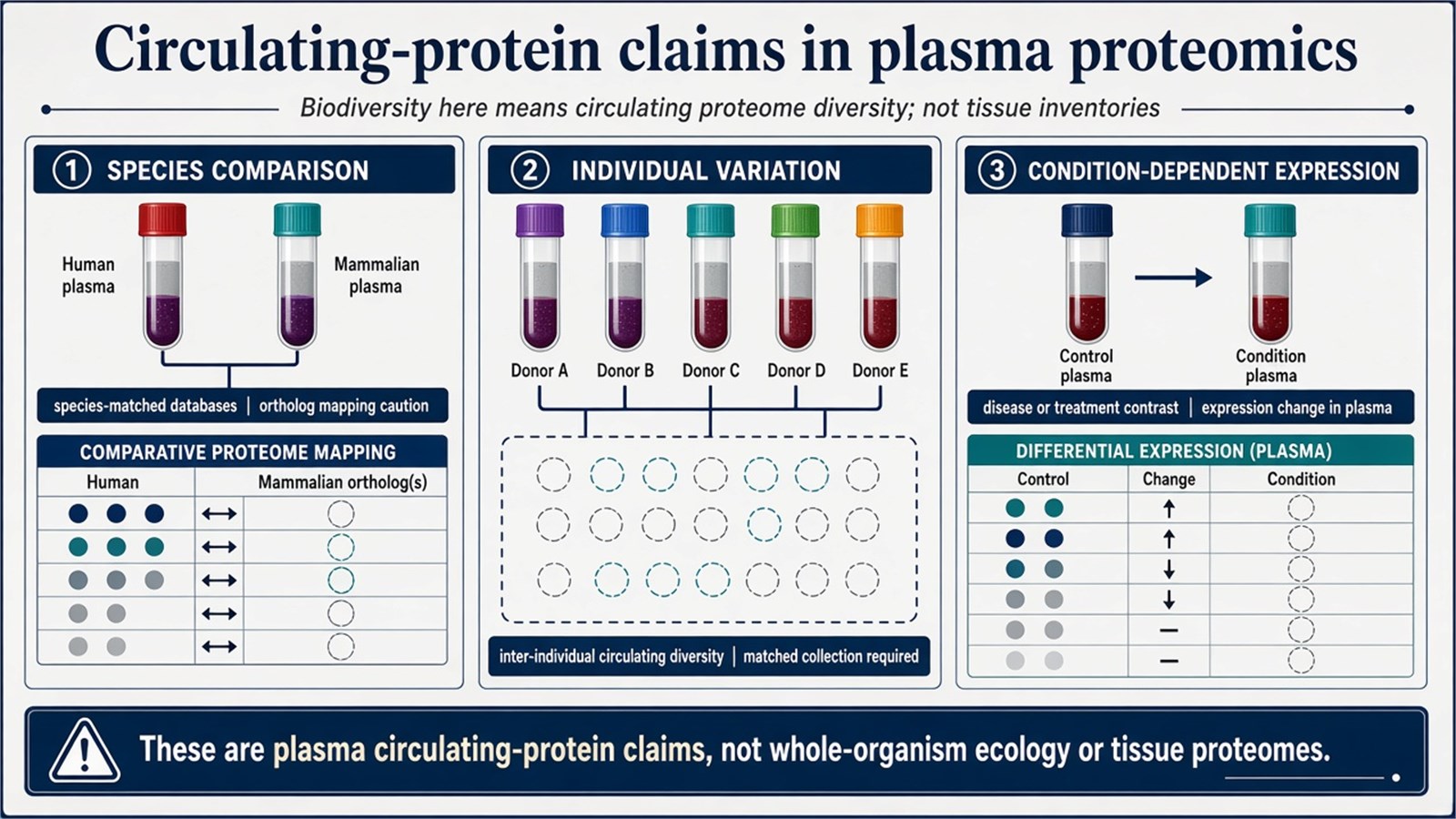
Figure 1. Plasma proteomics can address species comparison, individual variation, or condition-dependent expression; these are circulating-protein claims, not tissue inventories or ecology surveys.
Biodiversity and protein expression are different plasma questions. One compares who is sampled; the other compares how circulating abundance changes.
When These Two Claims Fit a Plasma Study
A biodiversity-style plasma study fits when species, strain, or individual identity is the contrast and each sample is still plasma collected under a comparable anticoagulant. An expression-style study fits when the same species and matrix are held constant and the contrast is treatment, disease model, or time. Mixing those designs in one table, or treating plasma as if it were tissue, is the usual source of over-read results.
|
Experimental claim |
Plasma proteomics often supports |
Reassess before queuing runs |
|---|---|---|
|
Cross-species circulating protein presence |
LC-MS/MS with a species-matched database |
Searching all mammals against a human-only library |
|
Inter-individual circulating diversity |
One matrix, one prep, quantified cohort |
Mixing serum with plasma or unmatched tubes |
|
Developmental or age-related circulating change |
Stage-matched plasma under one method |
Using a single adult plasma table as a developmental atlas |
|
Tissue diversity |
Tissue proteomics |
Listing tissues as plasma comparison groups |
|
Condition-dependent circulating expression |
Relative quantification across designed groups |
Inferring intracellular regulation from plasma fold-change |
|
Evolutionary narrative |
Independent evolutionary evidence |
Treating ortholog absence as proof of human uniqueness |
Prefer a species-matched search when biodiversity means cross-species plasma comparison. Prefer a single-species quantitative design when the question is protein expression under different conditions. Prefer tissue proteomics when the object is an organ, not the circulation.
Research Methods in Plasma Proteomics
The research methods in plasma proteomics primarily include mass spectrometry, protein chip technology, and bioinformatics analysis. They answer different parts of the biodiversity and expression questions and are not interchangeable.
Mass spectrometry is the most commonly used method for open plasma inventories. Bottom-up LC-MS/MS measures peptide mass-to-charge ratios and fragment spectra, then assigns sequences by database search. That assignment supports protein presence and, under a quantitative design, circulating abundance. Precursor mass alone does not determine protein structure, function, or enzymatic activity.
Protein chip technology can detect many named proteins on one platform when the corresponding probes exist. It can raise throughput for a closed target list. It does not measure proteins absent from the chip, and binding efficiency is not a substitute for sequence identification. Use a chip when the panel is predefined. Use mass spectrometry when the protein list is still open.
Bioinformatics analysis processes peptide-spectrum matches into protein tables, ortholog maps, differential lists, and network summaries. Correlations among proteins are associations in the circulating dataset. They are not, by themselves, physical interactions or causal regulatory maps.
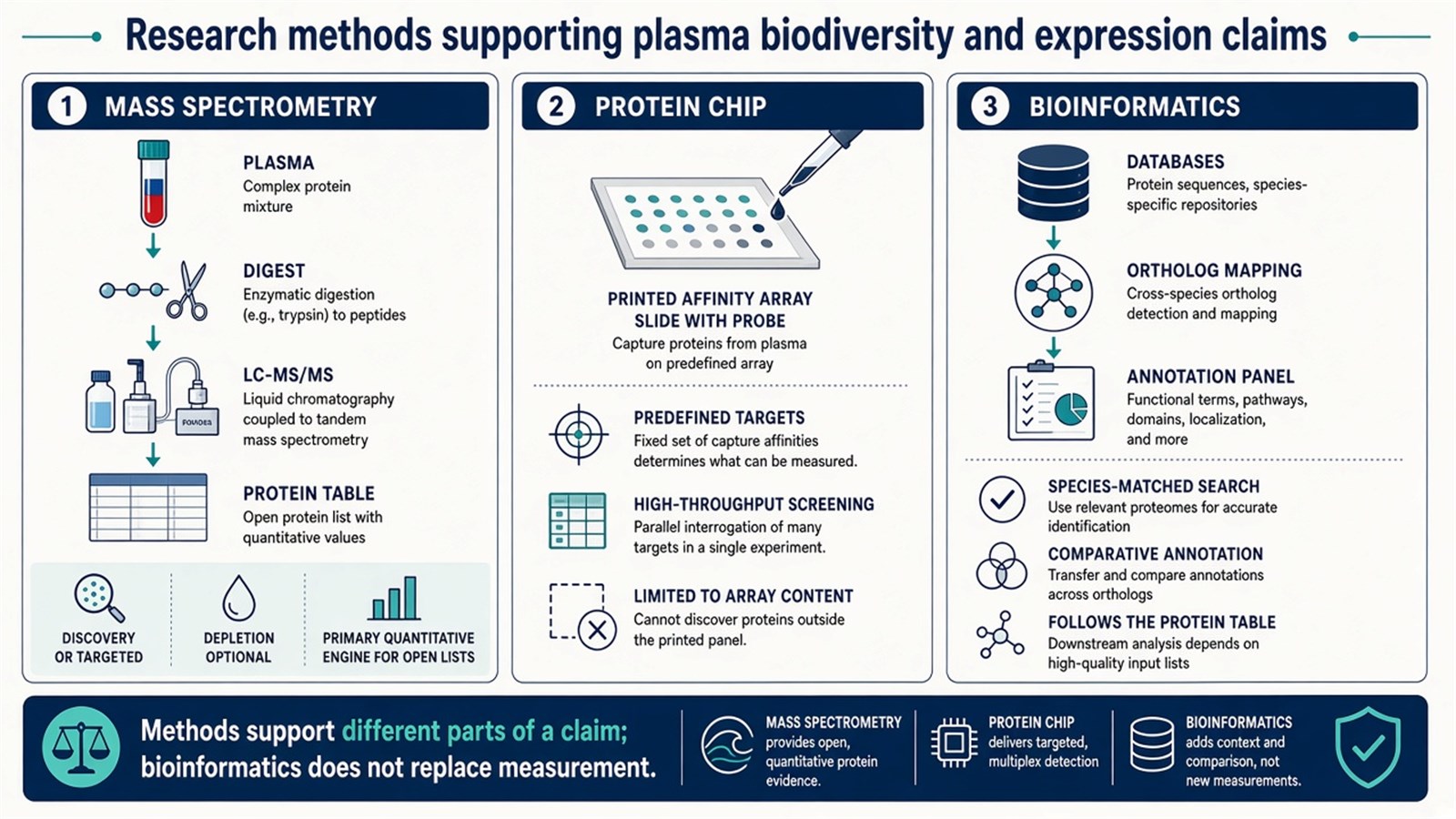
Figure 2. Plasma proteomics research methods include mass spectrometry, protein chip, and bioinformatics; each supports a different part of a biodiversity or expression claim, and bioinformatics does not replace measurement.
For high-abundance handling, DDA or DIA acquisition, and plasma-versus-serum matrix rules that affect both claims, see Plasma Proteome Profiling.
Application of Plasma Proteomics in Biodiversity Research
Plasma proteomics can contribute to biodiversity research when biodiversity is defined as variation in the circulating proteome. Comparing plasma proteins across species, individuals, or stages of development can show which circulating proteins are shared, which identifications depend on the searched database, and how inter-individual variation looks under one preparation. Comparing human plasma with plasma from other mammals can list overlapping and species-restricted identifications. That comparison does not, by itself, reveal unique aspects of human evolution. Ortholog mapping, gene loss, sequence divergence, and missing identifications caused by an incomplete database must be separated before any evolutionary sentence is written.
Tissues should not be entered as plasma biodiversity groups. A liver extract and a plasma sample are different matrices. Developmental claims require stage-matched plasma, not a mixture of adult clinical leftovers. Cross-species projects need a declared protein database for each species, or a carefully documented ortholog strategy, rather than a single human library applied to every mammal.
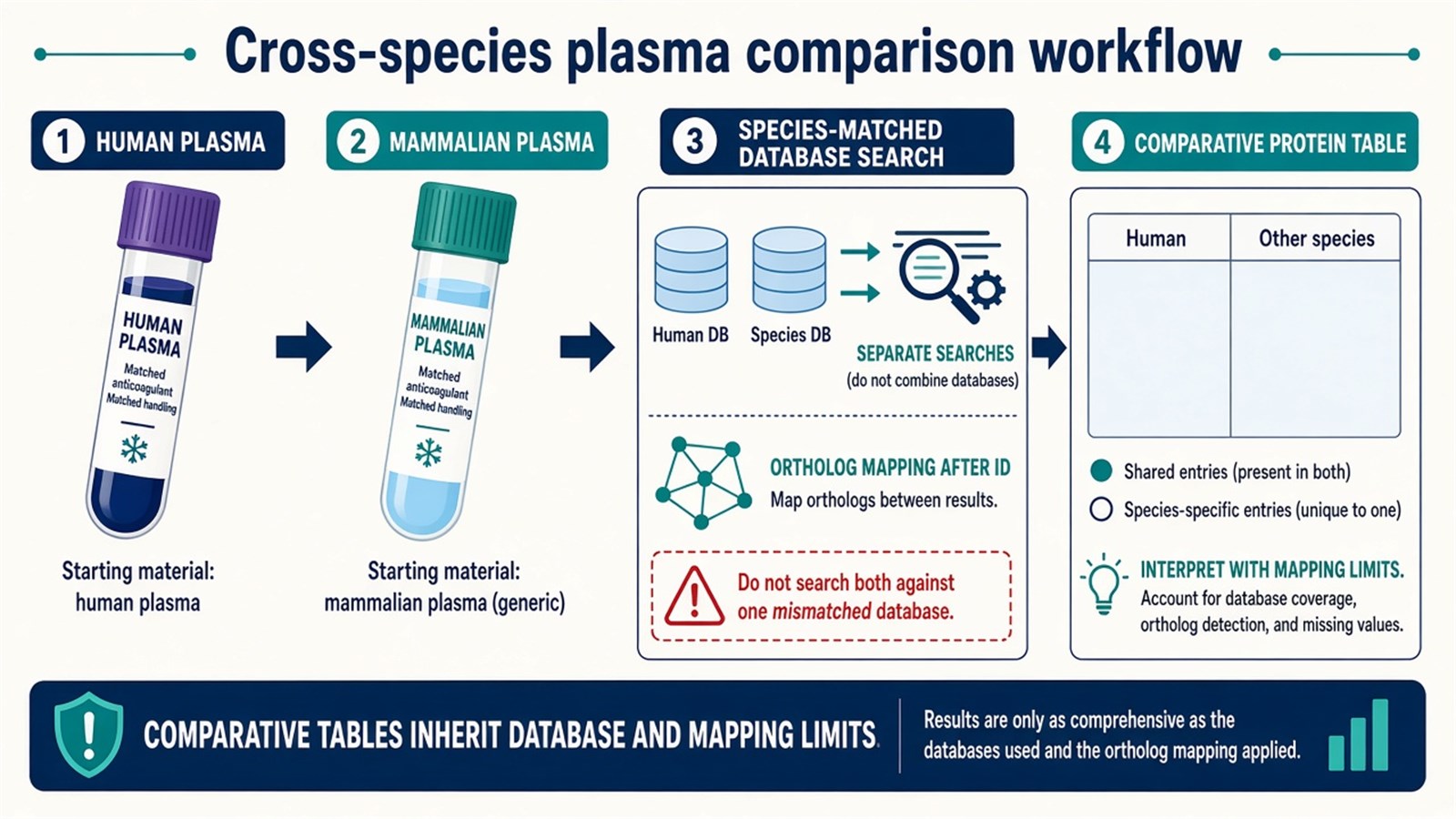
Figure 3. Cross-species plasma comparison searches human plasma and mammalian plasma against species-matched databases before a comparative protein table is interpreted.
A missing identification in one species is first a database and dynamic-range problem, then, only with further evidence, a biological difference.
For comparative plasma quantification in animal models or other mammals, researchers can refer to Mammalian Plasma Proteomes Quantitative Analysis Service for more detailed project scoping.
Application of Plasma Proteomics in Protein Expression Research
Plasma proteomics also supports protein expression research when expression means circulating abundance under defined conditions. Proteins execute many physiological activities, and changes in circulating levels can accompany health and disease models. Plasma proteomics can compare those levels across treatments, collection times, or experimental groups, and the resulting table can generate hypotheses about function and regulation. Circulating abundance is not the same as intracellular expression, translation rate, or protein activity in a tissue.
A fold-change in plasma may reflect secretion, leakage, clearance, sample handling, or a true change in production. Condition-dependent expression studies therefore need matched collection, a declared quantitative method, and, for proteins that will carry the biological claim, orthogonal follow-up. Bioinformatics enrichment of a plasma differential list summarizes circulating associations. It does not prove a regulatory mechanism inside an organ.
Experimental Limits and Design Boundaries
Plasma proteomics does not measure ecological biodiversity of habitats, does not inventory tissue proteomes, and does not convert a protein chip signal into an open species catalog. High-abundance plasma proteins still limit depth. Cross-species searches fail silently when the database is wrong. Inter-individual diversity is inflated by unmatched anticoagulants, hemolysis, and freeze-thaw. Expression tables remain relative unless standards and calibration are added.
Diagnostic or evolutionary conclusions sit outside ordinary research reporting unless independent evidence is in place. Once the claim is named as species comparison, individual variation, or condition-dependent circulating expression, the project can be scoped. Researchers can review the MtoZ Biolabs Plasma Proteomics Analysis Service for project-specific sample evaluation, feasibility assessment, and workflow planning.
Frequently Asked Questions
1. Does plasma proteomics measure biodiversity in the ecological sense?
Not by default. In this setting it compares circulating proteomes across species, individuals, or stages. It does not survey species richness in an ecosystem.
2. Can plasma proteomics compare tissues?
No. Tissue diversity requires tissue proteomics. Plasma is a biofluid matrix and should not be grouped with organ extracts in one biodiversity table.
3. Does comparing human and mammalian plasma explain human evolution?
It can list circulating proteins that are detected or not detected under each species-matched search. Evolutionary interpretation needs independent genomic and phylogenetic evidence.
4. Is a plasma expression change the same as intracellular protein expression?
No. Plasma reports circulating abundance. Intracellular expression, secretion, leakage, and clearance can all move that signal.
5. Can a protein chip replace mass spectrometry for open biodiversity surveys?
No. Chips measure predefined probes. Open cross-species inventories need sequence-based mass spectrometry and a species-matched database.
Reference
- Anderson N.L., Anderson N.G. (2002). The human plasma proteome: history, character, and diagnostic prospects. Mol. Cell. Proteomics, 1, 845-867. https://doi.org/10.1074/mcp.R200007-MCP200
- Geyer P.E., Holdt L.M., Teupser D., Mann M. (2017). Revisiting biomarker discovery by plasma proteomics. Mol. Syst. Biol., 13, 942. https://doi.org/10.15252/msb.20156297
- Farrah T., Deutsch E.W., Omenn G.S., et al. (2011). A high-confidence human plasma proteome reference set. BMC Med. Genomics, 4, 48. https://doi.org/10.1186/1755-8794-4-48
