



Yes, under a written design. No, not as ordinary denaturing peptide liquid chromatography–tandem mass spectrometry (LC-MS/MS) of a mixed sample. LC-MS/MS can name a small molecule, a peptide, or a covalent adduct. It does not, by itself, detect non-covalent binding, and it is not an essential or irreplaceable technology for small molecule–protein interactions.
A reversed-phase gradient that uses organic solvent and acid typically dissociates a non-covalent complex before the spectrometer sees it. Charge-state envelopes and intact-mass shifts belong to native or intact-mass experiments. They are not a chromatographic retention-time proof that the protein was bound. Researchers who already have a soluble protein and a compound mixture and need the ligand recovered after a size or bead cut can review the MtoZ Biolabs Affinity Selection-Mass Spectrometry Analysis Service for project-specific separation and LC-MS identification planning.
What the Title Question Is Asking
The original binding paragraph remains a study background. Protein structure and function are not determined by interactions with other molecules as a general law. Signal transduction and drug action remain contexts in which a pair may be tested. They are not reasons that LC-MS/MS must be used. Drug design and disease diagnosis are later claims.
The original role paragraph describes generic LC-MS/MS. Chromatography separates species that survive the column. The mass spectrometer then records precursors and fragments. That chain identifies and can quantify whatever was injected. It does not first separate a protein–ligand complex and then identify the interaction.
For which other physical events can report a protein–small-molecule contact, How to Detect Protein and Small Molecule Interactions is the complementary method-choice page. This page answers only the LC-MS/MS clause.
Three Designs That Can Use LC-MS/MS
A covalent mark
A reactive warhead or a photoaffinity analog can leave a mass on a peptide. After digest, LC-MS/MS can localize that adduct if the spectrum supports the site. The file names a modified peptide. It does not prove that the unlabeled parent compound occupied the same residue in solution.
A selection step, then the ligand
Affinity selection–mass spectrometry (AS-MS) incubates a protein with one compound or a mixture, then removes unbound ligand by ultrafiltration, size-exclusion chromatography, or a bead. The retained ligand is released and identified by LC-MS or LC-MS/MS. Recovery of that mass after the cut is not a dissociation constant, and a library hit is not a validated ligand until an orthogonal pair assay is named. A protein-only or bead-only arm is part of the file. Without it, plastic binders and filter binders are scored as ligands.
An intact-mass shift
If the complex survives ionization, an intact or native spectrum can show a mass increment matching the ligand. Occupancy in that ion population is not binding status from a reversed-phase peak pair. Retention time of a denatured protein does not report a charge-state change caused by non-covalent ligand. For that intact-mass arm, Native Mass Spectrometry Analysis Service is the complementary mass-shift page.
Comparing bound versus unbound chromatographic peaks of the protein does not ascertain binding. Under typical reversed-phase conditions the complex is already gone. A later elution of free ligand next to free protein is two species, not a complex.
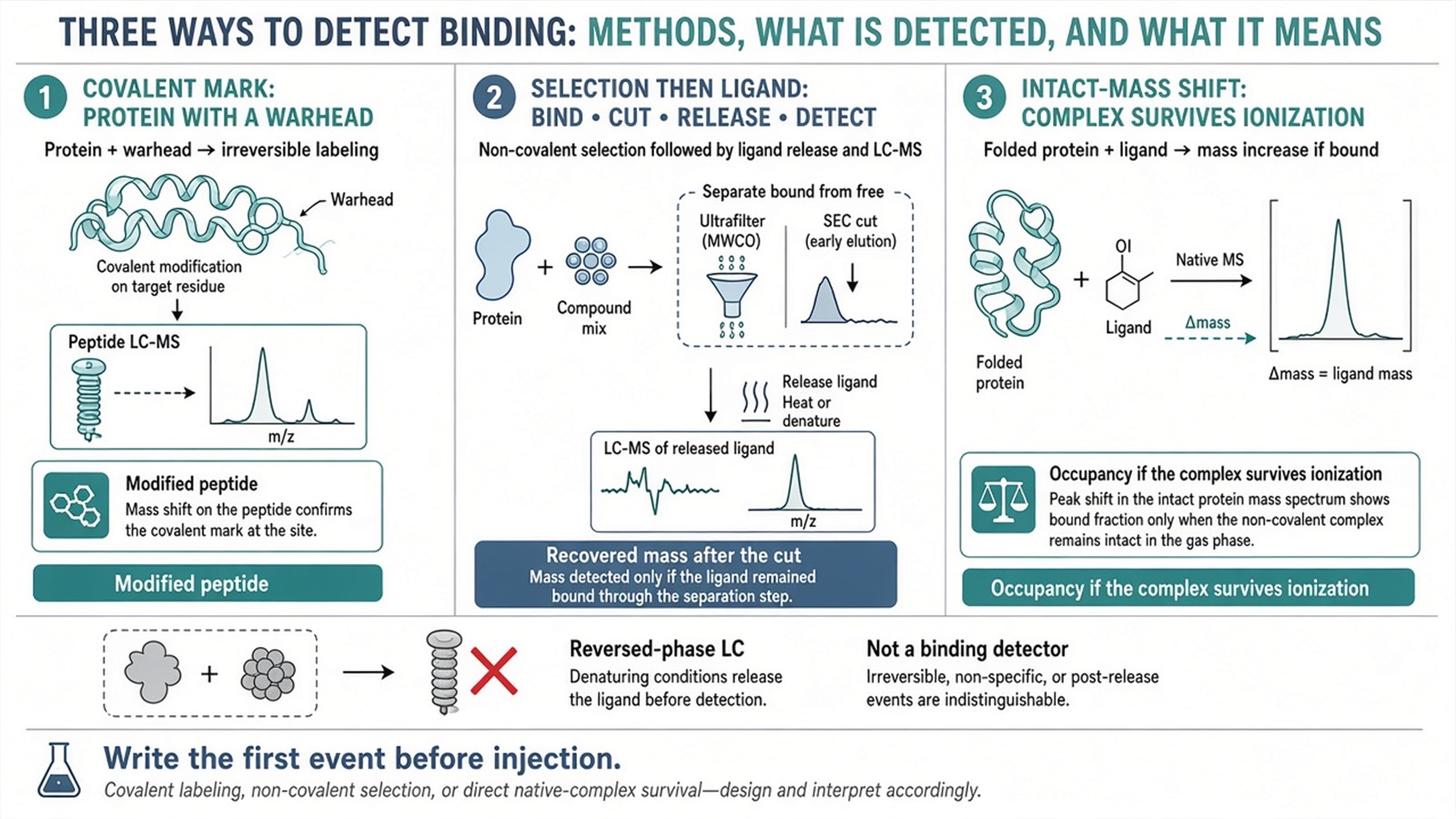
Figure 1. A covalent adduct, a selected ligand, or a surviving intact mass can enter LC-MS/MS. Mixing protein and compound on a reversed-phase column does not.
Write the first event before the first injection. Do not treat LC-MS/MS as a binding detector.
MRM Quantifies a Mass, Not an Interaction
Multiple reaction monitoring (MRM) follows a precursor-to-product pair. It can quantify a small molecule after extraction, or a peptide after digest, with high chemical selectivity. That number is an amount of that species in the injected vial. It is not precise quantification of small molecule–protein interactions, and it is not ideal for quantifying those interactions in complex biological samples.
A free-ligand depletion design can use MRM on the unbound compound after a protein is removed. The missing ligand is then an inference under that cut. It is still not a binding constant unless the concentrations, the cut, and the nonspecific loss are written. High selectivity and sensitivity are instrument properties of the transition. They are not interaction-specificity claims.
Hydrogen–deuterium exchange after a quench also uses peptide LC-MS/MS. The file reports protection of amides. It is not a detection of the ligand as a peak, and it is not absorbed into this yes-or-no page.
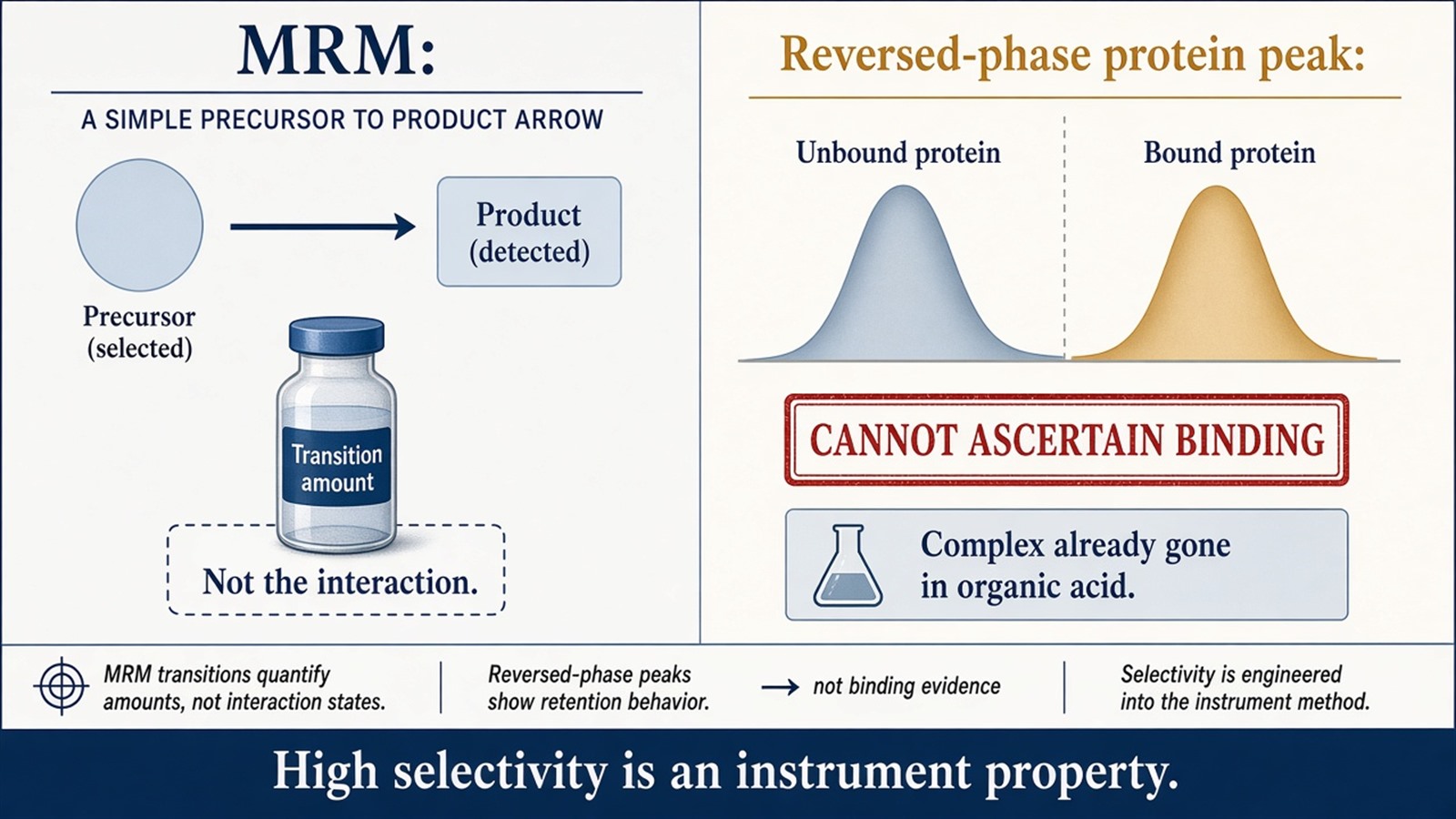
Figure 2. MRM reports a transition amount. A denaturing protein peak reports a protein. Neither peak pair is a non-covalent complex.
Experimental Limits
This page reduces the title to one first event and one LC-MS/MS file. Charge-state-to-retention-time logic, essential-technology language, and protein–protein interaction analysis as the related service sit outside ordinary research reporting. A bait-recovery table is a different experiment from a ligand file. Mixing a lysate with a compound and injecting the digest does not convert shotgun proteomics into a binding assay. Photoaffinity capture of proteins that sat near a probe is a covalent neighborhood list. It still has to name the analog and the enrichment, and it does not answer the title for an unlabeled parent.
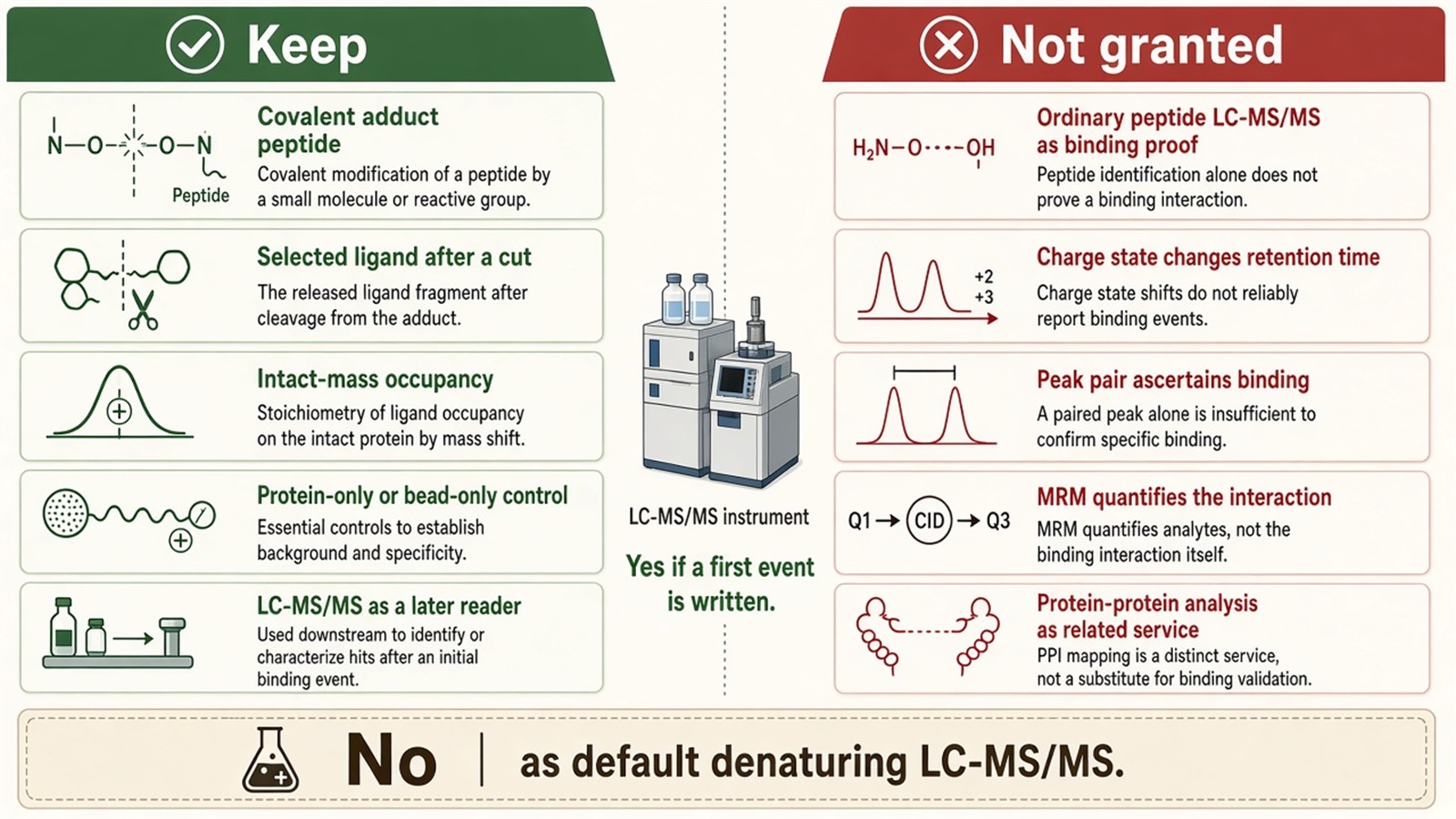
Figure 3. Keep: covalent peptide, selected ligand, or intact-mass occupancy. Not granted: retention-time binding status, MRM of an interaction, or a protein–protein service as the next step.
Project Planning and Service Scope
A usable request names whether the ligand will be read as a covalent peptide, a selected small-molecule peak, or an intact-mass increment, and which control arm will travel with that file. It also names the solvent and pH of the chromatography, because those conditions decide whether a non-covalent complex is still present. MtoZ Biolabs scopes AS-MS, native or intact-mass, and ligand-binding arms when those arms match the written question. Interpretability still follows that arm, not an irreplaceable LC-MS/MS heading.
Once the next sentence is a measured pair rather than a yes-or-no about the spectrometer, this detection-clause page should hand off. Researchers who need that pair file can review the MtoZ Biolabs Protein Ligand Binding Assay Service for project-specific sample evaluation, feasibility assessment, and workflow planning.
Frequently Asked Questions
1. Can ordinary peptide LC-MS/MS detect non-covalent binding?
Not as a default. Organic solvent and acid usually dissociate the complex.
2. Does a protein retention-time shift report ligand binding?
Under reversed-phase conditions it reports the protein’s chromatography, not a complex.
3. Does MRM quantify the interaction?
It quantifies a chosen transition. Interaction is a later inference.
4. When can LC-MS/MS support a binding sentence?
When a covalent mark, a selection cut, or a surviving intact mass is already written.
5. Is protein–protein interaction analysis the related experiment?
No. A bait-recovery table does not answer this title.
Reference
- Annis D.A., Nickbarg E., Yang X., Ziebell M.R., Whitehurst C.E. (2007). Affinity selection-mass spectrometry screening techniques for small molecule drug discovery. Curr. Opin. Chem. Biol., 11, 518-526. https://doi.org/10.1016/j.cbpa.2007.07.011
- Heck A.J.R. (2008). Native mass spectrometry: a bridge between interactomics and structural biology. Nat. Methods, 5, 927-933. https://doi.org/10.1038/nmeth.1265
- Loo J.A. (1997). Studying noncovalent protein complexes by electrospray ionization mass spectrometry. Mass Spectrom. Rev., 16, 1-23. https://doi.org/10.1002/(SICI)1098-2787(1997)16:1<1::AID-MAS1>3.0.CO;2-L
- Prudent R., Annis D.A., Dandliker P.J., Ortholand J.Y., Roche D. (2021). Exploring new targets and chemical space with affinity selection-mass spectrometry. Nat. Rev. Chem., 5, 62-71. https://doi.org/10.1038/s41570-020-00229-2
